CELPIP-General LS Practice Test: A Free Sample Run
This CELPIP-General LS practice test is a full Listening and Speaking run built from Celpify's free Test 1: six Listening parts with 38 questions, then eight Speaking tasks, in test order and on the real clock.
The real test takes about 1 hour 10 minutes in one sitting, celpip.ca says. Listening has 38 questions in 46 to 55 minutes, Speaking has 8 tasks in 15 minutes, and the fee is $199 plus applicable taxes. Citizenship applicants aged 18 to 54 have to show CLB 4 or higher in speaking and listening, and CELPIP-General LS is the version of the test made for that. Our guide to CELPIP for Canadian citizenship covers the requirement, and we compare every English test accepted for citizenship on one page. Not sure the LS is the test you need? CELPIP General vs General LS explains the difference.
Test 1 is free, so this CELPIP LS practice test is free too, and Listening needs no account. The Speaking prompts and the timer work right here on the page. You only need a free account if you want AI feedback on your recordings.
How the CELPIP Listening and Speaking (LS) Test Runs
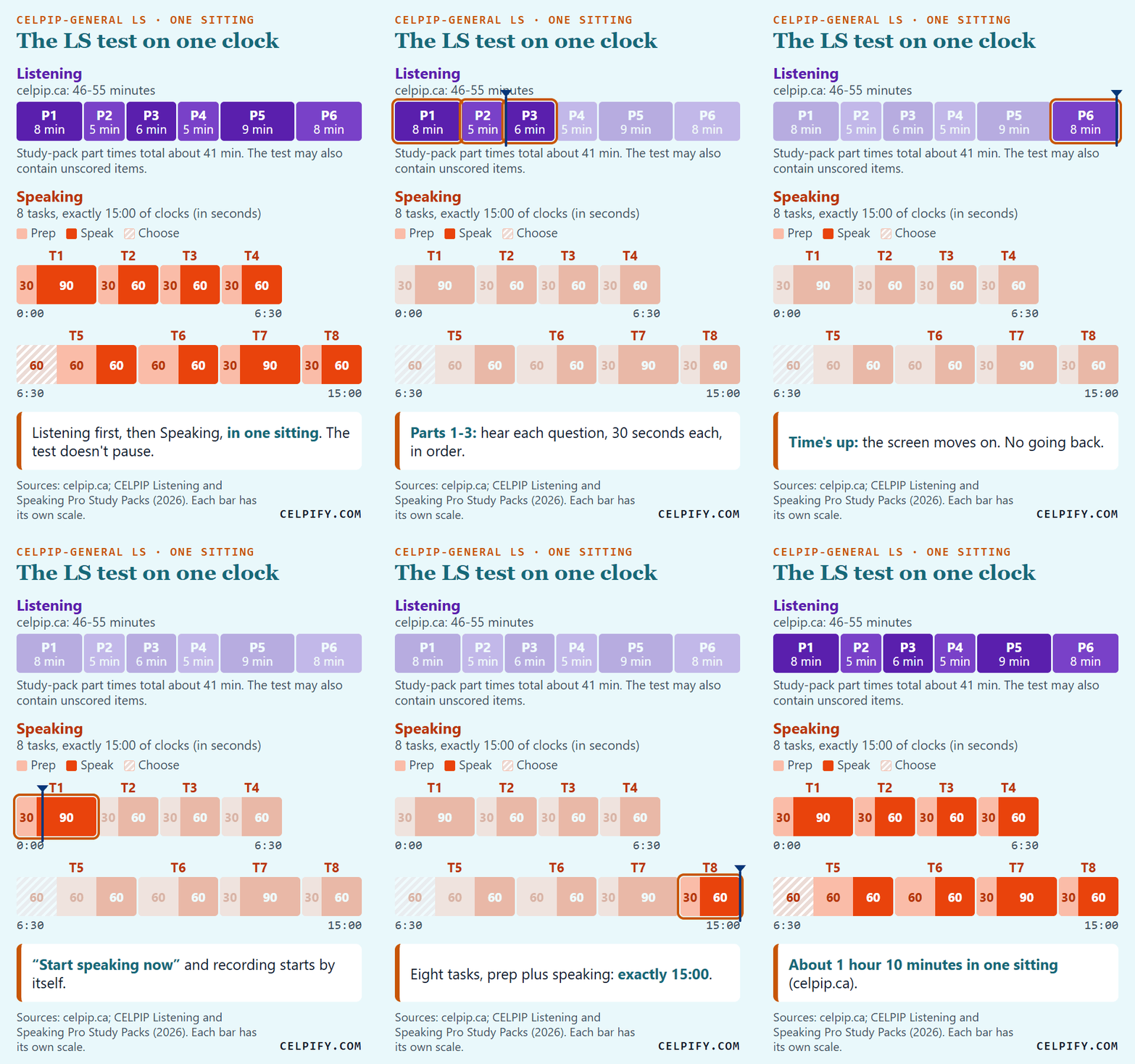
Listening comes first and Speaking comes last, in one sitting that doesn't pause.
How long is the CELPIP LS test? About 1 hour 10 minutes, with no separate speaking session. Here's the whole CELPIP LS test format, part by part. The Listening times are the approximate ones from the official Listening Pro Study Pack. They add up to about 41 minutes. celpip.ca gives the whole section 46 to 55 minutes, and the Listening test also contains unscored questions used for test development.
| Part or task | Questions or timer | Time |
|---|---|---|
| Listening: 38 questions in 46 to 55 minutes (celpip.ca) | ||
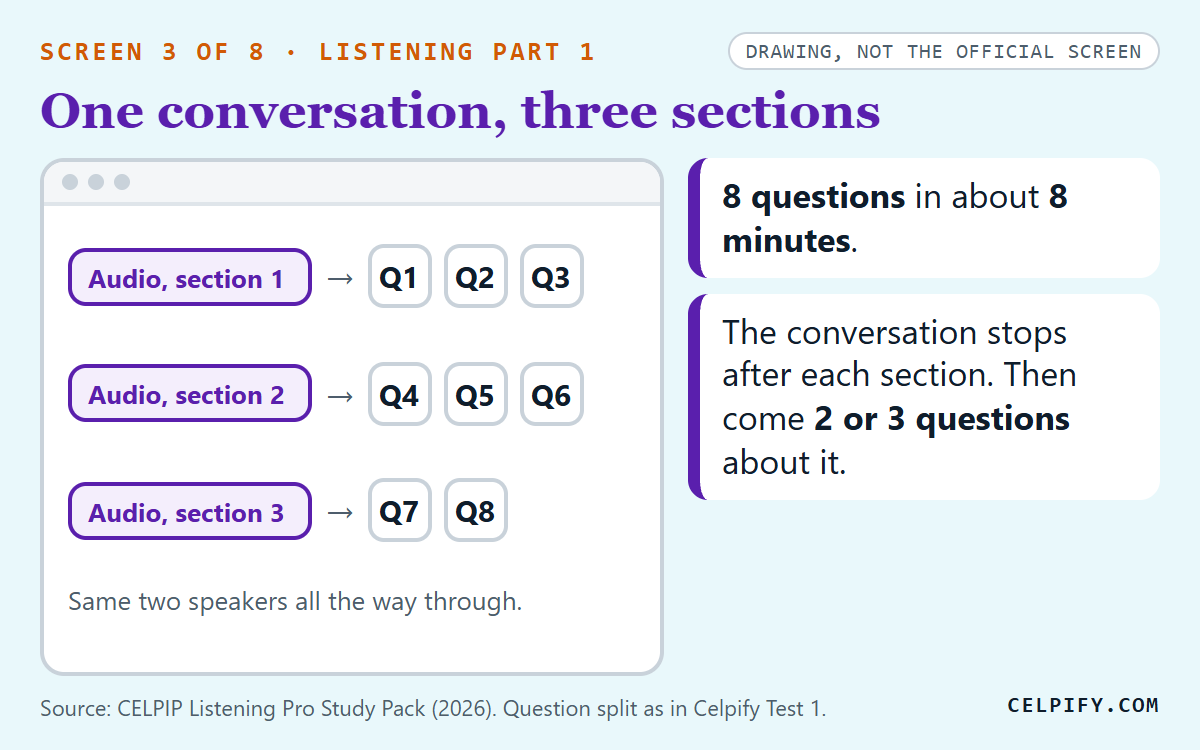
| Part 1: Listening to Problem Solving | 8 questions | about 8 min |
| Part 2: Listening to a Daily Life Conversation | 5 questions | about 5 min |
| Part 3: Listening for Information | 6 questions | about 6 min |
| Part 4: Listening to a News Item | 5 questions | about 5 min |
| Part 5: Listening to a Discussion | 8 questions | about 9 min |
| Part 6: Listening to Viewpoints | 6 questions | about 8 min |
| Speaking: 8 tasks in 15 minutes (celpip.ca) | ||
| Task 1: Giving Advice | 30 s prep, 90 s speaking | 2:00 |
| Task 2: Talking about a Personal Experience | 30 s prep, 60 s speaking | 1:30 |
| Task 3: Describing a Scene | 30 s prep, 60 s speaking | 1:30 |
| Task 4: Making Predictions | 30 s prep, 60 s speaking | 1:30 |
| Task 5: Comparing and Persuading | 60 s to choose, then 60 s prep, 60 s speaking | 3:00 |
| Task 6: Dealing with a Difficult Situation | 60 s prep, 60 s speaking | 2:00 |
| Task 7: Expressing Opinions | 30 s prep, 90 s speaking | 2:00 |
| Task 8: Describing an Unusual Situation | 30 s prep, 60 s speaking | 1:30 |
| Speaking clocks in total | 15:00 | |
Rules that change how you practise
- Each clip starts by itself and plays once. The test is timed and "will not pause for any reason," celpip.ca's test-day page says.
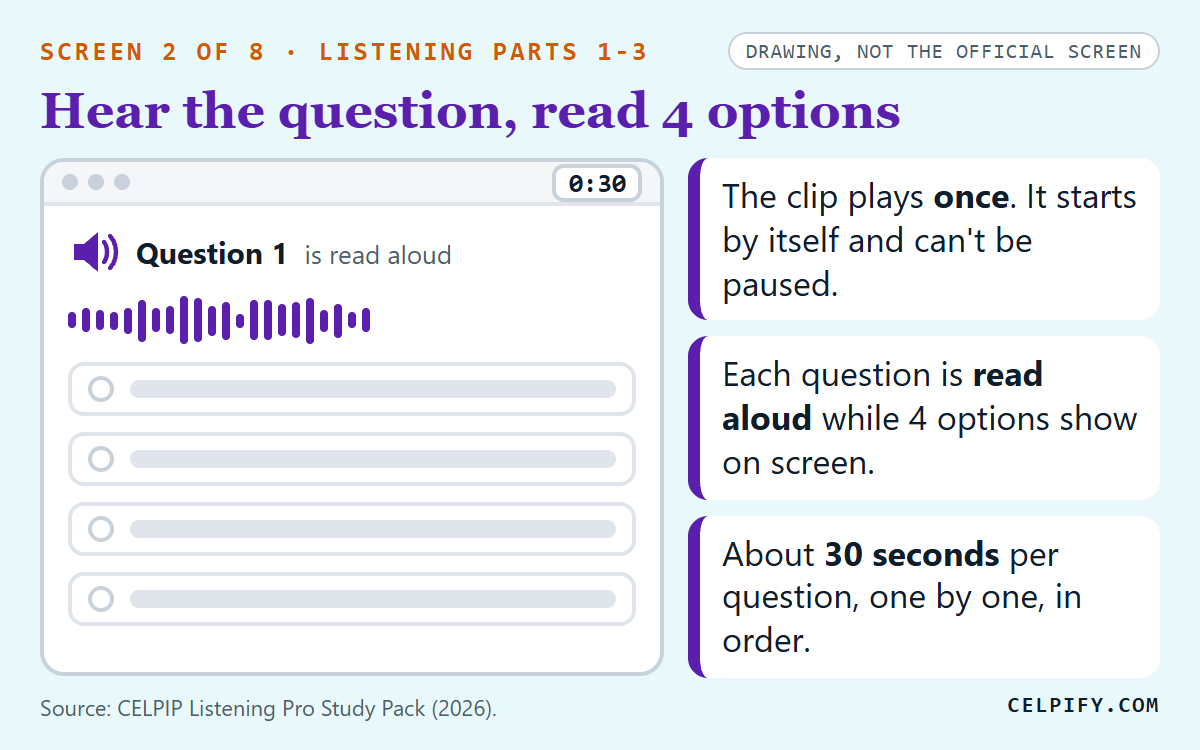
- In Parts 1 to 3 you hear each question read aloud and see four options on screen. You get about 30 seconds per question, one at a time, in order.
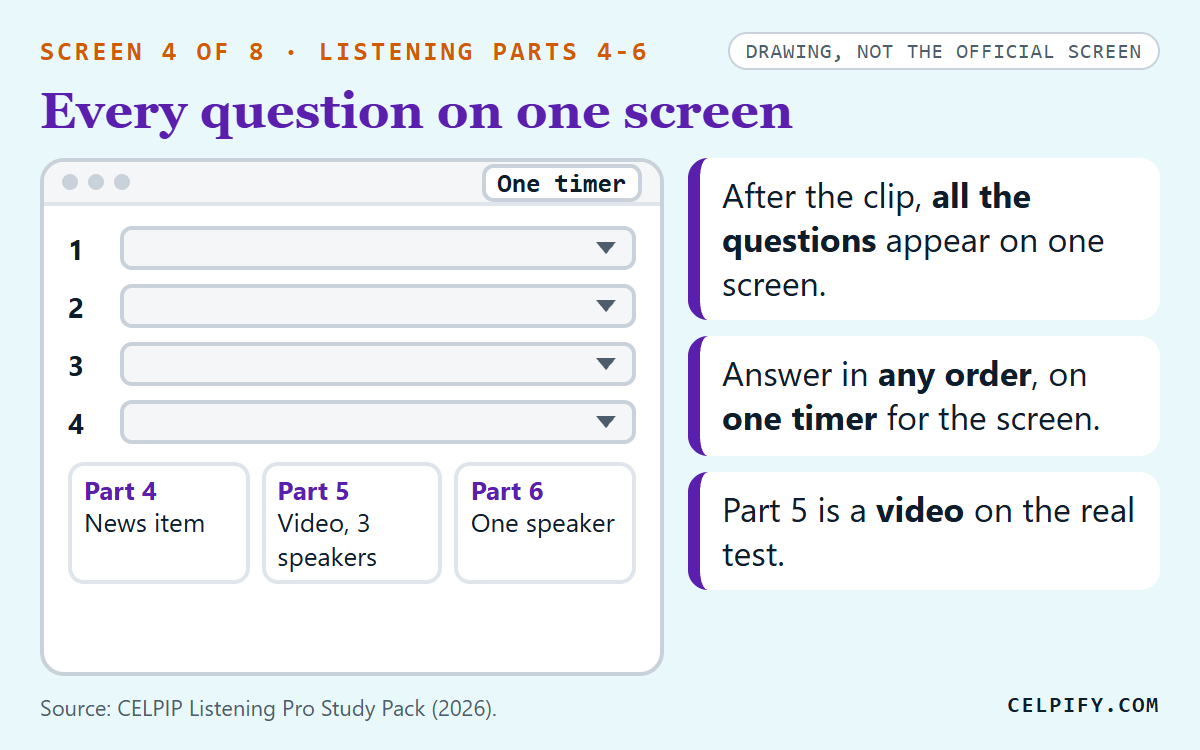
- In Parts 4 to 6 all the questions sit on one screen. You answer them in any order, with one timer for the screen.
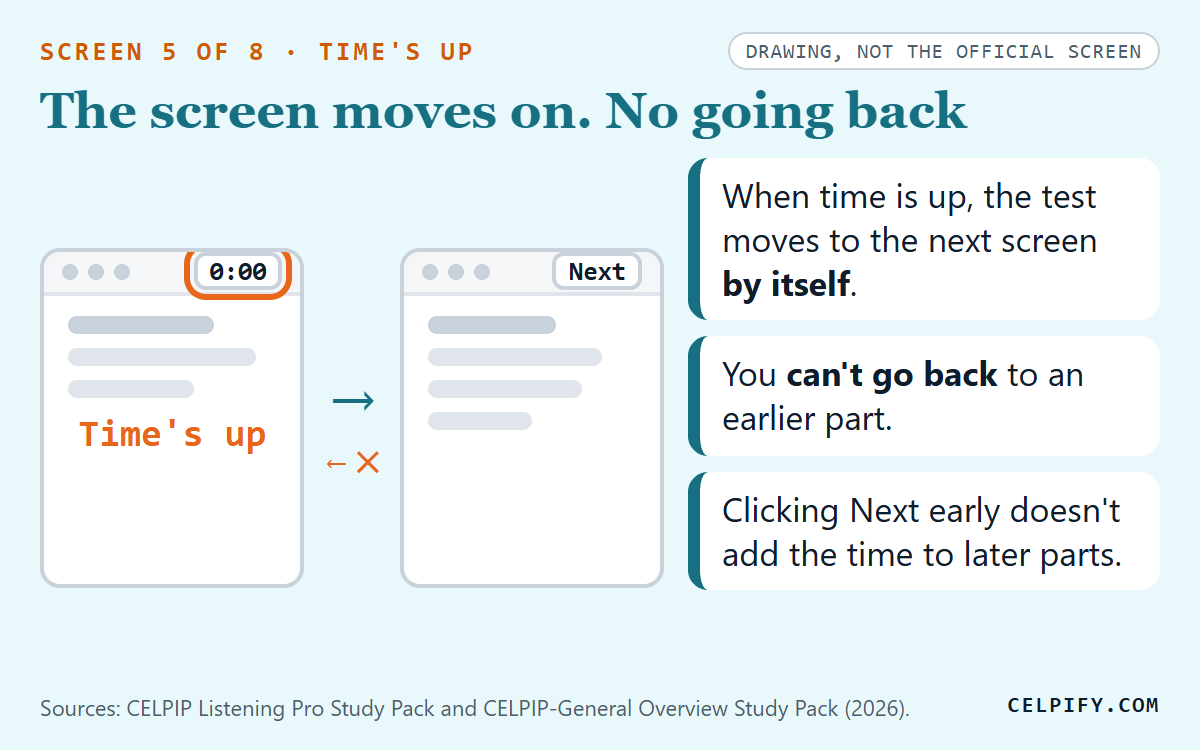
- When the time is up, the test moves to the next screen by itself, and you can't go back to an earlier part.
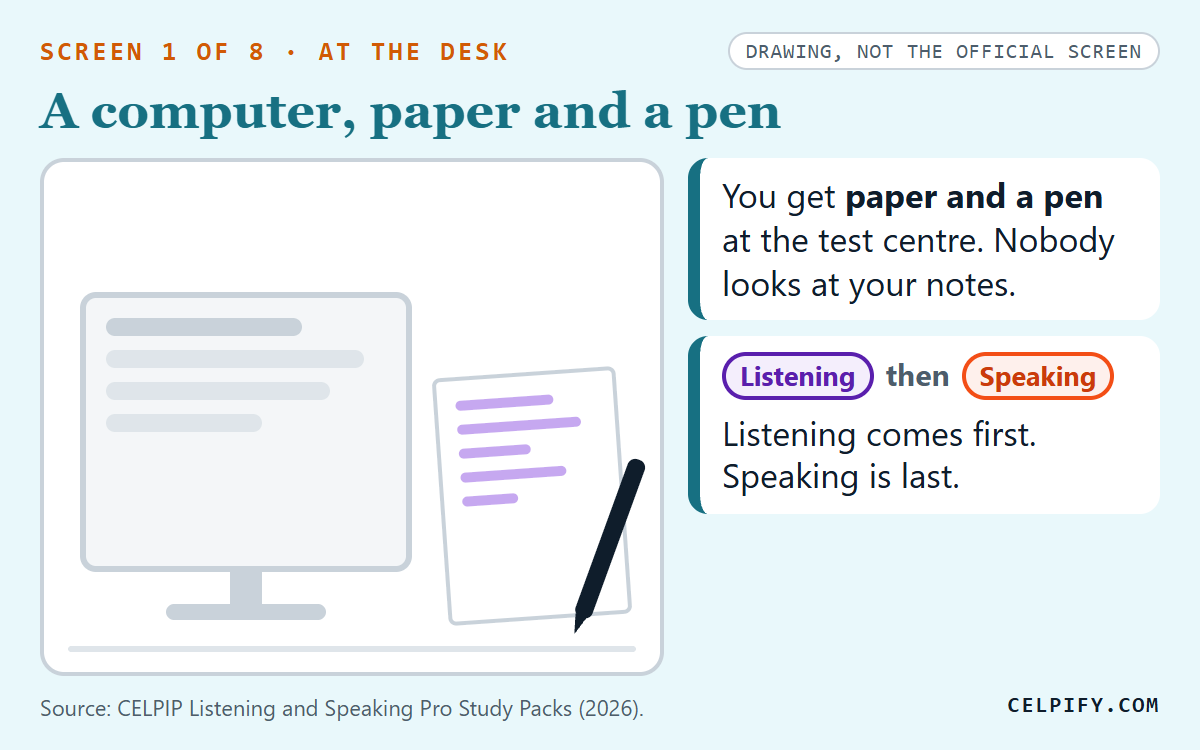
- You get paper and a pen at the test centre. Nobody looks at your notes.
- Part 5 is a video of three people talking on the real test. Celpify's Part 5 is audio only. Part 6 has one speaker.
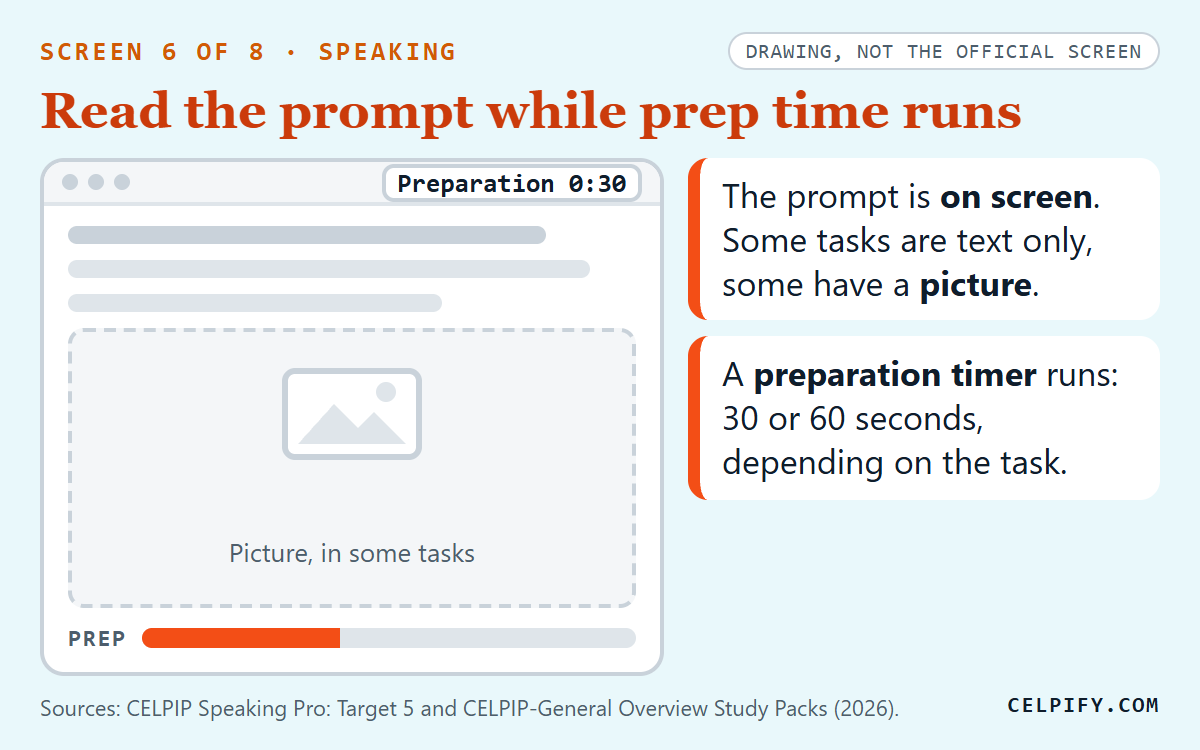
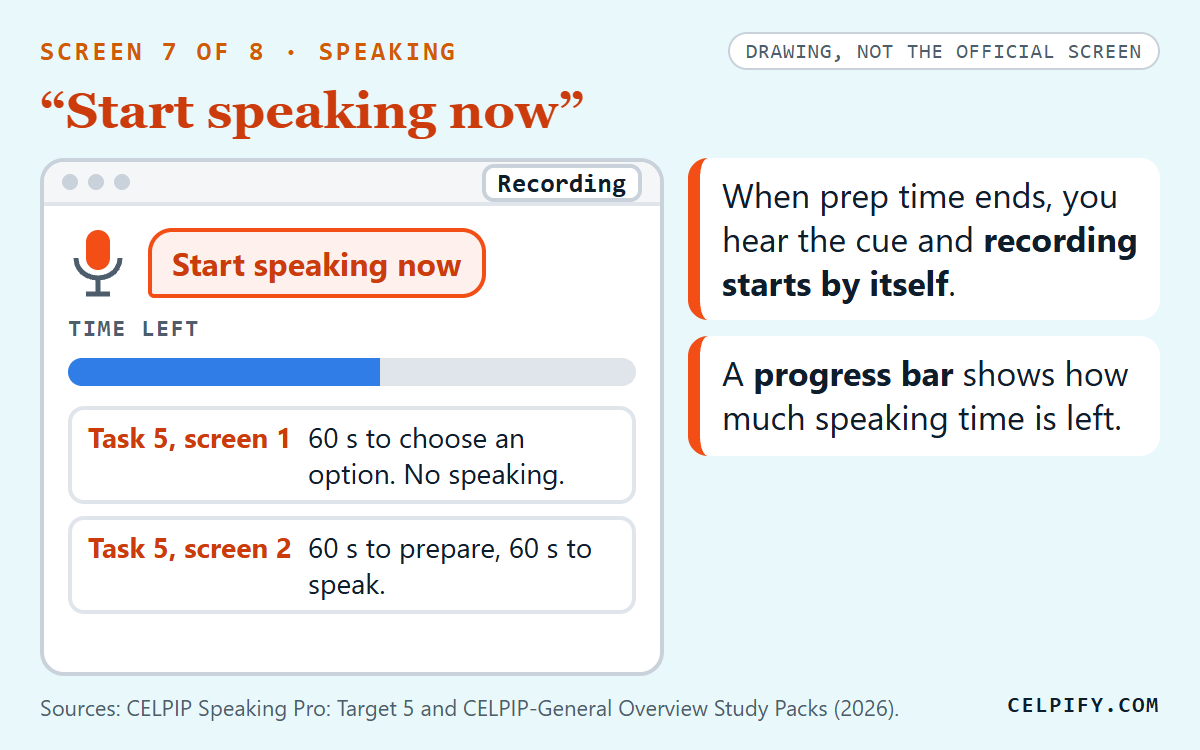
- In Speaking, the prompt is on screen. When prep time ends, you hear "Start speaking now" and the recording starts on its own.
Some summaries of the CELPIP listening and speaking test online carry old or wrong numbers. We've seen Part 1 given the wrong name, Speaking listed as "15-20 minutes" and Listening as "47-55". Even celpip.ca's older LS page still shows an earlier fee. The current figures on celpip.ca's citizenship and test-format pages are 46 to 55 minutes for Listening, 15 minutes for Speaking and $199 plus taxes. Part 1 is called "Listening to Problem Solving".
The CELPIP LS test, screen by screen
Eight simplified drawings of what happens on test day, not the official screens. Swipe or use the arrows.
Before You Start Your LS Practice Run
Find about 75 quiet minutes, headphones, paper and a pen, and a phone to record yourself.
Set it up the way a test centre would:
- Don't pause. Play each clip once, straight through.
- Take notes on paper. The official study pack warns that typing on a keyboard or screen isn't the same experience.
- Record your Speaking answers on your phone so you can play them back later.
- Go straight from Listening to Speaking. The real test has no scheduled break.
Two ways to take this CELPIP LS practice test
In the app, each Test 1 Listening part has its own practice page with a question timer on screen, and it scores the part for you. Start with Part 1 under the real clock, then Part 2, Part 3, Part 4, Part 5 and Part 6. Practice mode lets you pause and replay, so hold yourself to one listen. Then come back here for the reasons behind each answer.
On this page, Parts 2 and 3 play below with their spoken questions, and Parts 1 and 4 to 6 open on their own sample pages. Whichever you pick, it only counts as CELPIP LS test practice if you play each clip once.
We timed and transcribed our own Test 1 recordings while building this page. The Part 2 conversation runs 1:40 and Part 3 runs 2:04, inside the study pack's 1.5 to 2 and 2 to 2.5 minutes. The eight Speaking clocks add up to exactly 15:00, the same 15 minutes celpip.ca gives the section.
CELPIP LS Listening Practice: Test 1, Parts 1 to 6
38 questions, from the easiest part to the hardest.
Take the parts of this CELPIP-General LS sample test in this order, and write down your count after each one. You'll need all six counts for the score check further down.
- Part 1, Problem Solving (8 questions, about 8 minutes): play it on our CELPIP listening sample test, which has the full Part 1 with its spoken questions.
- Part 2, Daily Life Conversation (5 questions, about 5 minutes): right below.
- Part 3, Listening for Information (6 questions, about 6 minutes): straight after Part 2.
- Parts 4 to 6 (19 questions, about 22 minutes): Parts 4 to 6 with audio, all three clips with their questions.
Parts 2 and 3 aren't on any other Celpify article, so this is the only place you can play them outside the app.
Test 1, Part 2: Weekend Hiking Plan
1:40. Two friends who work together plan a weekend hike. AI-voiced practice audio, the same recording as Celpify's free Test 1, not official CELPIP audio. Questions 1 to 5 follow below.
Play it once
On test day the clip starts by itself, plays one time and can't be paused. Keep a pen ready, and leave the transcript closed until you've answered all five questions.
Show transcript
Part 2: questions 1 to 5
On the real test, Part 2 is one clip of about 1.5 to 2 minutes between two people who know each other. Then each question is read aloud while four options show on screen, with about 30 seconds per question. Press Hear the question, then pick an option. Your first pick locks the question.
Question 1. Why does the woman prefer Eagle Ridge at first?
Show the answer to question 1
Answer: D. Its harder climb leads to a rewarding viewpoint. Jenna says Eagle Ridge is "a tougher climb than Lakeshore, but the lookout should be worth it." A harder climb and a view that pays off: that's option D in other words.
- A.Kyle says the small lot there is usually full by seven thirty. That's a reason to leave early, not a later closing time.
- B.That's how Kyle describes Lakeshore later on: eight kilometres instead of twelve.
- C.The forecast is for Saturday in general. Nobody compares the weather on the two trails.
Question 2. What is the man conveying while he hesitates?
Show the answer to question 2
Answer: C. He is interested but has a family obligation. First he says "I would love to," and then he admits that his partner's parents arrive on Saturday morning. Interest first, then the conflict. No single sentence gives you this answer, so you have to join the two.
- A.He says the climb doesn't worry him, and he never questions her.
- B.He's the one who suggests leaving before six thirty to beat the parking.
- D.He wants to be home when they arrive. Taking them on the hike never comes up.
Question 3. How does their weekend plan change?
Show the answer to question 3
Answer: C. They move to Sunday and choose the shorter route. Two things change. Jenna moves the hike to Sunday, and Kyle asks for the shorter Lakeshore Loop. He sums it up himself: "Sunday at Lakeshore it is."
- A.The relatives come from Kingston to visit Kyle. The hike still happens.
- B.Saturday is exactly the day that doesn't work.
- D.They move it by one day, not one week.
Question 4. Why does Lakeshore suit their Sunday plan?
Show the answer to question 4
Answer: A. Its shorter distance lets them begin later. "It is eight kilometres instead of twelve, so we could start later after a busy Saturday." Shorter route, later start.
- B.Nobody mentions opening days for any parking lot.
- C.The lookout is on Eagle Ridge. The cooler weather is about Sunday in general.
- D.Nothing links the relatives to the trail.
Question 5. How do they divide the trip responsibilities?
Show the answer to question 5
Answer: B. The woman drives while the man brings the food. After Kyle offers sandwiches, trail mix and coffee, Jenna says, "I will drive, and you handle the food."
- A.It's the other way round.
- C.They pick the trail together, and nobody is given the parking.
- D.Nobody pays or books anything. The picnic tables are just a place to stop.
Test 1, Part 3: Community Centre Spring Program Registration
2:04. A woman who has just moved to the area asks the recreation coordinator about spring programs. AI-voiced practice audio, the same recording as Celpify's free Test 1, not official CELPIP audio. Questions 1 to 6 follow below.
Show transcript
Part 3: questions 1 to 6
Part 3 is one clip of about 2 to 2.5 minutes in which one speaker has the information the other needs, so expect dates, places, prices and names. The questions are read aloud, about 30 seconds each, in order.
Question 1. Who may register on March third?
Show the answer to question 1
Answer: A. Current members and people returning to programs. Early registration on March third is "only for current members and returning participants." Option A just swaps "returning participants" for "people returning to programs".
- B.New people like the woman start on March tenth. She even says it: "So March tenth for me."
- C.Three or more family members get a discount. It doesn't change the start date.
- D.The $15 late fee starts after March twenty-eighth, not on March third.
Question 2. Where is in-person registration handled?
Show the answer to question 2
Answer: B. In Room 104 on the first floor. "Come to the main office in Room 104 on the first floor." Right after that, he warns her about a room with almost the same number.
- A.The storage room is Room 401. This option mixes it up with the first floor, where the main office is.
- C.Room 401 is the storage room he tells her to avoid.
- D.Instructors don't handle registration. He even asks people not to contact them about places in classes.
Question 3. How are the two discounts determined?
Show the answer to question 3
Answer: C. One depends on timing; one on family enrolment. Ten percent off depends on when you register: the early-bird window, March third to seventh. Fifteen percent off depends on who registers: three or more family members.
- A.Age changes the program price (adult or youth), not the discounts.
- B.Only the early-bird discount depends on dates.
- D.Online and in person are just two ways to register. Neither one changes the price.
Question 4. What is the current policy on personal cheques?
Show the answer to question 4
Answer: D. They were accepted before, but not now. "We can no longer accept personal cheques." The words "no longer" tell you cheques used to be accepted. In Part 3, small phrases like this often carry the answer.
- A.Cheques aren't accepted for any program now.
- B.The dates don't change how you can pay.
- C.No cheque fee is mentioned. The only extra charge is the late fee.
Question 5. What distinguishes the three creative classes?
Show the answer to question 5
Answer: C. They are new to this spring's schedule. Kevin introduces them as "three brand-new ones". Being new this spring is the one thing all three share.
- A.Pottery is on Wednesday evenings.
- B.Only the cooking class is called a family class.
- D.Three different instructors are named: Daniel Marsh, Priya Sharma and Chef Rosa Kim.
Question 6. Why should waitlist questions go through Janet?
Show the answer to question 6
Answer: C. She centralizes current class availability details. Janet "manages all waitlist inquiries," and Kevin asks people not to call the instructors about availability. So one person keeps the up-to-date picture. The question asks why, not what, and nobody says the reason out loud: you build it from those two lines.
- A.Nothing connects Janet to the instructors' jobs.
- B.Payment comes up earlier in the talk, and Janet isn't part of it.
- D.Nobody says the late fee can be waived.
What Parts 2 and 3 were testing
Part 2 follows a plan that keeps changing. Saturday becomes Sunday, Eagle Ridge becomes Lakeshore, and the pick-up moves from six fifteen to eight thirty. Question 2 is the inference question: Kyle never says "I'm interested, but I'm busy". You get there by joining his "I would love to" with the visit he mentions next.
Part 3 is details and dates, and neat notes win it. Questions 1 to 5 each rest on one fact. Question 6 asks why, not what.
Parts 1 to 3 are the friendlier half of Listening, and our practice data agrees. On first tries between August 1 and October 12, 2026, 74% of answers in Parts 1 to 3 were correct on Celpify, against 63% in Parts 4 to 6. The full figures are on our CELPIP Listening Parts 4 to 6 practice page. They're Celpify practice and mock results, not official CELPIP data.
For strategy, read the CELPIP Listening Part 2 guide and the Part 3 guide. There are more Part 2 practice sets on the practice hub too.
Listening Answer Key: All 38 Test 1 Answers
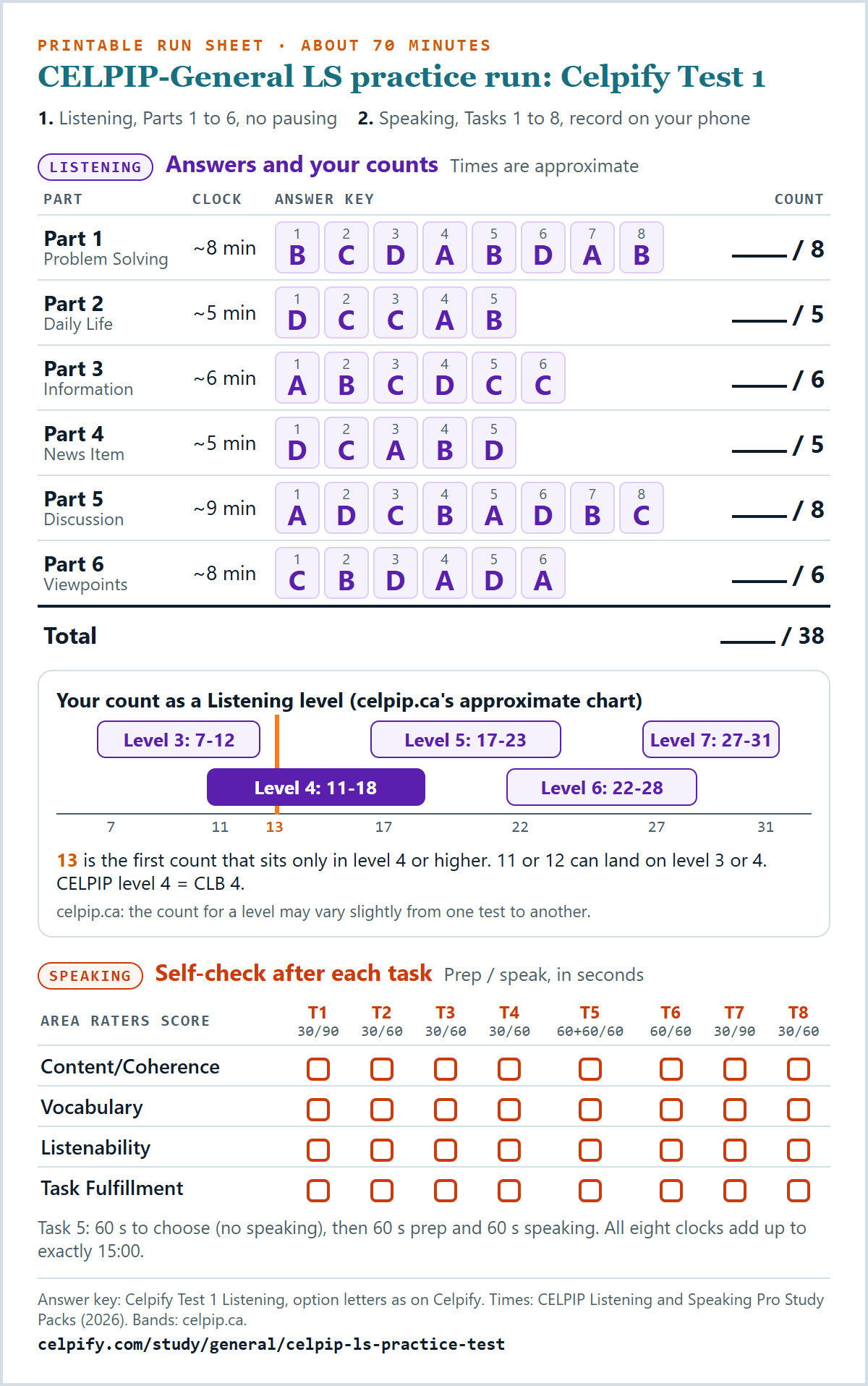
Here's your CELPIP LS practice test with answers: check your six counts below.
Each part opens to show the answer and a one-line reason. The letters are in the summary line, so you can mark a run fast. Parts 2 and 3 have fuller reasons in the sets above.
Part 1, Listening to Problem Solving: 1 B, 2 C, 3 D, 4 A, 5 B, 6 D, 7 A, 8 B
| Q | Answer | Why |
|---|---|---|
| 1 | B A fixed pink band appears on every page | The band shows up in exactly the same place on every page. |
| 2 | C To check whether paper feeding caused the mark | She changed trays and paper to see if the paper was to blame. |
| 3 | D The mark stays fixed across pages | Feed problems leave marks that move. This one doesn't. |
| 4 | A He is still deciding between the two possible causes | "I cannot tell which one it is yet." |
| 5 | B It may remove the streak without new parts | Cleaning "may clear it without replacing anything." |
| 6 | D They make a quick on-site replacement possible | Spares behind the counter mean a swap in about five minutes. |
| 7 | A A different design may avoid the same defect | It's a different model, so it shouldn't have the same fault. |
| 8 | B She needs preparation time before her meeting | She has to sort handouts and mount posters before 2:30. |
Part 2, Listening to a Daily Life Conversation: 1 D, 2 C, 3 C, 4 A, 5 B
| Q | Answer | Why |
|---|---|---|
| 1 | D Its harder climb leads to a rewarding viewpoint | A tougher climb, but "the lookout should be worth it." |
| 2 | C He is interested but has a family obligation | "I would love to," then the parents' visit. |
| 3 | C They move to Sunday and choose the shorter route | "Sunday at Lakeshore it is." |
| 4 | A Its shorter distance lets them begin later | Eight kilometres instead of twelve, so a later start. |
| 5 | B The woman drives while the man brings the food | "I will drive, and you handle the food." |
Part 3, Listening for Information: 1 A, 2 B, 3 C, 4 D, 5 C, 6 C
| Q | Answer | Why |
|---|---|---|
| 1 | A Current members and people returning to programs | March third is only for members and returning participants. |
| 2 | B In Room 104 on the first floor | The main office is Room 104. Room 401 is storage. |
| 3 | C One depends on timing; one on family enrolment | Early-bird dates, and three or more family members. |
| 4 | D They were accepted before, but not now | "No longer accept" means they used to. |
| 5 | C They are new to this spring's schedule | "Three brand-new ones." |
| 6 | C She centralizes current class availability details | She manages all waitlist inquiries, not the instructors. |
Part 4, Listening to a News Item: 1 D, 2 C, 3 A, 4 B, 5 D
| Q | Answer | Why |
|---|---|---|
| 1 | D approved despite some opposition | Council voted eight to three to approve it. |
| 2 | C about thirty-five percent | The city pays the remaining 35%. |
| 3 | A will carry the largest passenger volume | The two stations should serve 40,000 passengers a day. |
| 4 | B operating sooner and at a lower cost | Buses could run in 18 months for about half the price. |
| 5 | D while design and scheduling choices can still change | Consultations start before the plans are final. |
Part 5, Listening to a Discussion: 1 A, 2 D, 3 C, 4 B, 5 A, 6 D, 7 B, 8 C
| Q | Answer | Why |
|---|---|---|
| 1 | A The increase is far above comparable market changes | A 22% increase against about 8% for similar offices. |
| 2 | D Sales may lose valuable in-person client contact | Ben keeps coming back to face-to-face client meetings. |
| 3 | C To frame the financial trade-offs among the choices | She prices three options so the group can compare them. |
| 4 | B Informal personal contact can create new business | Two big accounts began with chats after client meetings. |
| 5 | A Two departments increased their measured output | Engineering and design: measured output up 15%. |
| 6 | D To address Ben's concern while preserving savings | A client lounge, and they still save about $70,000. |
| 7 | B It makes future rent increases more predictable | Increases are capped at 3% a year. |
| 8 | C Move sales and client functions while others stay remote | The Harbourview hybrid option. |
Part 6, Listening to Viewpoints: 1 C, 2 B, 3 D, 4 A, 5 D, 6 A
| Q | Answer | Why |
|---|---|---|
| 1 | C a mixed change shaped by local response | Benefits and harms, and "no simple verdict". |
| 2 | B support new businesses through additional local spending | About 300 newcomers, then 14 new businesses in Millbrook. |
| 3 | D worsen an existing shortage for lower-paid residents | Newcomers didn't cause the shortage, but made it worse. |
| 4 | A extremely scarce in many high-growth towns | Vacancy below 1% in nearly two thirds of those towns. |
| 5 | D expand housing and infrastructure as demand grows | Towns that built more avoided the price spikes. |
| 6 | A local planning shapes who benefits from growth | Preparation is "the central policy choice". |
Your Listening Count Out of 38 and the CLB 4 Line
How is the CELPIP Listening score calculated? Each right answer is one point, blank answers count as wrong, and a computer turns your count into a CELPIP level.
| CELPIP level | Correct out of 38 | CLB level |
|---|---|---|
| 10-12 | 35-38 | CLB 10-12 |
| 9 | 33-35 | CLB 9 |
| 8 | 30-33 | CLB 8 |
| 7 | 27-31 | CLB 7 |
| 6 | 22-28 | CLB 6 |
| 5 | 17-23 | CLB 5 |
| 4 | 11-18 | CLB 4, the citizenship minimum |
| 3 | 7-12 | CLB 3 |
Now read your tally against the citizenship bar. Level 4 runs from 11 to 18 correct and level 3 from 7 to 12, so 11 or 12 right can land on either side of the line. Thirteen is the first count that sits only in level 4 or higher. celpip.ca warns that the count for a level "may vary slightly from one test to another", because questions differ in difficulty. So use 13 as a practice target rather than a guarantee.
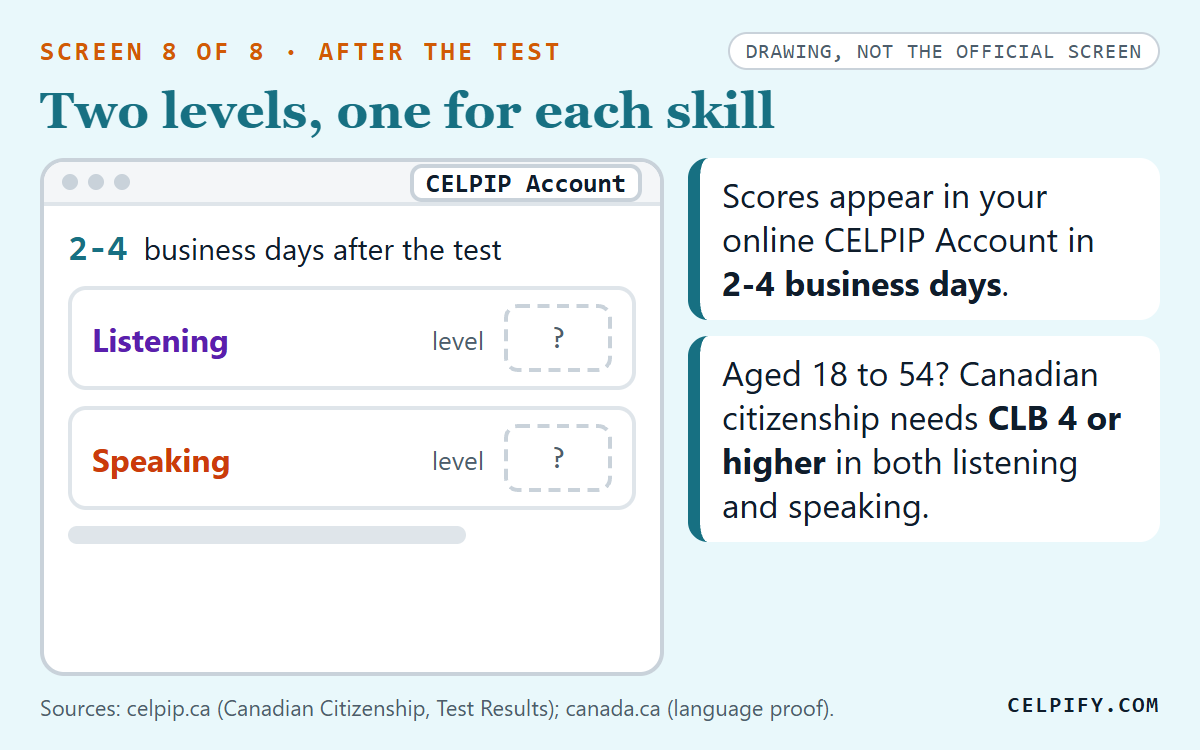
The two skills count separately. canada.ca asks for "4 or higher (up to 12) in listening and speaking", so a strong Listening level can't cover a weak Speaking one. Speaking has no count at all: raters give it a level, and the Speaking run below is where you practise for that. Real scores reach your online CELPIP Account in 2 to 4 business days.
The full CELPIP listening score chart has every band. For the requirement itself, including who has to prove it, see our guide to English tests for citizenship.
CELPIP LS Speaking Practice: Test 1, Tasks 1 to 8 on One Timer
Press play once and the track times the whole Speaking half for you.
The timer track has no voice, only tones. One beep starts your prep time, two beeps mean start speaking, and a long low tone means stop. Each task starts about two seconds after the one before.
- Keep the prompts in the table below open, with the pictures under the timer.
- Start the track and read Task 1 as the first beep sounds.
- Start recording on your phone at the two beeps, and stop at the long tone.
- Carry on through all eight tasks without stopping the track.
| Task | Test 1 prompt (short) | Prep / speak | Starts at |
|---|---|---|---|
| 1 Giving Advice | A coworker with a young family wants to leave a stable accounting job to do photography full-time. Advise him. | 30 s / 90 s | 0:00 |
| 2 Personal Experience | Describe your first day at a new job or school: how you felt, what happened, and what made it memorable. | 30 s / 60 s | 2:03 |
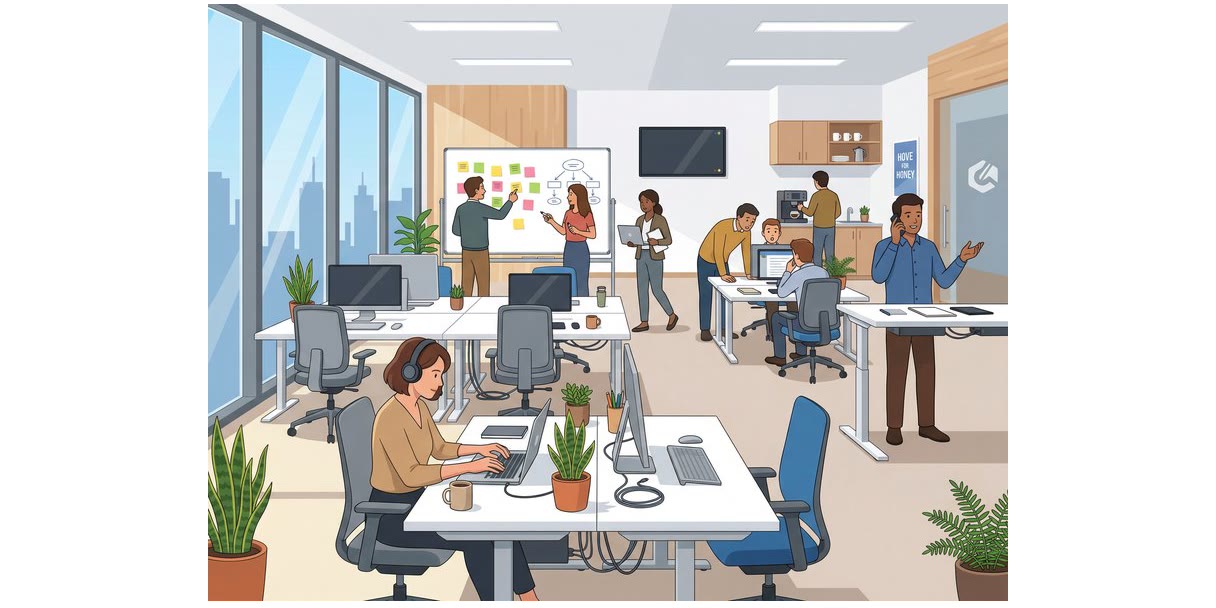
| 3 Describing a Scene | Describe what's happening in the busy office picture below. The listener can't see it. | 30 s / 60 s | 3:36 |
| 4 Making Predictions | Same picture: what will most probably happen next? | 30 s / 60 s | 5:09 |
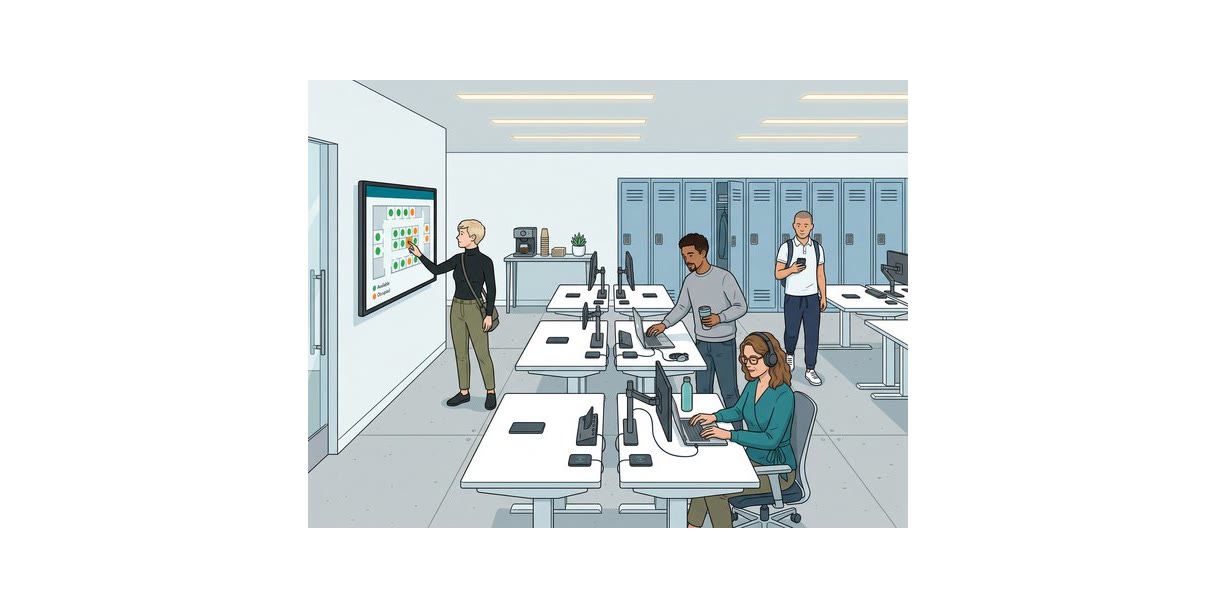
| 5 Comparing and Persuading | Choose the Open-Plan Office or the Traditional Office (no speaking). Then persuade a supervisor who suggests a Hot-Desking Workspace that your choice is better. | 60 s choose, 60 s / 60 s | 6:41 |
| 6 Difficult Situation | You're a project manager and the client has moved the deadline up by two weeks. Either ask your boss for at least one more week, or ask your team to split the remaining work. | 60 s / 60 s | 9:44 |
| 7 Expressing Opinions | Should remote work become the permanent standard, or should employees go back to the office? Explain why. | 30 s / 90 s | 11:47 |
| 8 Unusual Situation | Your child's favourite wind-up toy robot is broken. Call a toy repair shop, describe the robot and explain what's damaged (picture below). | 30 s / 60 s | 13:49 |
Task 5 has two steps, as on the test. You get 60 seconds to choose between two options, without speaking. Then you get 60 seconds to prepare and 60 seconds to argue for your choice against a new option.
Test 1 Speaking timer: all eight tasks (15:22)
Tones only, no voice. Prep and speaking times from CELPIP's Speaking Pro: Target 5 Study Pack (2026). The eight clocks add up to 15:00, plus a two-second gap between tasks. The transcript is the cue sheet.
Show transcript
The Test 1 Speaking pictures
Tasks 3 and 4 share the first picture. Task 5 shows two options on its first screen and the supervisor's suggestion on its second. Task 8 is the broken robot. Swipe or use the arrows.

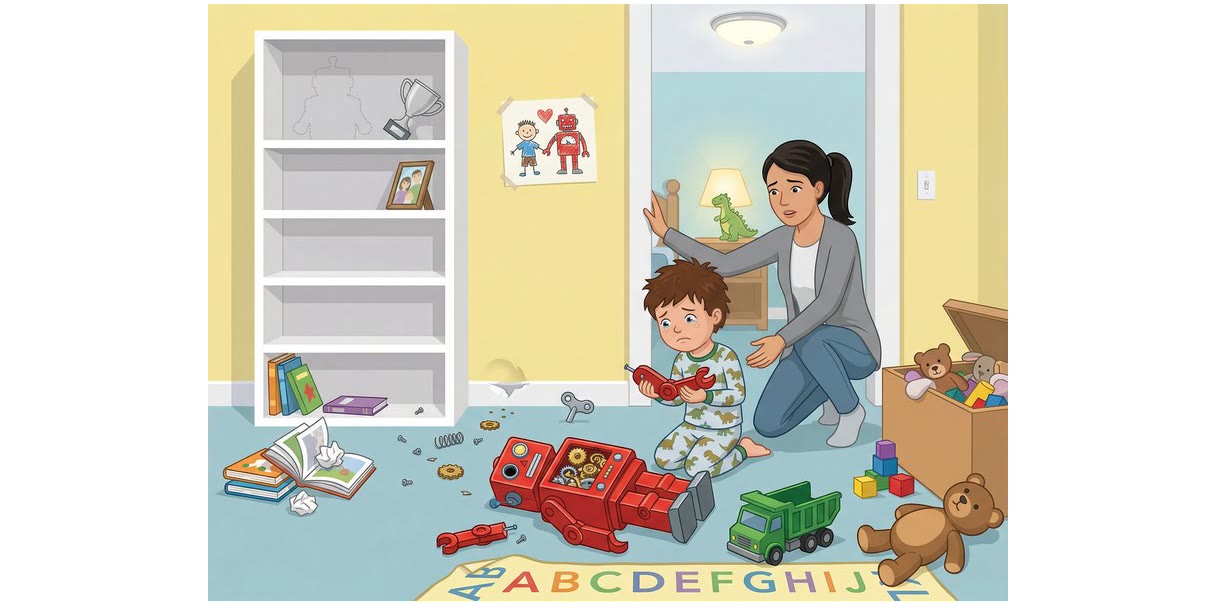
Done all eight? Play your recordings back next to the model answers in our CELPIP speaking test sample, which uses the same Test 1 prompts and pictures. You can jump straight to a task, for example Task 5, Comparing and Persuading. Those answers aim well above the citizenship bar, so use them for structure and ideas rather than as the level you need.
For feedback, you can record the same eight Test 1 tasks on Celpify Speaking practice and get AI feedback on each one. That part needs a free account, and the levels it shows are Celpify AI estimates, not CELPIP scores.
CELPIP raters score Speaking in four areas: Content/Coherence, Vocabulary, Listenability and Task Fulfillment. Listen to your recordings once for each area. If you want more prompts, every task has its own practice hub, starting with Task 1, Giving Advice.
What CLB 4-5 Sounds Like Next to CLB 7 in Speaking
The same short story, told at two levels.
Citizenship needs level 4. But what does level 4 sound like? We wrote one answer to Test 1 Task 2, "Describe your first day at a new job or school", twice: once at about Level 4-5 and once at about Level 7. The story, the voice and the facts stay the same, so the only thing that changes is the English.
CELPIP's Level Descriptors (May 2026) put the gap into "I can" statements. At Level 4 a speaker can "tell a short, simple story about something that happened to me" and speaks "with limited control of simple grammatical structures". Level 5 has "some control". At Level 7 it's "good control of simple grammatical structures", with "very few self-corrections, repetitions, or inappropriate pauses".
Two caveats. Celpify wrote both answers and an AI voice reads them, so CELPIP never scored them. And an AI voice can't show a real accent or real pronunciation trouble. To hear real test takers at Levels 4, 5 and 7, play the Task 1 and Task 8 recordings on celpip.ca's Score Comparison Chart, linked in the sources below.
Looking for a CELPIP LS test for citizenship sample answer? The first clip sits close to the bar, and the second is what a few more levels sound like.
About Level 4-5: my first day at a new job
42 seconds. Written by Celpify and read by an AI voice. Not an official CELPIP sample or score. The grammar mistakes and pauses are on purpose.
Show transcript
About Level 7: the same story
39 seconds. Written by Celpify and read by an AI voice. Not an official CELPIP sample or score.
Show transcript
| Area | About Level 4-5 | About Level 7 |
|---|---|---|
| Content/Coherence | One event and one feeling: "I feel very bad." "So... I feel better." | A reason behind the feeling and a point at the end: "one small mistake taught me it's okay to ask for help." |
| Vocabulary | Common words: "the fridge, the dishes", "very, very busy" | More precise words and an idiom: "walk-in fridge", "lunch rush", "slipped and smashed", "stuck with me" |
| Listenability | Verbs that don't change: "she show me", "I drop one plate", "the people was kind". Pauses and "uh" | Past tenses held steady: "gave me a quick tour", "was carrying". Almost no hesitation |
| Task Fulfillment | Covers how he felt, what happened and why he remembers it, in short separate pieces | Covers all three and links them, so the story builds to its point |
If your recording sounds like the first clip
CELPIP's Speaking Pro: Target 5 Study Pack lists things to work on at this level. Three of them match what you hear in the first clip:
- Support your feelings with reasons. "I felt terrible" is a start. "I felt terrible, but the head cook just laughed" tells the listener why the feeling changed.
- Keep your past tenses steady. Choose the past at the start of the story and stay there: showed, dropped, broke, said.
- Cut the pauses by planning during prep. Use the 30 seconds to note three beats (before, the problem, the ending), so you aren't searching for the next idea mid-sentence.
The citizenship bar is 4. Our advice, not an official rule: keep practising until you're steadily above it, so a nervous test day still leaves you clear of the line. The CELPIP Speaking Task 2 guide has more on telling a story in 60 seconds.
After Your LS Practice Run
Your weaker half decides what you practise next week.
If your Listening count came in under 13, go back to the part where you lost the most points. Every part has its own strategy guide and its own questions on Celpify Listening practice.
Did your Speaking sound more like the first clip? Work through the task guides, then practise fresh prompts against the clock with our CELPIP speaking samples.
Try the official practice too. celpip.ca offers free practice tests behind a short form, and the form has a CELPIP General LS option. celpip.ca says its free sample test helps you get familiar with the test format and timing, so do it once before test day.
Test 1 costs nothing on Celpify. Tests 2 to 60, and single-skill Listening or Speaking mocks, come with a paid plan.
Keep exploring:CELPIP listening practice · CELPIP speaking practice · CELPIP General vs General LS
Sources & further reading
The official sources behind the format, timing, scoring and citizenship facts on this page.
- CELPIP LS for Canadian CitizenshipAbout 1 hour 10 minutes in one sitting; Listening 38 questions in 46-55 minutes; Speaking 8 tasks in 15 minutes; $199 plus taxes; results in 2-4 business daysOfficial CELPIPcelpip.ca
- CELPIP Test Format & ScoringPart and task names, LS covers Listening and Speaking only, CELPIP levels equal CLB levels, unscored items, the free sample testOfficial CELPIPcelpip.ca
- CELPIP Test ResultsApproximate Listening counts per level and the disclaimer, scoring by computer, the four Speaking performance areas, 2-4 business daysOfficial CELPIPcelpip.ca
- CELPIP Test Day InformationThe test is timed, doesn't pause and has no scheduled breakOfficial CELPIPcelpip.ca
- CELPIP Score Comparison ChartOfficial Speaking sample responses at Levels 4, 5 and 7 (Tasks 1 and 8)Official CELPIPcelpip.ca
- CELPIP Level Descriptors (May 2026)The "I can" statements for Speaking Levels 4, 5 and 7Official CELPIPcelpip.ca
- CELPIP Listening Pro Study Pack (2026)Minutes and questions per part, question formats, no going back, paper and a pen, audio plays onceOfficial CELPIPcelpip.ca
- CELPIP Speaking Pro: Target 5 Study Pack (2026)Prep and speaking time per task, "Start speaking now", Level 5 things to work onOfficial CELPIPcelpip.ca
- CELPIP-General Overview Study Pack (2026)The LS test table, the Next button, and Speaking Task 5's two screensOfficial CELPIPcelpip.ca
- Free CELPIP Practice TestsOfficial free practice tests behind a short form, with a CELPIP General LS optionOfficial CELPIPcelpip.ca
- Language proof for Canadian citizenshipApplicants aged 18 to 54 show CLB 4 or higher in speaking and listeningIRCC · Government of Canadacanada.ca
- Language test results accepted for citizenshipCELPIP-G LS accepted at "4 or higher (up to 12) in listening and speaking"IRCC · Government of Canadacanada.ca