CELPIP Listening Sample Test with Audio and Answers

Here's a complete CELPIP Listening Part 1 you can play on this page. One conversation is split into three audio sections, and after each section you hear its questions read aloud. Under every question there's an answer panel that explains why each wrong option is wrong. The set comes from Celpify's free Test 1, so this CELPIP listening test sample follows the real Part 1 format question for question.
Treat it like a short CELPIP listening mock test. Play each section once without pausing and jot notes on paper, as you would at a test centre, then check your answers. Looking for a CELPIP listening practice test with answers in a PDF? You won't need one, because the transcripts and explanations sit right under the audio.
One thing before you press play: the voices are AI-generated practice recordings made for Celpify, not official CELPIP audio. The official free practice tests are on the CELPIP website, linked at the end.
How CELPIP Listening Part 1 Works
Part 1 is the first scored part of the Listening test: one conversation, heard in three pieces.
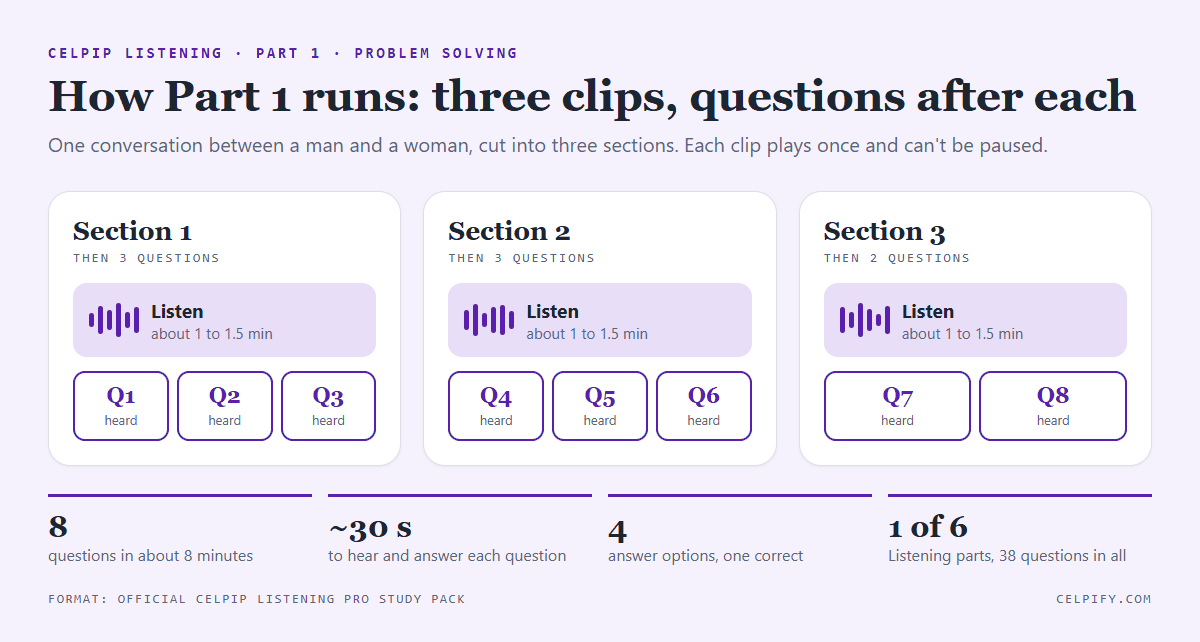
The official study pack describes Part 1 like this:
There are 8 questions, and the part takes about 8 minutes. It's one of six CELPIP Listening parts, and the whole Listening test has 38 scored questions over 46 to 55 minutes.
You hear two speakers, one man and one woman, who don't know each other. One has a problem and the other tries to help.
The conversation stops after each of its three sections, and you answer two or three questions about what you just heard.
In Parts 1 to 3 the questions are read aloud while the four options appear on screen. You get about 30 seconds for each one, and you answer them in order.
Each clip starts by itself and plays once. You can't pause it or play it again.
The pack says each section runs about 1 to 1.5 minutes. The sections in this sample are shorter, 36 to 44 seconds of conversation each, so expect the real clips to feel a bit longer. Nobody marks your notes. Write whatever helps you keep track: names, numbers, what went wrong, what they decide to do.
Want the strategy first? Our CELPIP Listening Part 1 strategy guide covers note-taking for a problem-solving conversation.
Sample Listening Test, Section 1: The Pink Band (Questions 1 to 3)
A customer at a print centre has a problem with the colour printer. Listen once, then answer the three questions that follow.
Section 1: the conversation, then Questions 1 to 3
About 59 seconds. The conversation plays first, then each question is read aloud. AI-voiced practice recording from Celpify's free Test 1.
Play it once
On test day the clip starts by itself, plays one time and can't be paused. Keep a pen and paper ready, and leave the transcript closed until you've answered.
Show transcript
Answer each question before you open its panel. On the real test the four options appear on screen while the question is read, and you have about 30 seconds.
Question 1. What problem is the woman reporting?
A. The printer stops before completing each page
B. A fixed pink band appears on every page
C. The side tray refuses to accept heavier paper
D. Her posters print with colours that are too pale
Show the answer to Question 1
Answer: B. She says every page has a pink band down the right side, and that it showed up "in exactly the same place" both times she printed. The option says the same thing in fewer words: "fixed" stands in for "exactly the same place."
A. The pages do come out. Each one just carries the same mark.
C. The heavier paper went through the side tray without trouble. It simply showed the same band.
D. Pale colour is never her complaint, and the posters are still work she has to finish.
Question 2. Why did she try the side tray?
A. To see whether the main tray was empty
B. To test whether posters needed heavier paper
C. To check whether paper feeding caused the mark
D. To confirm that the printer could make posters
Show the answer to Question 2
Answer: C. The technician asks whether the band shows up with every kind of paper or only the main tray. She had already wondered the same thing, so she switched trays and paper to see whether the paper was to blame. He later calls that possibility "a feed problem."
A. Nobody says the main tray was empty.
B. Heavier paper was part of her test, not a question about what the posters need.
D. The posters are part of her job for the day, not the reason she changed trays.
Question 3. What makes a feed problem less likely?
A. The printer accepts two different file sizes
B. The side tray contains heavier paper
C. The job includes both handouts and posters
D. The mark stays fixed across pages
Show the answer to Question 3
Answer: D. The technician explains that feed problems "usually leave marks that shift from page to page," while a band that stays in one place points to the imaging system.
A. File size never comes up.
B. True, and you heard it. But the heavier paper is what she tested with, not the reason a feed problem looks unlikely.
C. What she's printing tells you nothing about the cause of the mark.
Section 2: Clean It or Replace It? (Questions 4 to 6)
The technician works out what might be causing the band and what to try first.
Section 2: the conversation, then Questions 4 to 6
About 58 seconds. AI-voiced practice recording from Celpify's free Test 1.
Show transcript
Question 4. What does the technician's explanation show?
A. He is still deciding between the two possible causes
B. He has confirmed that loose toner caused the band
C. He believes the side tray damaged the imaging drum
D. He expects the toner display to identify the cause
Show the answer to Question 4
Answer: A. He names two suspects, the magenta cartridge and a worn drum, and then says it outright: "I cannot tell which one it is yet." The question asks what his explanation shows, so the answer describes his thinking instead of repeating a fact.
B. Loose toner is only a possibility the cleaning cycle might fix. Nothing is confirmed.
C. The side tray was her test, and it pointed away from paper feeding. It has nothing to do with the drum.
D. He puts the display check off and prefers to run the cleaning cycle first.
Question 5. Why does he try cleaning first?
A. It will show how much toner remains
B. It may remove the streak without new parts
C. It will test whether the paper is too heavy
D. It must be done before opening the cabinet
Show the answer to Question 5
Answer: B. "Cleaning may clear it without replacing anything" becomes "without new parts" in the option.
A. The display would show the toner level, and that's the step he's skipping for now.
C. The paper was already tested in Section 1.
D. Nothing links the cleaning cycle to the cabinet. The cabinet just holds the spares.
Question 6. How do the spare cartridges help?
A. They allow the display check to be skipped
B. They prove the cartridge is causing the band
C. They prevent the drum from wearing further
D. They make a quick on-site replacement possible
Show the answer to Question 6
Answer: D. The spares are in the cabinet behind the counter, so swapping the cartridge "should take about five minutes."
A. This joins two separate steps. The spares speed up the replacement; they don't change anything about the display.
B. A new cartridge is a test, not proof. If it doesn't help, the drum becomes the stronger suspect.
C. A new cartridge can't repair a worn drum.
Section 3: The Backup Printer (Questions 7 and 8)
The woman has a deadline, and the technician offers a way to protect it.
Section 3: the conversation, then Questions 7 and 8
About 46 seconds. AI-voiced practice recording from Celpify's free Test 1.
Show transcript
Question 7. Why is the backup printer useful?
A. A different design may avoid the same defect
B. It can repair the damaged printer without a technician
C. It is reserved for printing large posters
D. Its toner display gives more accurate readings
Show the answer to Question 7
Answer: A. "It is a different model, so it should not have the same defect." In the option, "a different model" becomes "a different design."
B. The repair technician deals with the broken printer. The backup printer only finishes her order.
C. He offers it for the whole job, not just the posters.
D. Nobody compares the two printers' displays.
Question 8. Why must the order be ready by one?
A. The repair technician arrives at that time
B. She needs preparation time before her meeting
C. The backup printer is unavailable after lunch
D. Her discount expires when the afternoon begins
Show the answer to Question 8
Answer: B. Her meeting is at two thirty, but she wants the printing done by one "because I still have to sort the handouts and mount the posters." Two times come up in this section, so note which one belongs to what.
A. No arrival time is given for the repair technician. He only says a repair visit could take several hours.
C. Nothing limits when the backup printer can be used.
D. The discount is for the delay, and nothing is said about it expiring.
Why the Wrong Answers Look Right
A few wrong options are easy to drop because nobody mentioned them at all. The others are built to sound right.
When we write listening questions for Celpify's practice tests, each wrong option gets a written reason it fails, like the ones in the panels above. In this set, a few of them are simple misses: a file size, an arrival time for the repair technician, a printer kept only for posters. Nobody said any of it. The rest fall into three groups, and they're worth learning to spot.
1. True, but it answers a different question
Question 3, option B is the clearest case. The side tray really did hold heavier paper, and you heard her say so. But the question asks what makes a feed problem less likely, and only the band staying in one place answers that. Options like this pass the "did I hear that?" check, so they feel safe.
2. Real pieces, joined the wrong way
These take two things from the conversation and connect them in a way nobody did. Question 4, option C ties the side tray to the drum. Question 5, option D ties the cleaning cycle to the cabinet, and Question 6, option A ties the spare cartridges to the display. Every piece was mentioned, but nobody linked them.
3. Too sure
The technician spends Section 2 thinking out loud. Options with "confirmed" (Question 4) or "prove" (Question 6) claim a certainty he never had. When a speaker is still weighing possibilities, the right answer usually reflects that.
What about the correct answers? They rarely repeat the audio word for word. "Exactly the same place" turned into "fixed," "without replacing anything" into "without new parts," and "a different model" into "a different design." The official study pack makes the same point: expect the answer in different words. So an option that copies a phrase you just heard isn't automatically right. Check it against the question before you pick it.
For more listening test practice habits, like setting up your notes for each part, see our CELPIP listening tips.
From This Sample to Your CELPIP Listening Score
Eight questions is a small slice of a 38-question test, so don't read too much into one result.
Each correct answer on the Listening test earns one point, and wrong answers cost nothing, so never leave a question blank. The computer converts your total out of 38 into a CELPIP level and also accounts for how hard the questions were. That's why the official study pack lists overlapping ranges. A total of 32, for example, sits in its level 8 range of 30 to 33 correct. The CELPIP listening score chart covers every band and what it converts to.
The test may also include an unscored part, and you won't know which one it is, so give every part your full effort.
Got 7 or 8 right? That's a good start, but Part 1 is the easiest part, and the audio and questions get harder all the way to Part 6. Missed three or more? Play the section again with the transcript open and find the sentence each answer came from. You'll quickly see whether you missed the words or misread the question.
You can answer this same set online in Celpify's free Test 1 listening practice. The other five parts of Test 1 are free on the CELPIP listening practice test page as well.
For the Reading side, try the CELPIP reading sample test: a full Part 2 set with the diagram and every answer explained.
Sources & further reading
The official CELPIP sources behind the format and scoring facts on this page.
- CELPIP Listening Pro Study PackPart 1 format, question types, paraphrase, and the approximate score rangesOfficial CELPIPcelpip.ca
- CELPIP Guidebook for Test Takers (July 2026)Listening test length, questions per part, and unscored contentOfficial CELPIPcelpip.ca
- CELPIP Test FormatOfficial overview of the four test componentsOfficial CELPIPcelpip.ca
- CELPIP Free Practice TestsOfficial free practice tests with the real test interfaceOfficial CELPIPcelpip.ca