CELPIP Speaking Test Sample: All 8 Tasks with Audio

This CELPIP speaking test sample covers all eight tasks from Celpify's free Test 1. That's eight CELPIP speaking questions with answers you can play, the same prompts and pictures as the practice screen, and a quick plan for each task.
Every answer here fits the real time limit, which is less common than you'd think. Many CELPIP speaking examples online are text only, so nobody checks them against a clock. When we timed the written sample answers in our own Test 1, the ones for Task 5 and Task 8 came to 236 and 251 words. Spoken at a natural pace, that's more than a minute and a half of talking for a task that gives you 60 seconds. So we rewrote them. For comparison, the official Level 12 Task 5 sample in CELPIP's Speaking Pro study pack is about 135 words, pauses and all.
The model answers are Celpify's own writing, read aloud by an AI voice at about 140 to 160 words a minute, which is a comfortable speaking pace. They show what a clear, well-organised answer sounds like, but they aren't recordings of real test takers. CELPIP publishes real test-taker recordings in its Score Comparison Chart, linked in the sources at the end of this page.
How to Use This CELPIP Speaking Sample Test
Do each task yourself first, with a timer running. Then listen.
Use this page as CELPIP speaking test practice. Read the prompt, start a timer for the preparation time, then record yourself for the full speaking time. A phone voice memo is fine. Only then play the model answer and compare. If you listen first, you'll borrow our ideas and learn nothing about your own timing.
| Task | Prep | Speak | Model answer |
|---|---|---|---|
| Task 1: Giving Advice | 30 s | 90 s | 185 words, 1:12 |
| Task 2: Talking about a Personal Experience | 30 s | 60 s | 134 words, 0:54 |
| Task 3: Describing a Scene | 30 s | 60 s | 134 words, 0:54 |
| Task 4: Making Predictions | 30 s | 60 s | 132 words, 0:49 |
| Task 5: Comparing and Persuading | 60 s to choose, then 60 s | 60 s | 125 words, 0:54 |
| Task 6: Dealing with a Difficult Situation | 60 s | 60 s | 130 words, 0:48 |
| Task 7: Expressing Opinions | 30 s | 90 s | 191 words, 1:17 |
| Task 8: Describing an Unusual Situation | 30 s | 60 s | 137 words, 0:56 |
The whole Speaking test takes about 15 minutes. At a natural pace, 60 seconds holds roughly 120 to 140 words, and 90 seconds about 185 to 210. Speak more slowly than that? Then plan fewer ideas rather than talking faster.
Each of the CELPIP speaking sample answers below comes with a note on what it does well, using the four areas CELPIP raters score. If you want the strategy behind every task in more depth, the CELPIP speaking tips guide walks through them one by one.
Task 1: Giving Advice (90 Seconds)
A coworker wants your opinion on a big career change.
Test 1 prompt
A coworker with a young family is considering leaving his stable accounting job to pursue his passion for photography full-time. Advise him on whether to make this career change.
30-second plan: don't quit yet, then three steps: test it on weekends, save six months first, ask for a four-day week. Close with when to go for it.
Task 1: model answer
185 words, 1:12 of a 90-second limit. Written by Celpify and read by an AI voice at a natural pace.
Try it before you press play
Give yourself 30 seconds to plan and 90 seconds to speak. Record it, then listen to the model.
Show transcript
CELPIP's advice for Task 1 fits in one line: speak directly to the person, give at least three suggestions, and back each one with a reason or an example. This answer does all three, and it signals every move (First, Second, And third) so the listener never gets lost.
It also answers the real question in its second sentence. "Should he quit?" deserves a direct answer, and relevance is part of Task Fulfillment. A list of pros and cons with no verdict leaves the rater guessing. At 185 words it fills about 72 of the 90 seconds, which leaves room to breathe. The Task 1 giving advice guide breaks the three-suggestion structure down second by second.
Task 2: Talking About a Personal Experience (60 Seconds)
Tell one short story, in the past tense, with real details.
Test 1 prompt
Describe your first day at a new job or school. Talk about how you felt, what happened, and what made it memorable.
30-second plan: warehouse in Calgary, nervous about English. Pallet jack hits the paper towels. Team laughs and helps. Lesson learned.
Task 2: model answer
134 words, 0:54 of a 60-second limit. Written by Celpify and read by an AI voice at a natural pace.
Show transcript
The story answers every part of the prompt (how the speaker felt, what happened, why it stuck) and stays in the past tense from start to finish. It also has one vivid moment, the boxes of paper towels falling everywhere, and that's the detail a listener will remember.
Can't think of a real first day? The official Speaking Pro pack says you can borrow a story if nothing from your own life comes to mind. Don't spend your 30 seconds hunting for the perfect memory. Pick one and go.
Task 3: Describing a Scene (60 Seconds)
Describe the picture to someone who can't see it.

Test 1 prompt
Describe some things that are happening in the picture below as well as you can. The person with whom you are speaking cannot see the picture.
30-second plan: busy office overview. Windows on the left, headset woman in front, whiteboard pair, yellow sweater helper, phone man on the right, coffee at the back. End on the mood.
Task 3: model answer
134 words, 0:54 of a 60-second limit. Written by Celpify and read by an AI voice at a natural pace.
Show transcript
Listen to the order. A one-line overview comes first, then the scene piece by piece, with a location for each person: on the left, in the front, behind her, on the right, at the back. Last comes a wrap-up about the mood. That's the structure the official Speaking Pro pack recommends for Task 3: a general statement, then details, then a wrap-up, with a feeling in there somewhere.
The present continuous (is typing, are standing) does most of the grammar work, and the answer doesn't try to mention everything. It picks six details and gives each one a place, which works far better than racing through fifteen. For more scenes to practise on, try the CELPIP speaking pictures set, or record your own version of this one on the free Test 1 busy office task.
Task 4: Making Predictions (60 Seconds)
Same office, new question: what happens next?
Test 1 prompt
In this picture, what do you think will most probably happen next?
On test day, Task 4 uses the same picture as Task 3. Scroll up to the office scene if you need it.
30-second plan: whiteboard pair calls a team meeting. Phone man has good news. Headset woman keeps working. Coffee comes over. By the afternoon, everyone's on the project.
Task 4: model answer
132 words, 0:49 of a 60-second limit. Written by Celpify and read by an AI voice at a natural pace.
Show transcript
The trap in Task 4 is describing the picture again. This answer spends one sentence setting up and the rest looking forward, and every prediction is tied to a clue in the picture: they look almost finished, so..., he seems excited on the phone, so.... That's what makes the predictions believable instead of random.
It also mixes its future forms: will, probably, likely, I expect. Four ways of saying the same thing give the Vocabulary and Listenability scores more to work with than "will" repeated six times. It runs about 49 seconds, and that's fine. An answer that finishes a little early is better than one that gets cut off mid-sentence.
Task 5: Comparing and Persuading (Two Parts)
First you choose between two options. Then you defend your choice against a third.
Task 5 is the task many sample answers get wrong, because it happens in two stages. In Part 1, you get 60 seconds to read two options and choose one. You don't speak yet. In Part 2, a new option appears, and you get 60 seconds to prepare and 60 seconds to persuade someone that your choice is better than the new one. An answer that only compares the first two options is answering a different question.

Test 1, Part 1: the two options
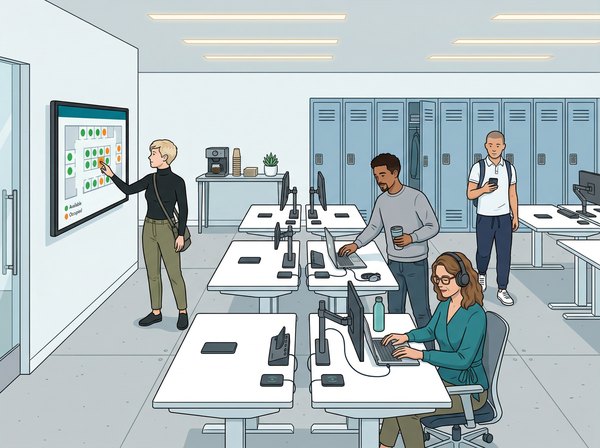
Option A, Open-Plan Office. Collaborative pods, standing meeting tables, and shared desks for 4 to 6 people. Plants, natural light and bright colours to attract young talent. Modular furniture that can be rearranged as the company grows, which keeps costs low.
Option B, Traditional Office. Private offices and cubicles for quiet, focused work. Every employee has their own desk, storage and personal area. A large boardroom for formal meetings and confidential work.
Test 1, Part 2 prompt
A different supervisor is suggesting a Hot-Desking Workspace instead. Persuade them that your chosen office layout is more suitable by comparing the two.
Hot-desking: no assigned desks, so employees book a workstation each morning in an app. It cuts real estate costs by assuming only 70% of staff are in the office on any given day, and it mixes departments because people sit somewhere different every day.
60-second plan: Part 1 choice was the open plan. Admit hot-desking saves rent, then three points: pods beat daily booking, the 70% idea fails in a busy week, modular furniture keeps costs down. Recommend.
Task 5: model answer
125 words, 0:54 of a 60-second limit. Written by Celpify and read by an AI voice at a natural pace.
Show transcript
The answer never mentions Option B. It argues against the supervisor's hot-desking idea, point by point, with facts from the screen: the booking app, the 70% assumption, and the cost argument turned around. That's what "comparing the two" means in Part 2.
It opens with a small concession (I understand why hot-desking sounds attractive), which keeps the tone polite. You're talking to a supervisor, and tone is scored under Task Fulfillment. At 125 words it's the shortest answer on this page, and it still makes three solid points. The Task 5 comparing and persuading guide has more on choosing fast in Part 1.
Task 6: Dealing With a Difficult Situation (60 Seconds)
Two ways to handle a problem. Pick one and speak to that person.
Test 1 prompt
You are a project manager. Your team has been working hard on a major project for three months. Yesterday, your boss told you the client has moved the deadline up by two weeks. Your team is already working overtime, and the new deadline seems impossible to meet without sacrificing quality.
Choose one: talk to your boss and explain why the deadline should be extended by at least one week, or talk to your team and propose splitting the remaining work so everyone meets the new deadline together.
60-second plan: talk to the boss. Thank them, show you understand the client, be honest about the team, name the risk, ask for one week, offer a revised schedule.
Task 6: model answer
130 words, 0:48 of a 60-second limit. Written by Celpify and read by an AI voice at a natural pace.
Show transcript
The official list for Task 6 reads almost like a checklist: speak directly to the person, be considerate but firm, outline the problem, make your request, and support it with reasons. Hold the model answer up against that list and every item is there.
The firm part is a single sentence, and it doesn't hedge: I'm asking you to go back to them and request at least one extra week. The considerate part is everything around it, especially the offer at the end, which gives the boss something to take back to the client. Either option can score well. Choose one and commit to it, because an answer that wanders between the two sounds unsure.
Task 7: Expressing Opinions (90 Seconds)
Take a side on a question and defend it for a minute and a half.
Test 1 prompt
Do you think remote work should become the permanent standard, or should employees return to traditional office settings? Explain your reasons.
30-second plan: remote should be the standard where the job allows it. Reasons: commute time, cheaper offices and wider hiring, the environment. Answer the loneliness point. Close.
Task 7: model answer
191 words, 1:17 of a 90-second limit. Written by Celpify and read by an AI voice at a natural pace.
Show transcript
Pick a side during your prep time, find at least three reasons, and give each one an example or detail. That's the official Task 7 strategy, and this answer follows it closely. It states its side in the first sentence and never wobbles, and every reason gets something concrete: two hours on a bus, a designer in Halifax, fewer people driving to work.
Then it does one extra thing. It names the other side (some people feel lonely at home, and some projects need meetings) and answers it in a sentence, so the position sounds considered rather than one-sided. An answer that sits on the fence with "both have pros and cons" goes against the official advice to pick a side early. This one runs 191 words in 77 seconds.
Task 8: Describing an Unusual Situation (60 Seconds)
A phone call about a picture the other person can't see.
Test 1 prompt
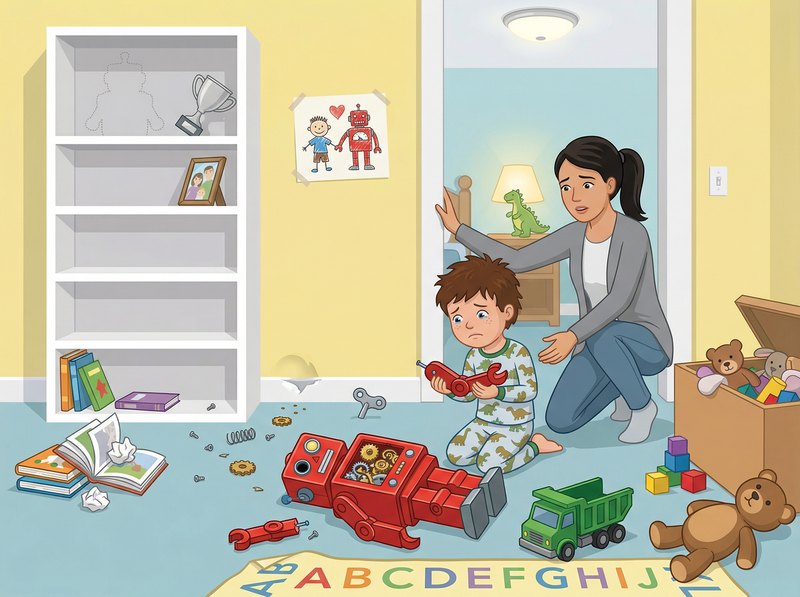
You found your child's favourite wind-up toy robot broken on the floor. Call a toy repair shop, describe the robot, and explain what is damaged.
30-second plan: open the call. What it is and how it broke. Tin, red, square head, grey boots. Then the damage: chest open, parts on the carpet, arm off, key out, one eye dark. Ask two questions. Thank them.
Task 8: model answer
137 words, 0:56 of a 60-second limit. Written by Celpify and read by an AI voice at a natural pace.
Show transcript
Task 8 is a role play, and the official strategy is to set up the call at the start and finish it properly at the end. The answer does both, from Hi, is this the toy repair shop? to Thanks so much. In between, it describes the robot the way a repair shop would need it: what it looks like first, then what's broken, one piece at a time.
This is also the answer we rewrote. Our original Test 1 version put the robot on a table, gave it a round head, and ran to 251 words. The picture shows a boxy robot on a bedroom floor, and 251 words won't fit in 60 seconds. Describe the picture on the screen, even when it isn't what you expected. The Task 8 unusual situation guide has more practice on describing things the listener can't see.
How to Score Your Own CELPIP Speaking Practice
Compare your recording to the model on the four areas raters listen for.
Each CELPIP speaking response is rated by two or three trained raters, and they don't count errors. They listen across four areas, which CELPIP publishes as its performance standards. Play your recording back and ask one question for each:
| Area | What it covers | Ask yourself |
|---|---|---|
| Content/Coherence | Number and quality of ideas, organisation, examples | Did I give reasons and details, or just claims? |
| Vocabulary | Word choice, range, precision | Did I repeat the same few words? |
| Listenability | Rhythm, pronunciation, pauses, grammar and sentence variety | Could a stranger follow me the first time? |
| Task Fulfillment | Relevance, completeness, tone, length | Did I answer every part, in the right tone, using most of the time? |
One warning before you replay our answers too many times. CELPIP asks every test taker for spontaneous, original responses, and memorised content can get results invalidated. Borrow the structure and use your own sentences. Your version of Task 3 should describe the same office in your own words.
Once you know roughly where you stand, the CELPIP speaking score chart shows how each level lines up with CLB. All eight Test 1 tasks are free to practise on Celpify, with feedback on your recording, starting with the Task 5 office layout question.
The plan behind each of these answers, task by task and second by second, is on our CELPIP speaking templates page.
Sources & further reading
Official CELPIP sources for the task timings, strategies and scoring described on this page.
- CELPIP Test FormatOfficial structure of the Speaking test and its eight tasksOfficial CELPIPcelpip.ca
- CELPIP Guidebook for Test Takers (July 2026)Speaking takes about 15 minutes; names of all eight tasksOfficial CELPIPcelpip.ca
- CELPIP Speaking Pro Study Pack, Tasks 1 to 4Performance standards and key strategies for Tasks 1 to 4Official CELPIPcelpip.ca
- CELPIP Speaking Pro Study Pack, Tasks 5 to 8Task 5 to 8 strategies and the Level 12 Task 5 sample transcriptOfficial CELPIPcelpip.ca
- CELPIP Score Comparison ChartReal test-taker speaking responses with audio and transcripts at each levelOfficial CELPIPcelpip.ca
- Using CELPIP Sample Responses in the ClassroomTwo or three raters per response; memorised or copied content can invalidate resultsOfficial CELPIPcelpip.ca