English Test for Canadian Citizenship: Every Accepted Proof
There isn't one English test for Canadian citizenship. The language requirements for Canadian citizenship fit in one sentence: if you're 18 to 54 on the day you sign your application, IRCC needs proof that you can speak and listen in English or French at Canadian Language Benchmark (CLB) level 4 or higher. A test result is one kind of proof, and canada.ca lists four others.
So do you need a language test for Canadian citizenship? Often you don't. You may already hold proof that costs nothing: a diploma from a program taught in English, the test results they sent with their PR application, or a LINC certificate. If you do need a test, the English ones IRCC accepts are CELPIP-General LS (or the full CELPIP-General), IELTS General Training and PTE Core. Only listening and speaking count.
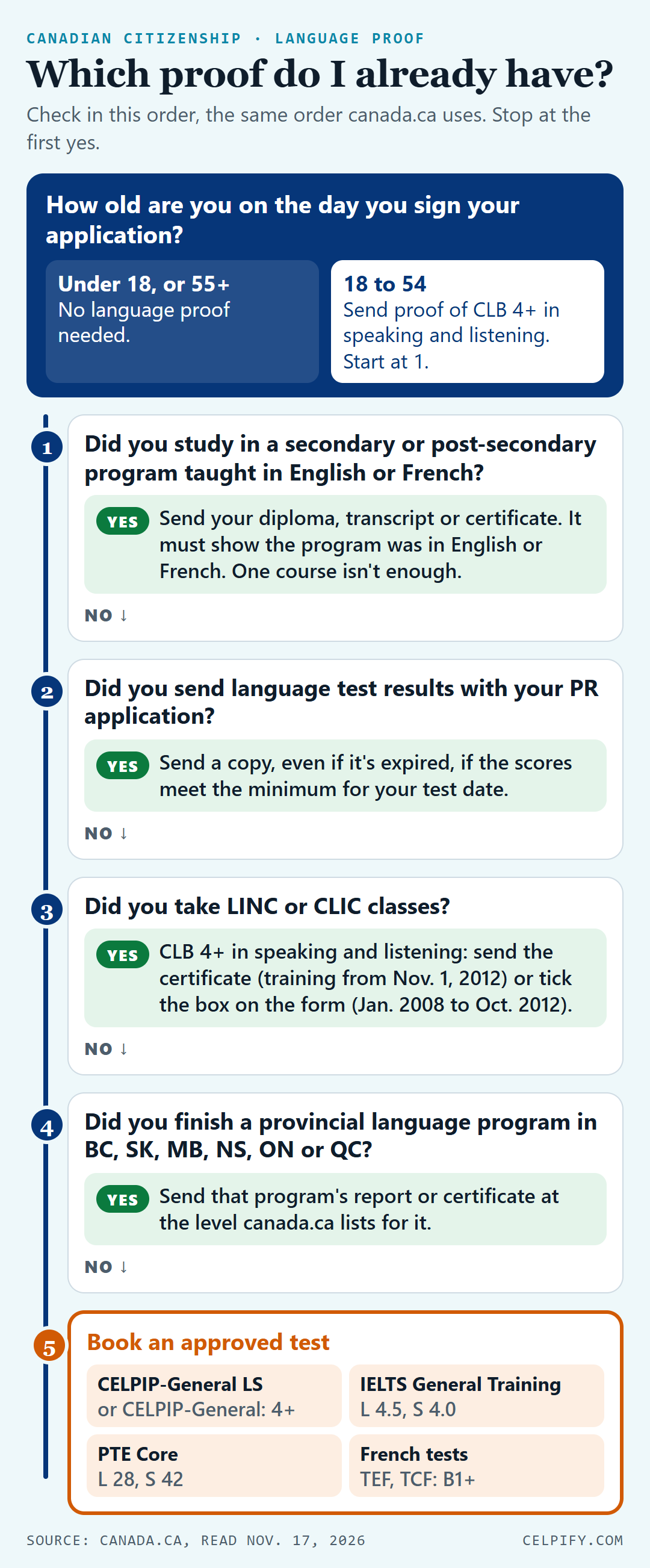
Check your own files before you book anything. The chart below follows the order of canada.ca's five language proof steps.
Who Needs Language Proof for Citizenship: the 18-54 Rule
It comes down to your age on one specific day: the day you sign your application.
canada.ca puts it this way: if you're between 18 and 54 years old on the day you sign your application, you must show "an adequate knowledge of English or French". Adults aged 55 and above don't need to prove their language skills, and neither do children under 18. The signing date is what counts. Sign a week before your 55th birthday and you still need proof.
That's the citizenship language requirement. canada.ca says "adequate knowledge" means you can:
take part in short, everyday conversations about common topics
understand simple instructions, questions and directions
use basic grammar, including simple structures and tenses
show you know enough common words and phrases to answer questions and express yourself
Those speaking and listening skills equal CLB 4 in English or NCLC 4 in French. The English language requirement for Canadian citizenship and the French one are the same level.
Your document isn't the only check
IRCC reviews the proof you send. It also notes "how well you speak when talking to a citizenship official at any time during the application process", and it can assess your level during a citizenship test with an official if it needs to. If your English is close to the line, passing a test isn't the whole job. Get used to talking about everyday things out loud, because an official may hear you speak.
The proof itself isn't optional. IRCC returns the entire application if your proof is missing, can't be read, or is in another language without a certified English or French translation. Adults 18 to 54 can also ask for a waiver of the language requirement; canada.ca's waiver page explains who qualifies.
The English Test Isn't the Citizenship Test
If you're 18 to 54, you have two separate requirements. One is language proof: CLB 4 in speaking and listening. The other is the citizenship test, which asks about the rights and responsibilities of Canadian citizens and Canada's history, geography, economy, government, laws and symbols. Passing one doesn't cover the other.
Every Language Proof IRCC Accepts for Citizenship
You only need one document, and four of the five kinds don't involve booking anything.
| Proof | What it must show | Cost |
|---|---|---|
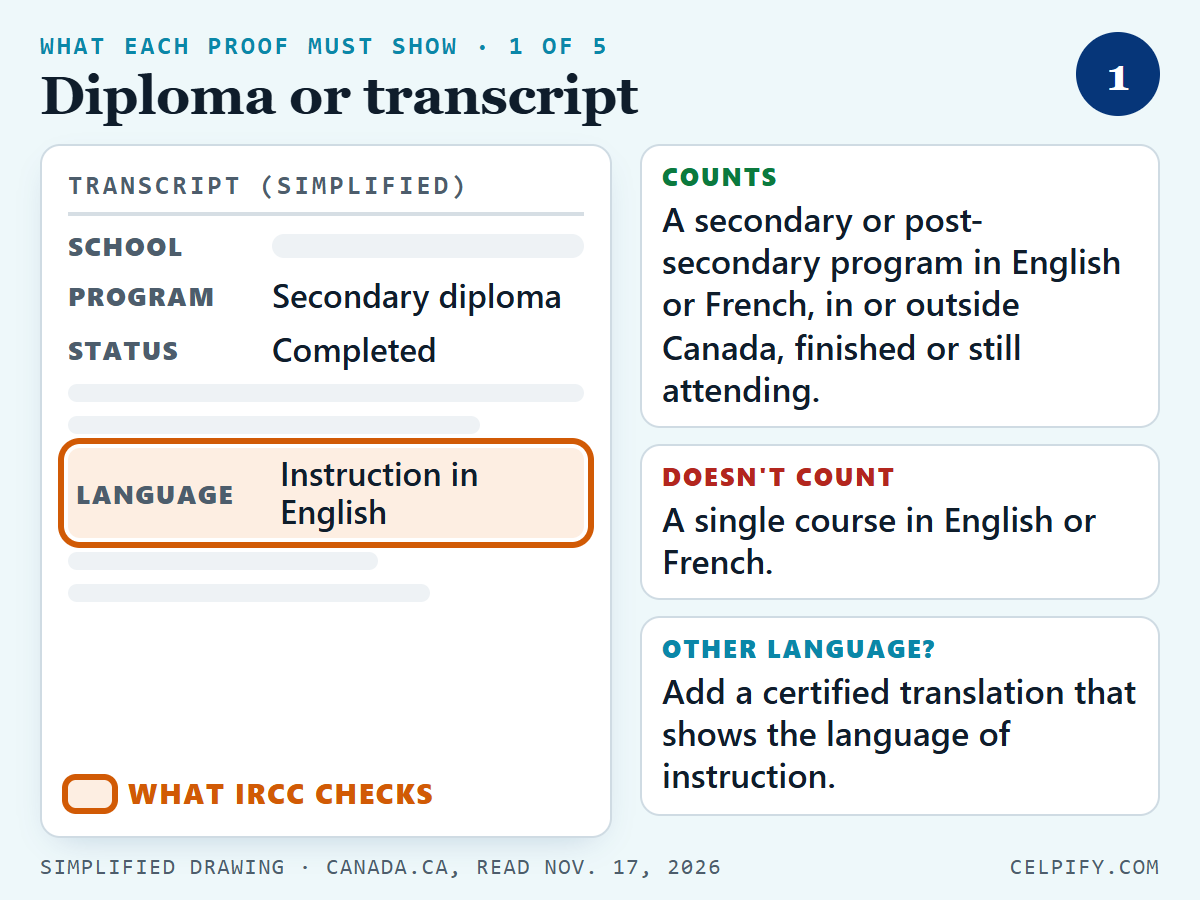
| Diploma, transcript or certificate | You finished, or are attending, a secondary or post-secondary program taught in English or French, in or outside Canada. A single course isn't enough. | Nothing, if you have it |
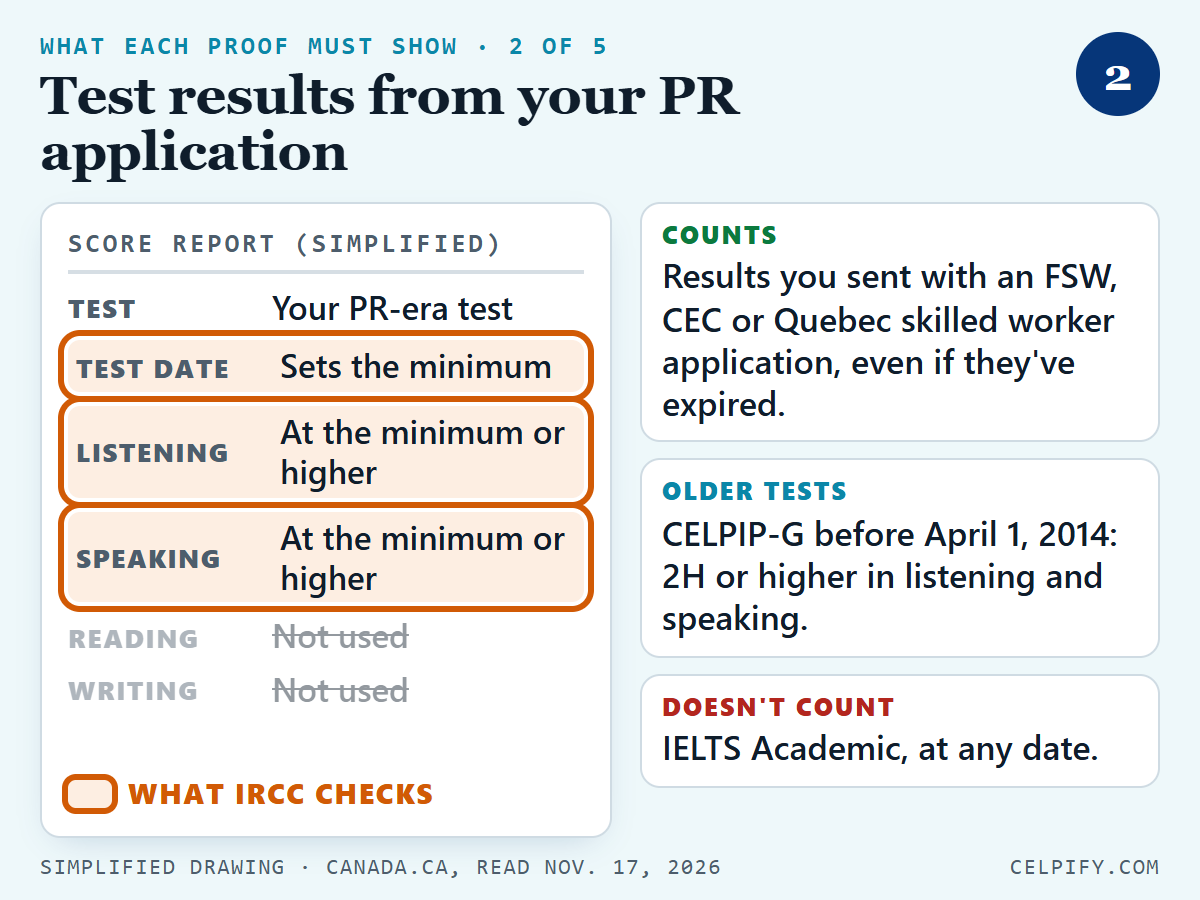
| Test results sent with your PR application | Listening and speaking at the minimum for that test and test date. Accepted even if they've expired. | Nothing |
| LINC or CLIC certificate | CLB 4 or higher in speaking and listening | Nothing |
| Provincial language program document | The level canada.ca lists for that program in BC, Saskatchewan, Manitoba, Nova Scotia, Ontario or Quebec | Nothing |
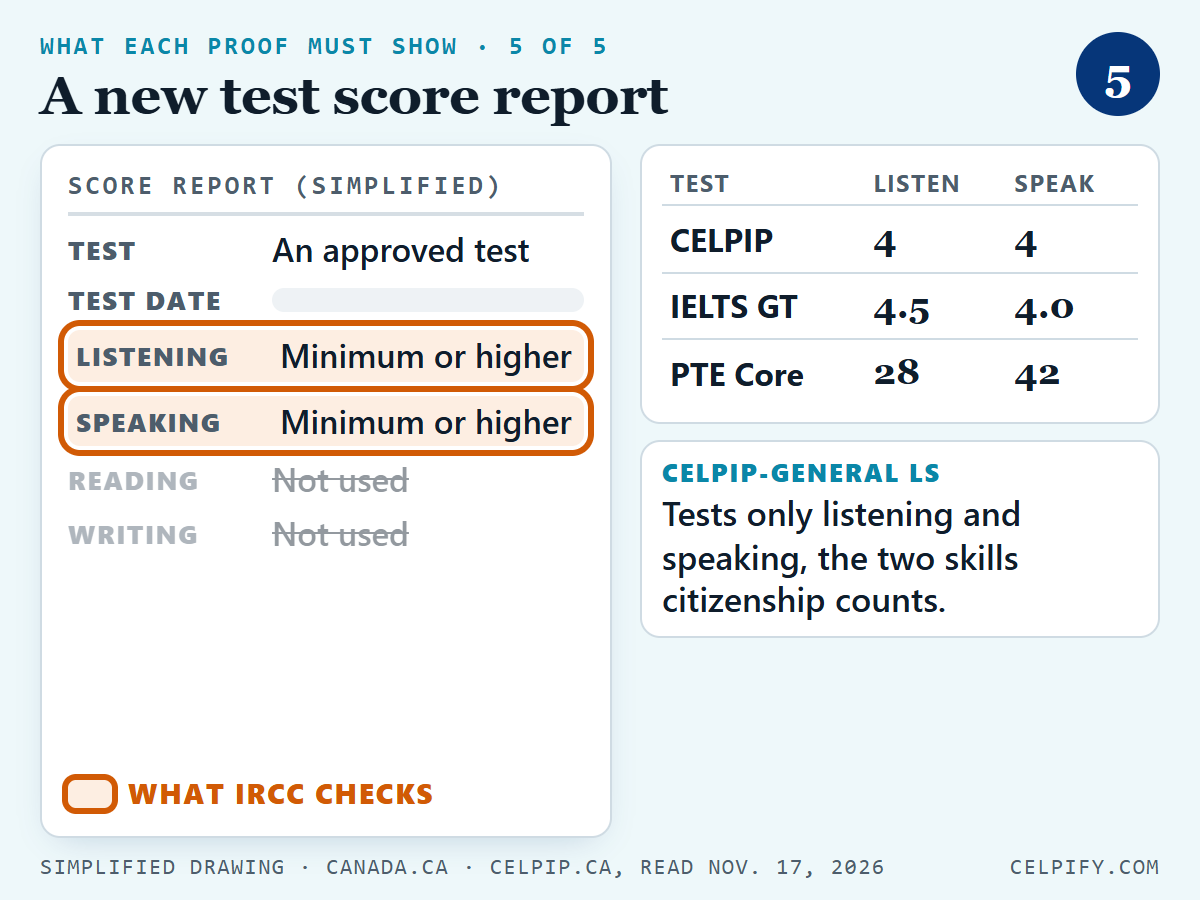
| A new approved test | Listening and speaking at the citizenship minimum | CELPIP-General LS: $199 plus taxes in Canada |
If a document isn't in English or French, send a certified English or French translation with it. For a diploma or transcript, the translation should show that the program was taught in English or French. The slides below show what IRCC looks for on each kind of language proof for Canadian citizenship.
Proof of language for Canadian citizenship: what each document must show
Simplified drawings, one per kind of proof. The orange boxes are what IRCC checks. Swipe or use the arrows.
LINC certificates, provincial programs and the CLB placement test
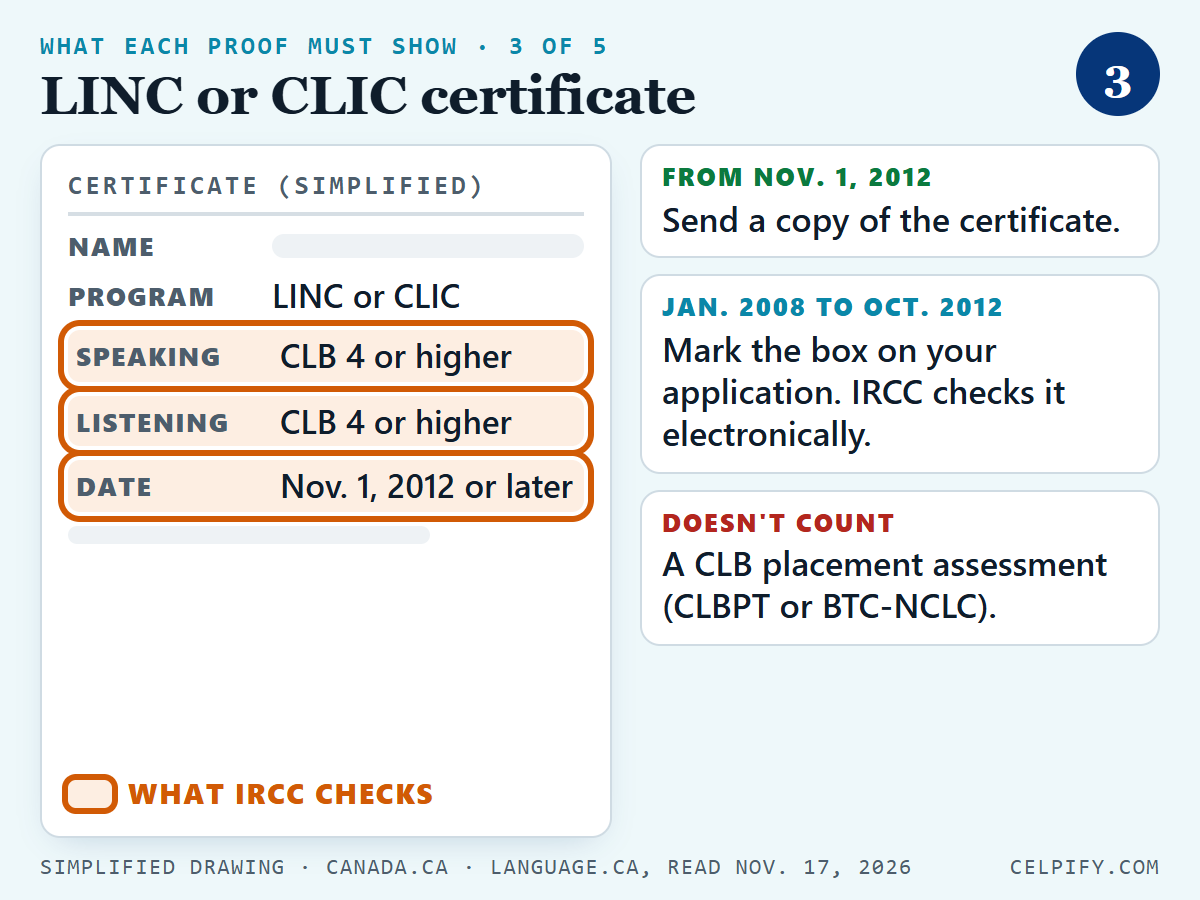
If you took government-funded language classes, your LINC certificate for citizenship (or CLIC, the French version) has to show CLB 4 or higher in speaking and listening. Trained on or after November 1, 2012? Send a copy of the certificate. If you trained between January 2008 and October 2012, you don't send anything: mark the box on your application and IRCC verifies it electronically.
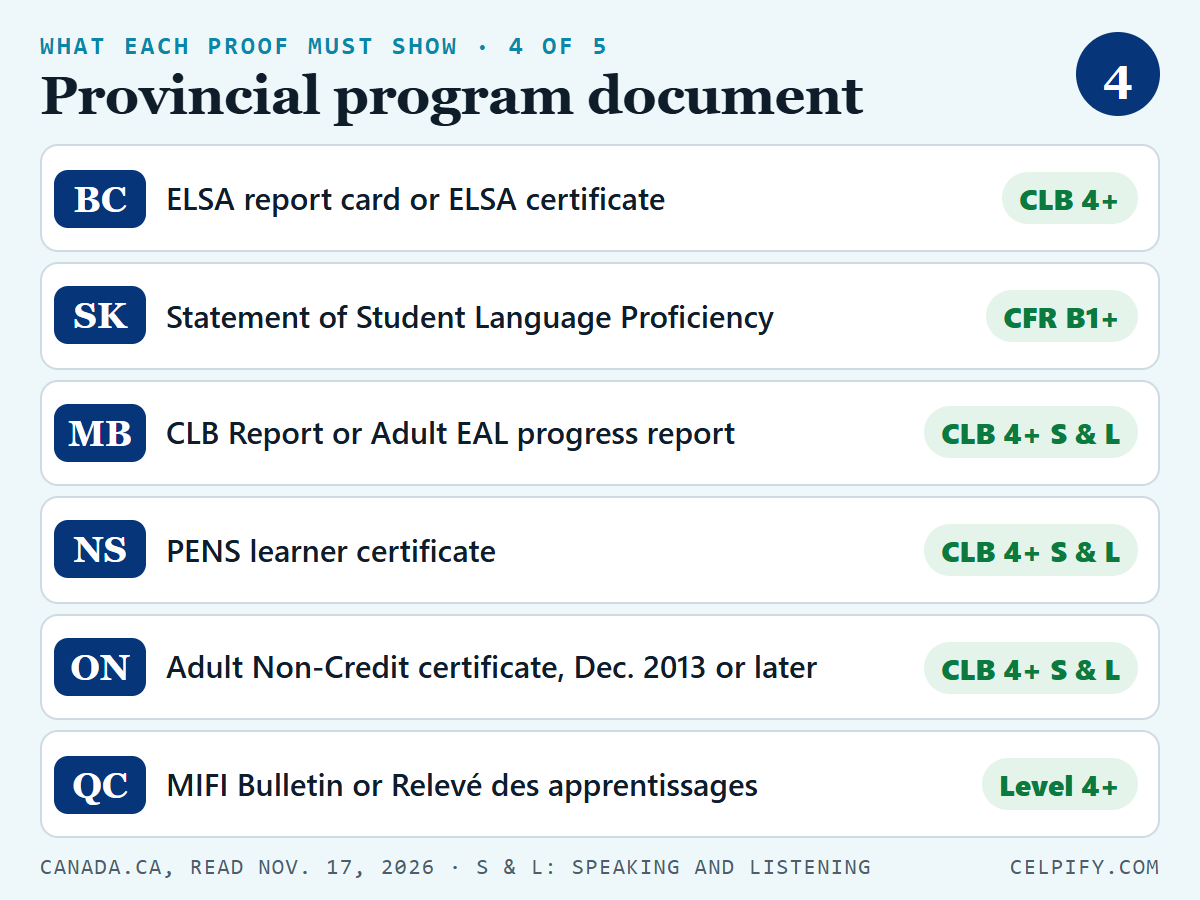
canada.ca also accepts documents from some provincial programs:
British Columbia: an ELSA certificate, or an ELSA report card for training after 2010, at CLB 4 or higher. Only ELSA results are accepted.
Saskatchewan: a Statement of Student Language Proficiency from the Ministry of Education, at CFR level B1 or above.
Manitoba: a Manitoba Canadian Language Benchmark Report or an Adult EAL student progress report, at CLB 4 or higher in speaking and listening.
Nova Scotia: a PENS learner certificate at CLB 4 or higher in speaking and listening.
Ontario: an Adult Non-Credit Language Training certificate at CLB 4 or higher in speaking and listening, dated December 2013 or later.
Quebec: a MIFI "Bulletin" or a "Relevé des apprentissages" at level 4 or higher on the Échelle québécoise. Which skills it has to show depends on its date.
Check your exact document against canada.ca's provincial program step before you send it.
One mix-up catches people. A Canadian Language Benchmark test for citizenship sounds like the right thing to book, but language.ca says "the CLBPT and BTC-NCLC are not accepted for Citizenship purposes". Those are placement tests, used to decide which class you start in. What counts as proof is the certificate you earn when you finish the course.
Which English Test for Canadian Citizenship, and the Score Each Needs
Three English tests qualify, and on each one only listening and speaking count.
Any of these counts as an English test for citizenship, as long as you reach the minimum in both skills:
| Test | Citizenship minimum | Watch out for |
|---|---|---|
| CELPIP-General or CELPIP-General LS | 4 or higher (up to 12) in listening and speaking | The LS version tests only those two skills |
| IELTS General Training | 4.5 in listening, 4.0 in speaking | IELTS Academic isn't accepted |
| PTE Core | 28 in listening, 42 in speaking | Speaking needs the higher number |
| French: TEF Canada, TEFAQ, TEF IRN, TCF Canada, TCFQ | B1 or higher in listening and speaking | DELF: B1 or higher. DALF: all results accepted |
If you're using IELTS for Canadian citizenship, only General Training works. If all you have is an IELTS Academic result, IRCC tells you to find other proof. It also won't take any other third-party test, "even if they're similar".
CELPIP-General LS is the version built for this job. celpip.ca says it "assesses only the Listening and Speaking skills required for the citizenship language requirement". It takes about 1 hour and 10 minutes in one sitting: Listening has 38 questions over 46 to 55 minutes, and Speaking has 8 tasks in 15 minutes. In Canada it costs $199 plus applicable taxes, and scores are online in 2 to 4 business days. We haven't listed IELTS or PTE Core fees, so check those on each test's own website when you book.
If you're still choosing, our guides compare CELPIP General or General LS, CELPIP vs IELTS and CELPIP vs PTE Core. If you already have a result, you can turn an IELTS or PTE Core score into a CLB level in a few seconds.
What CLB 4 Means: the Level 4 English Test for Citizenship in Practice
CLB 4 is everyday English, and you can hear what that sounds like further down.
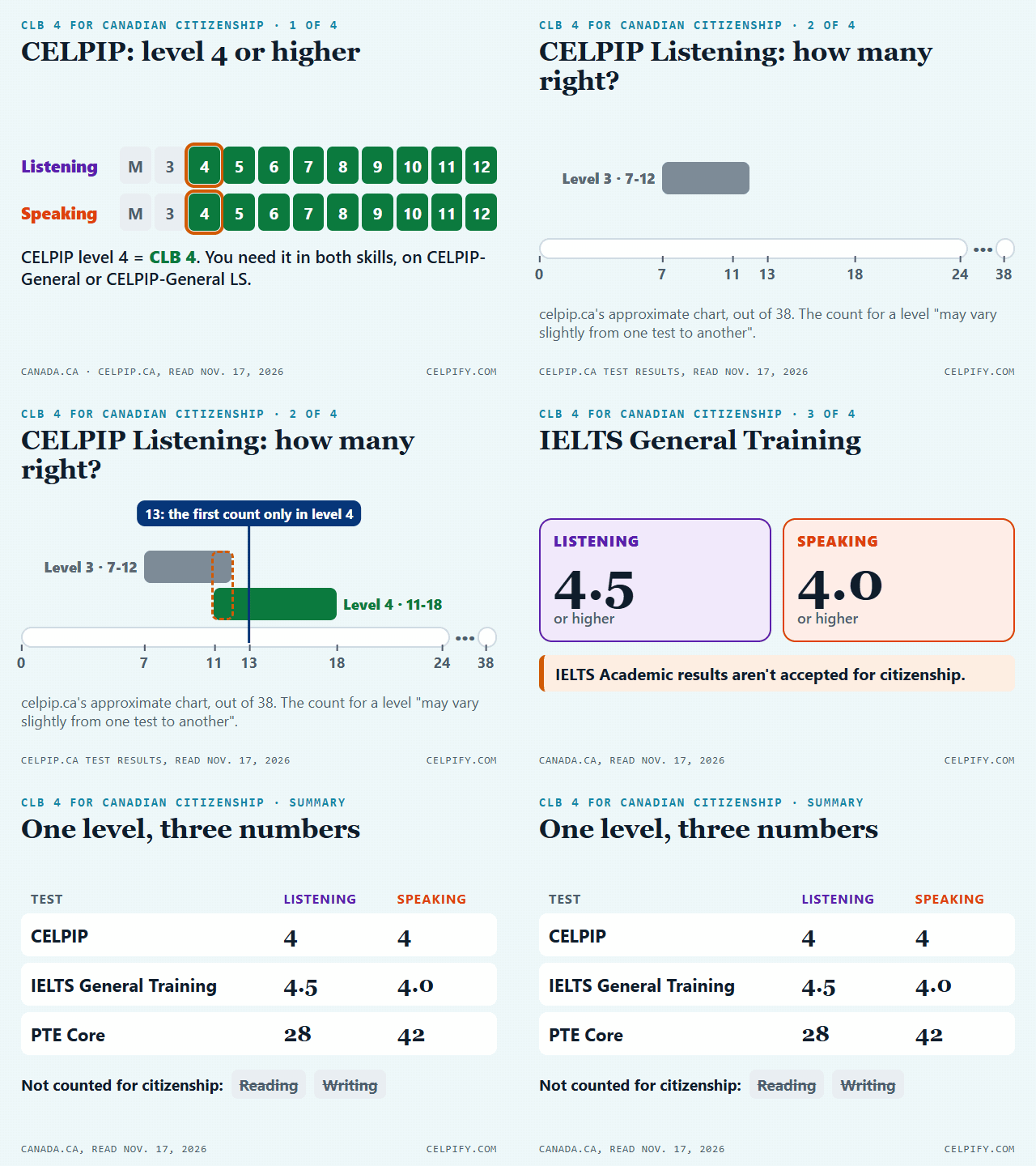
On CELPIP, level 4 is CLB 4. celpip.ca's chart describes it as "adequate proficiency for daily life activities", and citizenship asks for nothing higher.
How many Listening questions is level 4?
Listening is scored out of 38, and celpip.ca publishes an approximate chart that turns your count into a level. Level 3 is 7 to 12 correct. Level 4 is 11 to 18. The bands overlap, so 11 or 12 correct could land on either level, and 13 is the first count that sits only in level 4.
Use 13 as a rough target. The chart warns that the raw score for a level "may vary slightly from one test to another", because some questions are harder than others. Speaking has no count at all. Raters listen to your answers and give a level based on four areas: content and coherence, vocabulary, listenability, and task fulfillment.
Hear an everyday CELPIP conversation
Celpify's free Test 1 gives you a feel for it. Its Listening Part 3 opens with a woman who has "just moved to the neighbourhood" asking a recreation coordinator about spring programs. It's the short, everyday kind of conversation CLB 4 describes. Play the first 44 seconds once, take notes like you would on test day, and then answer the question under it.
Test 1 Listening Part 3: a newcomer at the community centre
The first 44 seconds of the conversation from Celpify's free Test 1, Part 3. AI-generated voices, not official CELPIP audio. On test day you hear the whole conversation once, then the questions.
One play, then answer
Keep the transcript closed. On the real test the clip starts by itself and can't be paused, so jot down dates and names as you hear them.
Show transcript
Check what you heard
On the real test this question is read aloud after the conversation and the four options appear on screen. Here it's written out. Pick one to see why each option is right or wrong.
Question 1. Who may register on March third?
Show the answer to question 1
Answer: A. Current members and people returning to programs. Kevin says early registration opens on Monday, March third, "but that's only for current members and returning participants." Option A says the same thing with different words: returning participants are people coming back to programs.
- B.That's the woman's situation, and she works out that her date is March tenth "since I'm new."
- C.Families aren't part of the March third rule. Kevin ties that date to members and returning participants only.
- D.The fifteen-dollar fee is for registering after March twenty-eighth. It's a penalty for being late, not a way in early.
In Test 1 the full conversation runs about two minutes, with six questions. You can practise CELPIP Listening and practise CELPIP Speaking on their own, since those are the only two skills the LS test checks.
The test maker explains level 4 itself in the video below. The official CELPIP channel streamed this session for citizenship applicants in November 2020. The video starts at its Speaking half, where a CELPIP presenter plays one test taker's Task 1 answer and explains why it reaches level 4 but not level 5. It's from 2020, so trust celpip.ca over the video for current fees and test-day rules.
CELPIP LS Listening and Speaking Levels 4 and 5, Citizenship Edition (official CELPIP live session, November 2020)
Can You Use Old or Expired Test Results for Citizenship?
Yes, if they're the results you sent with your PR application. That's the case canada.ca spells out.
canada.ca's second language proof step asks one question: "Did you submit language test results when you applied for permanent residence?" If you did, and the results are high enough, it tells you to "include a copy of your test results (even if they're expired) with your citizenship application." IRCC's Help Centre names the applications this covers: the federal skilled worker class, the Canadian experience class and the Quebec-selected skilled worker program.
So can you use an expired CELPIP for citizenship? Yes, if it's the result you sent with one of those PR applications. Older results are judged on the scale in use when you took the test:
CELPIP-G taken on or before March 31, 2014: 2H or higher in listening and speaking. From April 1, 2014: 4 or higher.
IELTS General Training taken on or before November 27, 2008: 4.0 or higher in listening and speaking. From November 28, 2008: 4.5 in listening and 4.0 in speaking.
TEF Canada taken on or before June 30, 2012: level 3 or higher in listening and speaking. From July 1, 2012: B1 or higher.
IELTS Academic doesn't count, whatever the date.
Compare that with the usual CELPIP rule. CELPIP scores are "valid for two years from the date your score report is issued", and that's the window Express Entry and the PGWP check. The citizenship path for PR results doesn't apply it. Our guide on how long CELPIP results stay valid for each program sets the programs side by side.
What about an old result you never sent to IRCC, like a CELPIP LS score from a few years ago? canada.ca's page for new tests lists minimum results and no date limit. It doesn't say "even if they're expired" either. If your result is old and wasn't part of a PR application, ask IRCC before you rely on it.
Cheapest and Fastest Way to Prove Your English for Citizenship
The cheapest proof is the one already in your files.
Go down this list in order and stop at the first thing you have:
A diploma, transcript or certificate from a program taught in English or French.
The test result you sent with your PR application, expired or not, if it meets the minimum.
A LINC, CLIC or provincial program certificate at CLB 4 in speaking and listening.
Only then, a test. CELPIP-General LS is the CELPIP made for citizenship, and at about 1 hour and 10 minutes it's the shortest CELPIP you can book. Choose the full CELPIP-General instead only if you'll also need CELPIP scores for PR or a work permit. Our guide to which CELPIP test to book for citizenship and how to prepare covers that choice.
Where can you do your English test for Canadian citizenship? CELPIP runs at test centres across Canada, and celpip.ca's Find a Test Date page shows upcoming dates by location. Our guide on how to register for CELPIP walks through the booking.
Searching for a free English test for Canadian citizenship as a PDF? IRCC doesn't publish one. It accepts a document from the list above or a result from an approved test, and nothing else. The free part is practice: Celpify's Test 1 Listening and Speaking questions are free to try.
Sources & further reading
The official pages behind every rule, score and fee on this page, read on November 17, 2026.
- Who can apply for citizenship (Government of Canada)Age on the day you sign, what adequate knowledge means, how IRCC checks it, the 55+ exemption and the citizenship testIRCC · Government of Canadacanada.ca
- Language proof for citizenship, step 1: educationCLB 4 in speaking and listening, returned applications and proof from a program in English or FrenchIRCC · Government of Canadacanada.ca
- Language proof, step 2: results sent with a PR applicationResults accepted even if they're expired, the older score scales and IELTS General Training onlyIRCC · Government of Canadacanada.ca
- Language proof, step 3: LINC or CLICCLB 4 in speaking and listening and the November 1, 2012 dateIRCC · Government of Canadacanada.ca
- Language proof, step 4: provincial language programsThe documents and levels accepted from BC, Saskatchewan, Manitoba, Nova Scotia, Ontario and QuebecIRCC · Government of Canadacanada.ca
- Language proof, step 5: get testedEvery accepted test and its citizenship minimumIRCC · Government of Canadacanada.ca
- IRCC Help Centre: language tests for citizenshipNo other third-party tests, and reusing results sent with FSW, CEC and Quebec skilled worker applicationsIRCC · Government of Canadaircc.canada.ca
- Waiver for citizenship requirementsAdults can request a waiver of the language requirementIRCC · Government of Canadacanada.ca
- For immigration or citizenship (Centre for Canadian Language Benchmarks)The CLBPT and BTC-NCLC aren't accepted for citizenshipCLB · language.calanguage.ca
- CELPIP LS for Canadian citizenshipLS length, sections, fee and results timeOfficial CELPIPcelpip.ca
- CELPIP test resultsLevel 4 equals CLB 4, the approximate Listening chart and results in 2-4 business daysOfficial CELPIPcelpip.ca
- CELPIP test format and scoringScores are valid for two years from the date the score report is issuedOfficial CELPIPcelpip.ca
- CELPIP LS Listening and Speaking Levels 4 and 5, Citizenship Edition (official CELPIP channel, 2020)A CELPIP presenter marks a level 4 Speaking answer against the four scoring areasOfficial CELPIP · YouTubeyoutube.com