CELPIP Vocabulary List: 30 Words in Test-Style Audio

Most CELPIP vocabulary lists are silent. You get a page of synonyms and idioms, but you never hear the words the way the Listening test plays them, inside a full sentence and only once.
This list has sound. We took 30 words and phrases from Celpify's free Test 1 and cut a short clip of the sentence where each one is used. Most come from Listening Parts 1, 2, 4 and 6. The rest come from the model answers on our CELPIP speaking test sample. Each of the 30 CELPIP vocabulary words has a plain meaning and a tag for the part or task where you hear it. Play the clip, then say the sentence out loud yourself.
Two things to know before you press play. These clips are Celpify practice material written in the CELPIP format, not words copied from the real test. And the voices are AI-generated, so use them as clear practice audio rather than as a model of a Canadian accent.
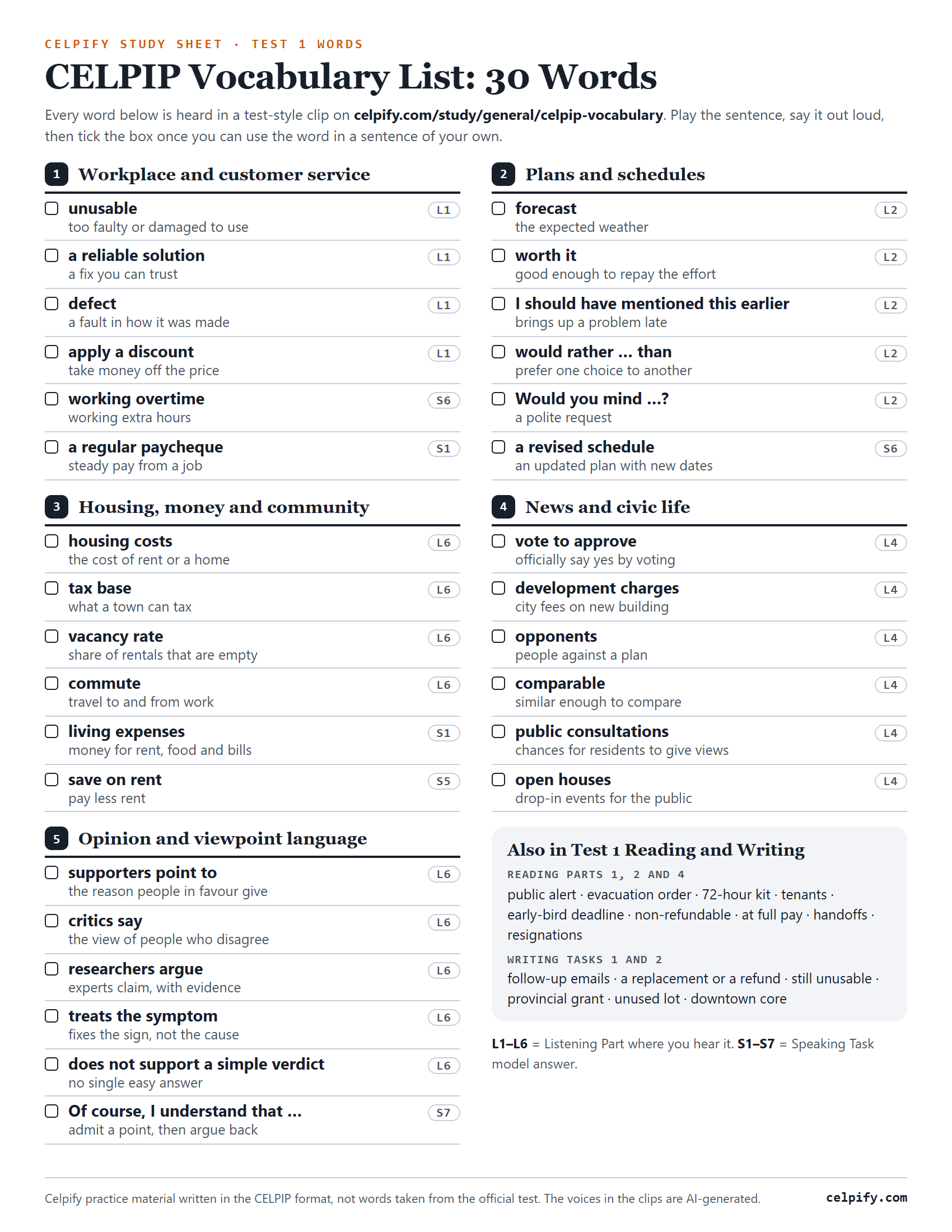
If you were looking for a CELPIP vocabulary PDF, this sheet does the same job with no sign-up. Open the full-size sheet, then print it on one letter-size page or save it to your phone. Tick a word once you can use it in a sentence of your own.
How CELPIP Raters Judge Vocabulary
Vocabulary is one of the four things raters score in Speaking and in Writing. Rare words aren't on the list.
CELPIP's performance standards for Speaking and Writing list the same four factors under Vocabulary: word choice, suitable use of words and phrases, range of words and phrases, and precision and accuracy. The guiding question is short: "What is the range of your vocabulary and can you use it naturally?"
Notice the word naturally. A rare word in the wrong place costs you on suitable use and on precision. A common word used exactly right helps on both. The official Writing study pack says a Level 9 writer can "choose words and phrases to provide accurate details, descriptions, and comparisons." Accurate, not fancy.
Swaps that sound clever but go wrong
On October 12, 2026, Google's AI summary for "celpip vocabulary" suggested upgrades like the ones below. Each one changes the meaning, or makes the tone far too formal for a friendly email or a spoken answer.
| Suggested swap | What goes wrong | Say instead |
|---|---|---|
| understand → decipher | You decipher a code or messy handwriting, not a coworker's idea. | understand, follow, see |
| think → deduce | Deduce means you worked something out from evidence. It doesn't mean "believe." | think, believe, feel |
| a lot of → myriad | Rare and very formal. "A myriad of problems" sounds forced when you speak. | many, plenty of, a wide range of |
| important → paramount | It means more important than anything else. Most things aren't. | important, key, a top priority |
| fix → mend | People mend clothes or fences. You fix or repair a printer. | fix, repair, sort out |
Which words should you learn, then? Good vocabulary for CELPIP is mostly ordinary words used precisely. The 30 below are what speakers in test-style audio actually say, and you can use any of them in your own answers without sounding like a thesaurus.
Workplace and Customer Service Vocabulary
Listening Part 1 in Test 1 is a print-shop problem: a customer's colour pages keep coming out with a pink band. Two phrases come from Speaking model answers about work.
Workplace and customer service
Listening Part 1 and Speaking Tasks 1 and 6. Press play to hear each sentence.
- unusableListening Part 1
so faulty or damaged that you can't use it
The black-and-white draft looked normal, but the colour version is unusable.
- a reliable solutionListening Part 1
a fix you can trust to work every time
I have twenty colour handouts and two posters to finish, so I really need a reliable solution.
- defectListening Part 1
a fault in the way something was made
It is a different model, so it should not have the same defect.
- apply a discountListening Part 1
take some money off the price
I will move the job to the backup printer if this quick test fails, and I will apply a discount for the delay.
- working overtimeSpeaking Task 6
working more hours than your normal schedule
They've been working overtime for a month already, and if we push any harder, mistakes will start slipping through.
- a regular paychequeSpeaking Task 1
steady pay from a job (Canadian spelling: cheque)
You'd keep a regular paycheque and your benefits, but you'd also get one full day for photography.
Several of these double as CELPIP writing vocabulary. Test 1's Writing Task 1 asks you to complain about a laptop that is "still unusable" after "two follow-up emails," with nobody offering "a replacement or a refund." Unusable, defect and apply a discount would all fit in that email. For openers, purpose statements and sign-offs, see our CELPIP Writing Task 1 vocabulary guide.
Plans and Schedules: Everyday Conversation Words
Listening Part 2 is a daily life conversation. In Test 1, two coworkers change a weekend hike, and the polite phrases tell you what's really going on.
Plans and schedules
Listening Part 2 and Speaking Task 6.
- forecastListening Part 2
what the weather is expected to be
The forecast for Saturday looks perfect. Should we finally do Eagle Ridge?
- worth itListening Part 2
good enough to repay the time or effort
It is a tougher climb than Lakeshore, but the lookout should be worth it.
- I should have mentioned this earlierListening Part 2
a polite way to bring up a problem late
I should have mentioned this earlier. My partner's parents are arriving from Kingston around nine on Saturday.
- would rather … thanListening Part 2
prefer one choice to another
I would rather change the plan than have you rush through the visit.
- Would you mind …?Listening Part 2
a polite way to ask someone for a change
Would you mind switching to the Lakeshore Loop? It is eight kilometres instead of twelve, so we could start later after a busy Saturday.
- a revised scheduleSpeaking Task 6
an updated plan with new dates or times
If it helps, I'll put together a revised schedule this afternoon, so you have something concrete to show them.
Listen for "I should have mentioned this earlier." It's the moment the plan changes, and Question 2 in Test 1 depends on it: the man is interested, but he has a family obligation. If you only noted the times and the trail names, you'd miss it.
Housing, Money and Community Vocabulary
Four of these come from Listening Part 6, a talk about remote workers moving to smaller towns. Two come from Speaking answers about money.
Housing, money and community
Listening Part 6 and Speaking Tasks 1 and 5.
- housing costsListening Part 6
what people pay to rent or own a home
Some employees have left expensive cities for smaller communities with lower housing costs.
- tax baseListening Part 6
all the income and property a town can collect tax on
Town officials say the added customers helped fill empty storefronts and expanded the municipal tax base.
- vacancy rateListening Part 6
the share of rental homes that are empty and available
A regional housing survey also found rental vacancy rates below one percent in nearly two thirds of the towns receiving the largest influxes.
- commuteListening Part 6
travel to and from work every day
Some employers report that staff now commute from neighbouring towns because they cannot rent near the communities they serve.
- living expensesSpeaking Task 1
the money you need for rent, food and bills
I'd save at least six months of living expenses first, because a new business can take a year or two to bring in a steady income.
- save on rentSpeaking Task 5
pay less for the space you rent
I understand why hot-desking sounds attractive, because it saves on rent …
Everyday Canadian terms such as health card and stat holiday have their own page, along with notes on the accent and on spelling: Canadian English for CELPIP: Accent and Spelling Guide.
News and Civic Vocabulary (Listening Part 4)
Part 4 is a news item read by one speaker. In Test 1 it's a city council vote on a light-rail line, so most of the words are about voting on the project and paying for it.
News and civic life
Listening Part 4.
- vote to approveListening Part 4
officially say yes to a plan by voting
Riverdale City Council voted eight to three last night to approve a fourteen-kilometre light-rail extension from downtown to Westpark.
- development chargesListening Part 4
fees a city charges on new building projects to help pay for services
The city will finance the remaining thirty-five percent through municipal bonds and development charges on new Westpark housing.
- opponentsListening Part 4
people who are against a plan or idea
Councillor Derek Fong, one of the three opponents, argued for bus rapid transit instead.
- comparableListening Part 4
similar enough that you can fairly compare them
He said a comparable bus network could open within eighteen months for about half the price.
- public consultationsListening Part 4
meetings or surveys where residents give their views on a plan
Public consultations on station design and the construction schedule will begin next month, before the plans are finalized.
- open housesListening Part 4
events where the public can drop in, look and ask questions
Residents may comment online or attend two open houses in November.
These clips are single sentences from the report. To hear the whole Part 4 news item and answer its questions, along with Parts 5 and 6, try our CELPIP listening practice for Parts 4 to 6.
Opinion and Viewpoint Language (Part 6 and Speaking Task 7)
Listening Part 6 sorts views by who holds them, and Speaking Task 7 asks for your own. The same phrases help with both.
Opinion and viewpoint language
Listening Part 6 and Speaking Task 7.
- supporters point toListening Part 6
the reason that people in favour give
Supporters point first to local business activity.
- critics sayListening Part 6
this is the view of people who disagree
Higher-income newcomers did not create the existing shortage, critics say, but their ability to pay more intensified competition.
- researchers argueListening Part 6
experts make this claim and back it with evidence
Housing researchers argue that migration alone does not explain why outcomes differ from town to town.
- treats the symptomListening Part 6
deals with the sign of a problem, not its cause
Restricting newcomers treats the symptom, whereas increasing supply and planning infrastructure addresses the underlying constraint.
- does not support a simple verdictListening Part 6
the facts don't point to one easy answer
The evidence does not support a simple verdict.
- Of course, I understand that …Speaking Task 7
admits the other side's point before you answer it
Of course, I understand that some people feel lonely at home, and some projects really do need face-to-face meetings.
The official Listening study pack says the Part 6 speaker "will use low-frequency and specialized language," and it tells you to "identify who is mentioned, what their opinions are, and why." In Test 1, supporters, critics and researchers each get a turn. Treat those words as signposts and note who holds which view.
In Speaking Task 7, "Of course, I understand that…" does a different job. It admits the other side's point before you come back to yours, so your opinion sounds fair instead of stubborn.
CELPIP Listening Vocabulary Is Mostly Paraphrase
Answer options rarely repeat the speaker's words, so you need to recognize an idea when it comes back in new ones.

The official Listening study pack is blunt about this: "You should never expect the correct answer choice, or any answer choice, to be stated in the exact same words that were said in the audio clip." In the animation, "about five minutes" becomes "quick" and "lookout" becomes "viewpoint." In the Part 6 example, a number turns into a description: "below one percent" becomes "extremely scarce."
We write Celpify's listening questions the same way, so the right option usually restates the idea instead of repeating it. That should change how you study CELPIP listening vocabulary. Learn words in pairs: when lookout goes into your notebook, viewpoint goes next to it. And practise turning numbers and details into describing words, because answer options often do exactly that.
The same pack backs the audio approach on this page. It tells you to "use the Listening transcripts as sources of new vocabulary," keep a vocabulary journal, and "listen to how the speaker says it in the audio." The Reading pack gives the same advice for reading passages, which is where the CELPIP reading vocabulary on the printable sheet comes from: public alert, non-refundable and handoffs are all from Test 1's reading texts. For more on the listening side, see our CELPIP listening tips, or try a full part in the CELPIP listening sample test.
CELPIP Speaking Vocabulary for Pictures (Tasks 3 and 4)
In Tasks 3 and 4 you talk about a picture. Exact nouns and present-continuous verbs do most of the work.
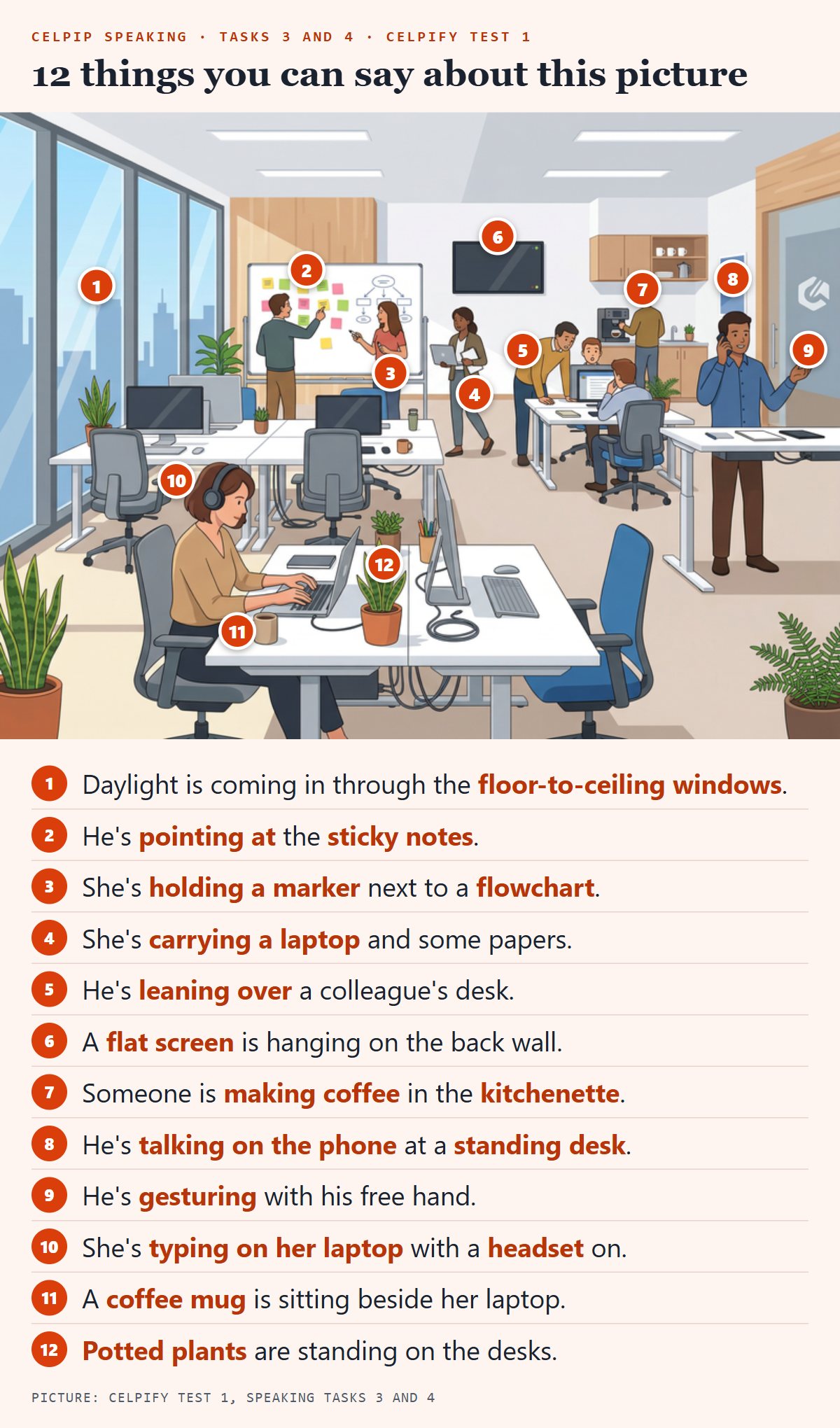
Each label puts something you can see together with what's happening: He's leaning over a colleague's desk. Someone is making coffee in the kitchenette. That's most of what Speaking Task 3, Describing a Scene, asks for. Start with the place in one sentence, then move across the picture in an order a listener can follow, left to right or front to back.
Task 4 uses the same picture but asks what will happen next, so the verbs change. In our Task 4 model answer, the pair at the whiteboard will probably call the rest of the team over, and the man on the phone will hang up and hurry over.
Don't memorize a block of picture phrases to recite on test day. A label only helps if that thing is in the picture you get, and celpip.ca warns that memorized or copied content can get test results invalidated. Use the labels to build up your words, then describe the picture in front of you.
Sources & further reading
The official CELPIP sources behind the scoring and test-format facts on this page.
- CELPIP Test ResultsVocabulary is one of four scored dimensions in Speaking and in WritingOfficial CELPIPcelpip.ca
- CELPIP Test Format and ScoringNames of the Listening parts and Speaking tasks used on this pageOfficial CELPIPcelpip.ca
- CELPIP Speaking Pro Study Pack, Tasks 1 to 4Speaking performance standards: the four Vocabulary factors and the guiding question (p. 3)Official CELPIPcelpip.ca
- CELPIP Writing Pro: Target 9+ Study PackWriting Vocabulary factors (p. 3) and the Level 9 vocabulary descriptor (p. 4)Official CELPIPcelpip.ca
- CELPIP Listening Pro Study PackParaphrase in answer options (p. 5), Part 6 language (p. 11), learning words from transcripts (p. 12)Official CELPIPcelpip.ca
- CELPIP Reading Pro Study PackUsing reading passages as sources of new vocabulary (p. 10)Official CELPIPcelpip.ca
- Using CELPIP Sample Responses in the ClassroomMemorized or copied content can lead to invalidated resultsOfficial CELPIPcelpip.ca