CELPIP Listening Practice: Parts 4 to 6 with Audio

After Part 3, the CELPIP Listening test stops reading the questions aloud. In Parts 4, 5 and 6 you hear one longer clip, and then all the questions for that part appear together on one screen. You can answer them in any order, and one timer covers the whole screen.
This page is CELPIP listening practice for that switch. It has three full clips from Celpify's free Test 1: a news item, a discussion between three colleagues and a talk that presents several viewpoints. Under each clip is its full question block. Pick an option and you'll see why it's right or wrong, along with a reason for every other option. The transcripts come after the answers, hidden until you open them.
The voices are AI-generated practice recordings made for Celpify, not official CELPIP audio.
Two claims that turn up in AI search summaries of this section are wrong. Part 5 doesn't test what people wear or what's on the table, and Part 6 isn't a debate between two speakers. The official CELPIP study pack says so on both counts, and we quote it below.
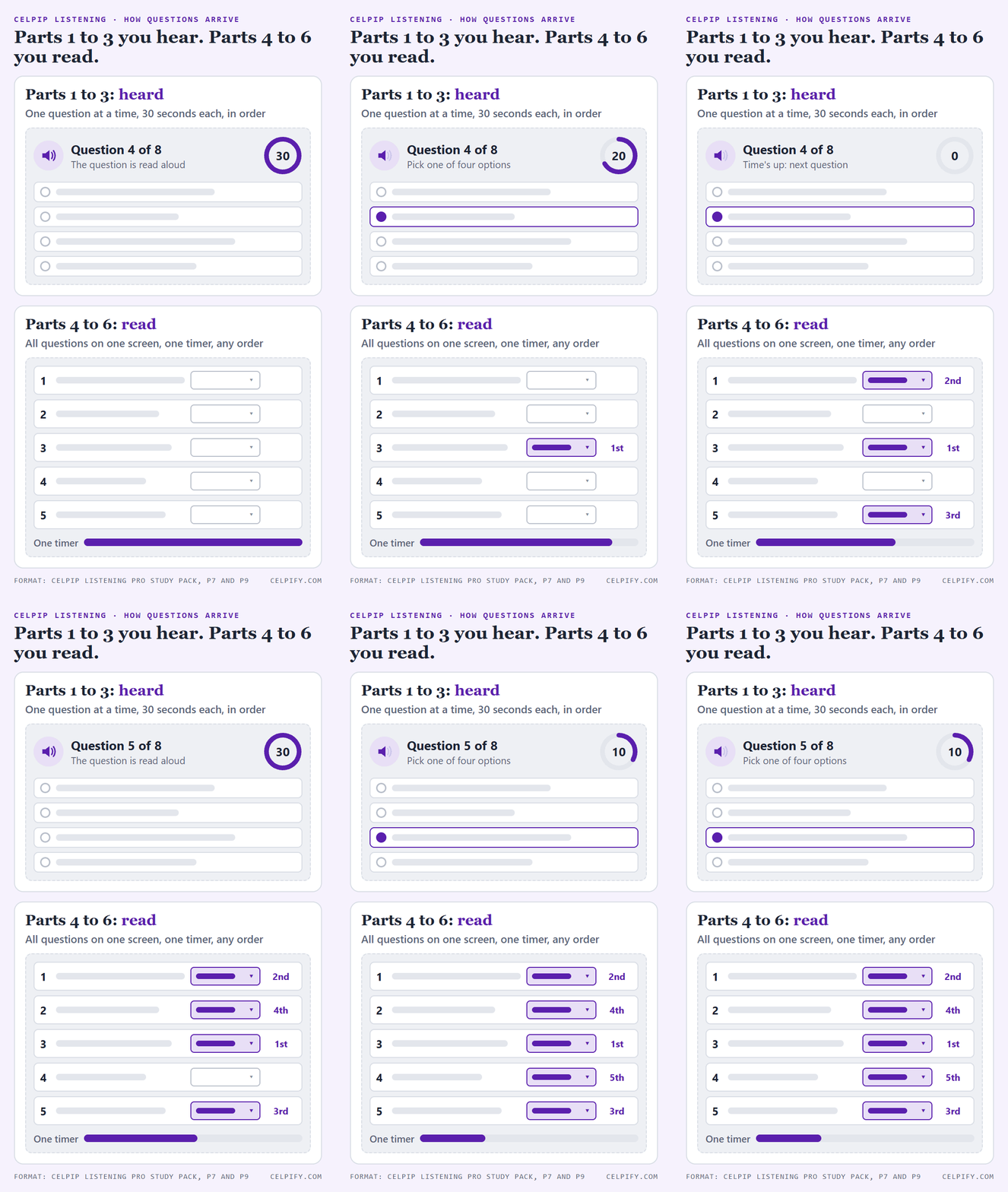
The official Listening Pro Study Pack lays the two formats side by side. In Parts 1 to 3 you "Hear the questions, read the 4 answer choices," the "Questions appear one by one," and you have "30 seconds to hear and answer each question." In Parts 4 to 6 you "Read the questions and the 4 answer choices," "All questions appear on the same screen," there's a "Set amount of time to answer all questions on screen," and you "Can answer questions in any order."
The pack calls the Parts 4 to 6 items sentence completion questions. In CELPIP's official practice tests, Parts 4 and 6 look like that: you choose the best way to complete each statement from a drop-down menu. Part 5 is different. Its items are full questions, and you choose the best answer to each one from a drop-down. The Test 1 sets below follow the same pattern.
What does this change for you? You read the questions instead of hearing them, so reading speed starts to count. You also manage the time yourself, with one clock for the whole screen instead of 30 seconds per question. And the clips get longer: the Part 6 talk runs about 3 minutes. Celpify learners get noticeably fewer of these on-screen questions right. On first tries between August 1 and October 12, 2026, 63% of answers in Parts 4 to 6 were correct, against 74% in Parts 1 to 3. And 9.5% of Parts 4 to 6 answers were left blank, compared with 5.7% in Parts 1 to 3. These are Celpify practice and mock results, not official CELPIP data.
Want the first half of the test too? The CELPIP listening sample test plays a full Part 1 with its spoken questions.
CELPIP Listening Part 4 Practice: Listening to a News Item
One speaker reads a short local news report, and five sentences to complete follow on one screen.
The pack describes Part 4 as one speaker and one clip of about 1.5 minutes, with about 5 questions and about 5 minutes for the whole part. The tone is "formal, factual, descriptive: like a radio or TV news report." The pack's examples are a local event where something unexpected happened, a new technology that helps people and an interesting encounter with animals.
News reports are full of who, what, when, where and why, and the pack tells you to listen for exactly those. It also has a tip about names: "a person is introduced by their full name and then referred to by their last name." Write the full name down the first time you hear it.
The Test 1 report runs 1 minute 4 seconds, shorter than the study pack's "about 1.5 minutes," and it's packed with numbers: a vote, a distance, a budget, two funding shares, a start date, a passenger count and a rival bus plan at "about half the price." Note each one with what it belongs to. Question 2 turns two of them into wrong options.
Before the clip, the screen says: "You will hear a news report about a transit project."
Part 4: Riverdale Transit Expansion Approved
1 minute 4 seconds, one news reader. The same recording as Celpify's free Test 1 Part 4. AI-generated voice, not official CELPIP audio. The five questions follow below.
Play it once
On test day the clip starts by itself, plays one time and can't be paused. Take notes on paper, and keep the transcript closed until you've answered.
Part 4 questions: complete the sentences
On the real test these five appear together after the report, each with a drop-down menu. Pick an option to check it and see the reason for every choice.
Blank 1. Council's vote means the light-rail expansion has been ___.
Show the answer to blank 1
Answer: D. approved despite some opposition. The report opens with the result: council voted eight to three to approve the extension. So the project is approved, but three councillors were against it. "Despite some opposition" says exactly that.
- A.Nothing was put off. Council voted last night, and construction is set to start in September.
- B.Buses were Councillor Fong's alternative, and he was on the losing side of the vote.
- C.The vote was eight to three, so three councillors voted against it.
Blank 2. The city is responsible for ___ of the project cost.
Show the answer to blank 2
Answer: C. about thirty-five percent. Federal and provincial governments cover 65%, and the city pays "the remaining thirty-five percent" through municipal bonds and development charges on new Westpark housing.
- A."Half" comes from a different sentence: Fong says a bus network would cost about half the price of rail. It isn't anyone's share of this project.
- B.Sixty-five percent is the federal and provincial share, not the city's.
- D.The cost is split, and senior governments pay most of it.
Blank 3. Riverside and Central Market will be built first because they ___.
Show the answer to blank 3
Answer: A. will carry the largest passenger volume. The reason comes in the same sentence: together the two stations "are expected to serve forty thousand daily passengers." The option turns that number into "the largest passenger volume."
- B.Station design isn't finished. Public consultations on it begin next month.
- C.The report only describes funding for the whole project. No station gets its own money.
- D.Westpark Terminal is in the second phase, with Oakwood and Hillcrest. Location isn't the reason given.
Blank 4. Councillor Fong favours buses because they could be ___.
Show the answer to blank 4
Answer: B. operating sooner and at a lower cost. Fong said a comparable bus network "could open within eighteen months for about half the price." Eighteen months is the "sooner" and half the price is the "lower cost."
- A.That's the supporters' argument, and it's an argument for light rail.
- C.Fong says nothing about who would pay for a bus network.
- D.This is reversed. Supporters say light rail carries more passengers.
Blank 5. Holding consultations next month allows residents to comment ___.
Show the answer to blank 5
Answer: D. while design and scheduling choices can still change. The consultations cover station design and the construction schedule, and they begin "before the plans are finalized." So residents can comment while those choices are still open.
- A.The consultations start next month. Construction doesn't even begin until September.
- B.That choice is already made. Council approved light rail last night.
- C.The topics are station design and the construction schedule, not funding.
Show the Part 4 transcript
Riverdale City Council voted eight to three last night to approve a fourteen-kilometre light-rail extension from downtown to Westpark. Five stations will be added along the route. The project is expected to cost three hundred and twenty million dollars. Federal and provincial governments will cover sixty-five percent. The city will finance the remaining thirty-five percent through municipal bonds and development charges on new Westpark housing. Construction is scheduled to begin in September and take about three and a half years. Riverside and Central Market stations will be built first because together they are expected to serve forty thousand daily passengers. Oakwood, Hillcrest, and Westpark Terminal will follow in the second phase. Councillor Derek Fong, one of the three opponents, argued for bus rapid transit instead. He said a comparable bus network could open within eighteen months for about half the price. Supporters replied that light rail carries more passengers and can encourage development around stations. Public consultations on station design and the construction schedule will begin next month, before the plans are finalized. Residents may comment online or attend two open houses in November.
To answer the same report with a timer, open Test 1 Part 4 in Celpify's free practice. Our CELPIP Listening Part 4 strategy guide covers note-taking for news reports.
CELPIP Listening Part 5 Practice: Listening to a Discussion
Three colleagues argue their way to a decision. Eight questions follow, all on the same screen.
On the real test, Part 5 is a video
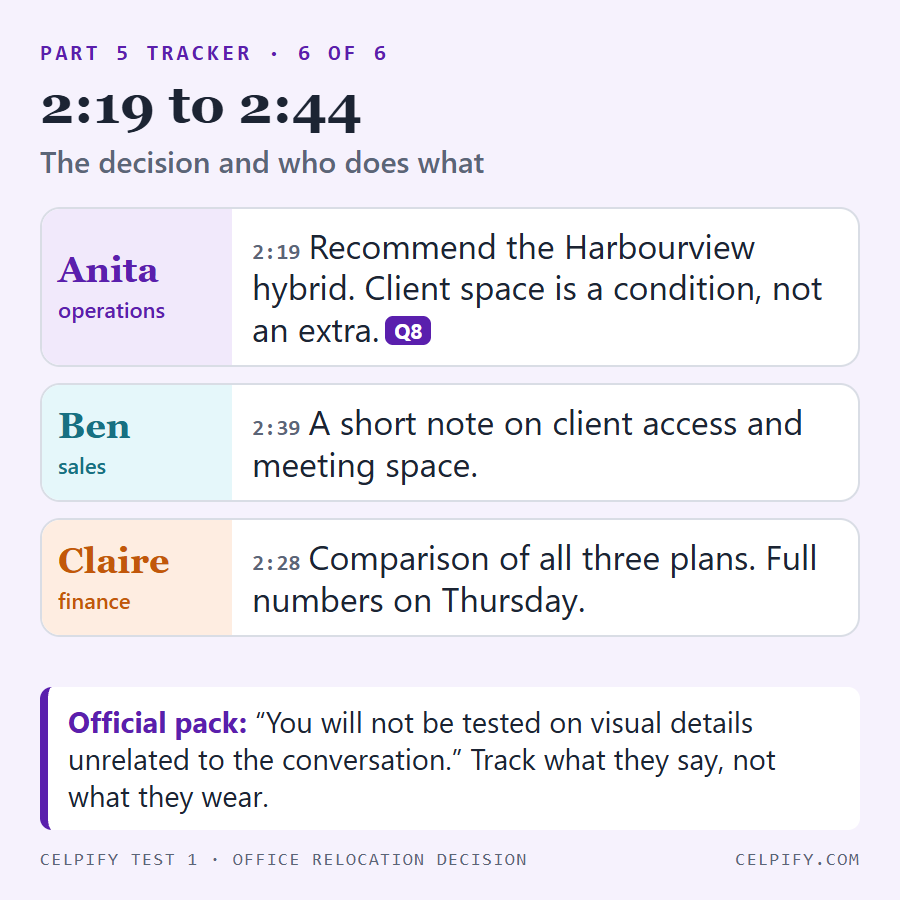
Celpify's Part 5 is audio only. On test day you watch a video of three people talking. The official study pack is clear about what you're tested on: "You will not be tested on visual details unrelated to the conversation, such as whether a character was wearing glasses, what colour someone's shirt was, or which items were on top of a coffee table." Use faces and body language to read how people feel, but take notes on what they say.
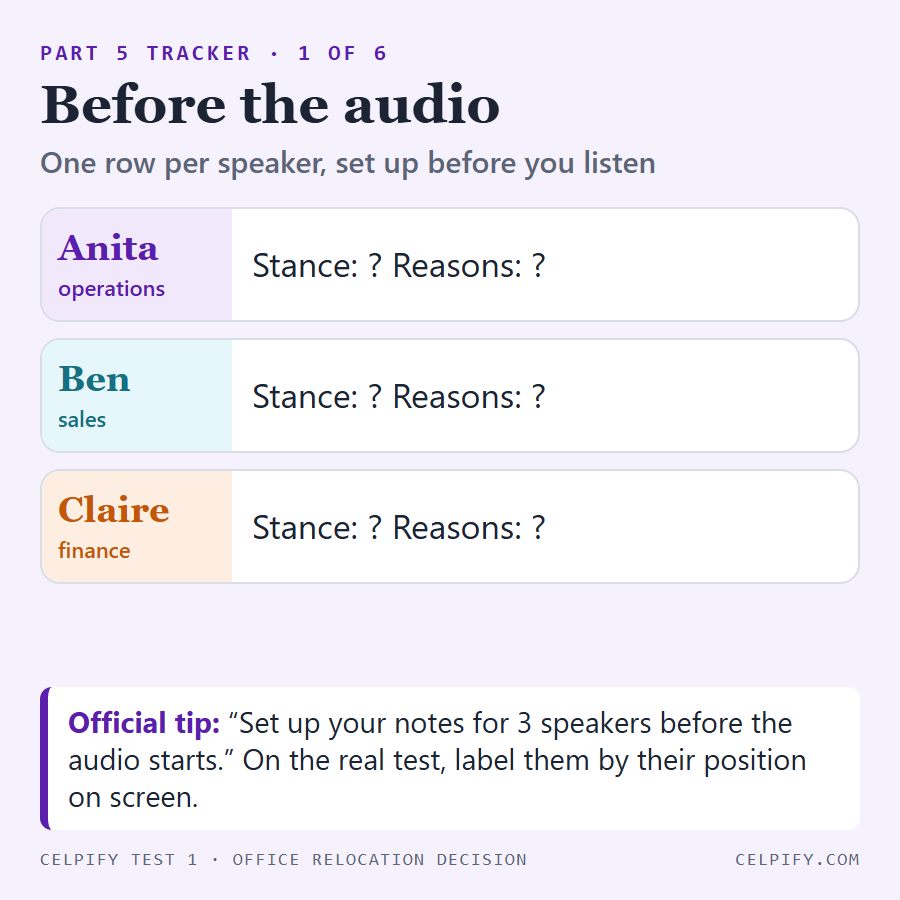
The pack gives Part 5 about 9 minutes, with one clip of about 1.5 to 2 minutes and about 8 questions. The talk is "relatively informal," it mixes facts, opinions and emotions, and the "speakers will sometimes disagree." Set up notes for three speakers before the clip starts, labelled by their positions on screen as they're introduced. While you listen, track how each person feels and what they agree or disagree about. Afterwards, give yourself roughly 30 seconds per question, as the pack suggests.
The Test 1 discussion runs 2 minutes 44 seconds, longer than the study pack's 1.5 to 2 minutes. With no video, each speaker gives their name and department in their first line. Before it plays, the screen shows this introduction:
You will hear three colleagues discussing whether their company should relocate its main office. The speakers are Anita, the operations director; Ben, the head of sales; and Claire, the finance manager.
Part 5: Office Relocation Decision
2 minutes 44 seconds, three speakers: Anita, Ben and Claire. The same recording as Celpify's free Test 1 Part 5. AI-generated voices, audio only (the real test uses a video). The eight questions follow below.
Part 5 questions
On the real test all eight appear together after the discussion, each answered from a drop-down menu. Pick an option to check it.
Question 1. Why does Anita oppose renewing the current lease?
Show the answer to question 1
Answer: A. The increase is far above comparable market changes. Anita gives two numbers: the landlord wants a 22% increase, while comparable offices are rising by about 8%. That gap is why she calls renewing "difficult to justify."
- B.Nobody says the building is closing. The lease simply ends in eight months.
- C.It's the opposite. Ben says most of the team's client meetings still happen face to face, and downtown makes them easy.
- D.The meeting rooms still exist. Later Ben wants rooms that feel more professional than the current ones.
Question 2. What is Ben's main concern about leaving downtown?
Show the answer to question 2
Answer: D. Sales may lose valuable in-person client contact. From his first turn Ben talks about clients: most of the sales team's client meetings happen face to face, and the downtown address makes those visits easy. His next point backs it up: two big accounts began with informal conversations after client meetings.
- A.The 15% rise in output is Anita's point about engineering and design, not Ben's worry.
- B.Claire brings up the five-year lease near the end, and Ben never objects to it.
- C.Ben asks whether transit works for clients. Nobody says employees would refuse the train.
Question 3. Why does Claire present three cost levels?
Show the answer to question 3
Answer: C. To frame the financial trade-offs among the choices. She prices renewal ($168,000 a year), a similar office in Harbourview ($110,000) and fully remote work (about $30,000) so the group can weigh them side by side. At the end she promises a comparison "so the executive team can see the trade-offs."
- A.Claire never pushes the cheapest choice. Her own suggestion, the hybrid at about $85,000, isn't the cheapest.
- B.Harbourview is one of her three options, and her hybrid plan is based there.
- D.The amounts are far apart: $168,000, $110,000 and about $30,000.
Question 4. What do Ben's recent accounts demonstrate?
Show the answer to question 4
Answer: B. Informal personal contact can create new business. Ben says two of the largest accounts last quarter "began with informal conversations after client meetings, not with scheduled online calls." The question asks what that story shows, so the answer is the general lesson: informal, in-person contact brought in business.
- A.This is reversed. The accounts began with conversations after client meetings, "not with scheduled online calls."
- C.Parking comes up much later, as one of Ben's conditions for Harbourview. It has nothing to do with these accounts.
- D.Too strong. Ben wants a shared office for sales, not every team downtown, and he ends up supporting an office outside downtown.
Question 5. What evidence does Anita give for remote work?
Show the answer to question 5
Answer: A. Two departments increased their measured output. Engineering and design have worked remotely for three years, and "their measured output is up fifteen percent." Two departments and measured output: the option says the same thing in other words.
- B.Ben is the one who talks about sales accounts, and he says the big ones started in person, not online.
- C.Claire's remote estimate still includes rented meeting rooms, so that cost doesn't disappear.
- D.No one reports what clients asked for.
Question 6. Why does Anita propose a client lounge?
Show the answer to question 6
Answer: D. To address Ben's concern while preserving savings. Ben has just asked for parking and meeting rooms that feel more professional. Anita answers, "The lower rent leaves room for that," and adds that even with a client lounge they'd save about $70,000 in the first year. She meets his concern and keeps the savings.
- A.The lounge is for clients. Engineering and design stay remote under the hybrid plan.
- B.The thirty parking spaces come from Claire, as a separate feature of the building.
- C.No employee coffee area is mentioned. Ben's informal conversations happened after client meetings.
Question 7. What benefit does the three-percent cap provide?
Show the answer to question 7
Answer: B. It makes future rent increases more predictable. Claire says the five-year lease "limits annual increases to three percent, so we would not face another sudden jump." With a cap, the company knows the most its rent can rise each year.
- A.$30,000 is Claire's estimate for fully remote work, not the Harbourview rent.
- C.The proposed lease is for five years. The three is the percentage.
- D.The cap is about rent increases. Parking is a separate point, and nobody promises anything forever.
Question 8. What arrangement does the group finally support?
Show the answer to question 8
Answer: C. Move sales and client functions while others stay remote. Anita sums it up as "the Harbourview hybrid option." Under that plan, sales, reception and meeting rooms move to a smaller Harbourview office, while engineering and design keep working remotely.
- A.They decide against renewing, and engineering and design stay remote.
- B.That's Claire's fully remote option, which Ben argued against.
- D.The transit link has already improved: the express line opened last year. And they agree on a recommendation now.
Question 4 was the hardest Test 1 Part 5 question for Celpify learners. Only 37% of 105 learners got it right on their first try in the same period. Everything it needs is in one sentence from Ben. The hard part is the question itself: it asks what his story demonstrates, so the answer is the general lesson, not a detail you can match word for word. The pack warns about this too: never expect the right answer "to be stated in the exact same words that were said in the audio clip."
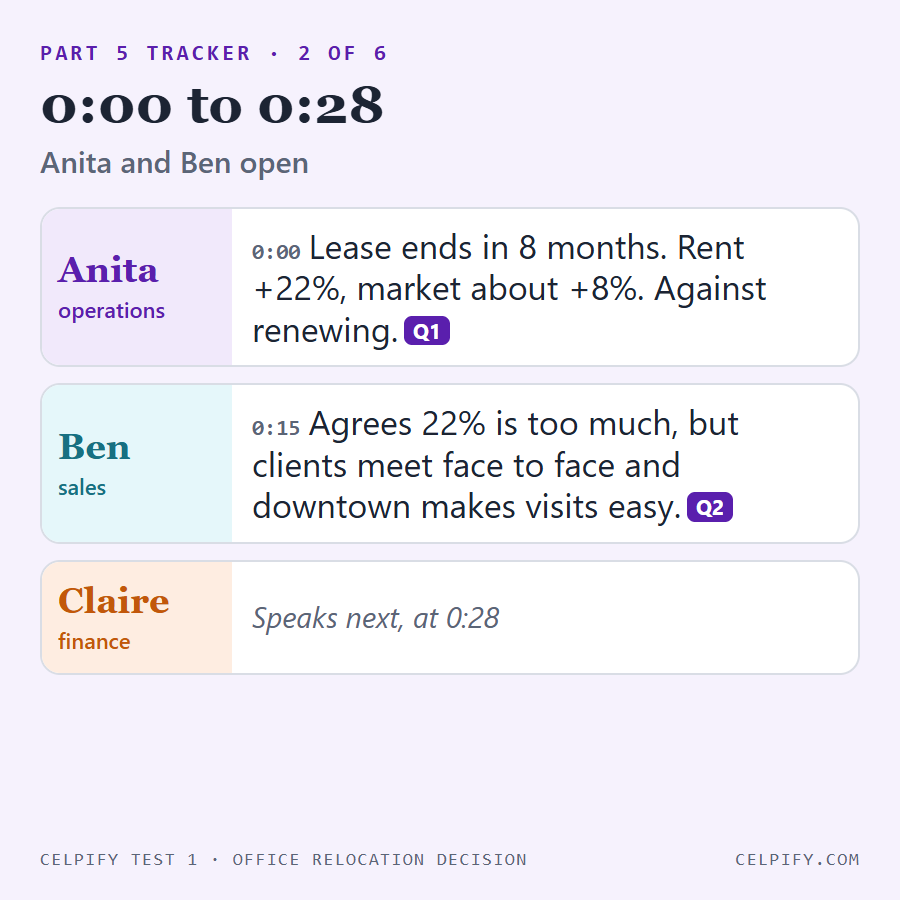
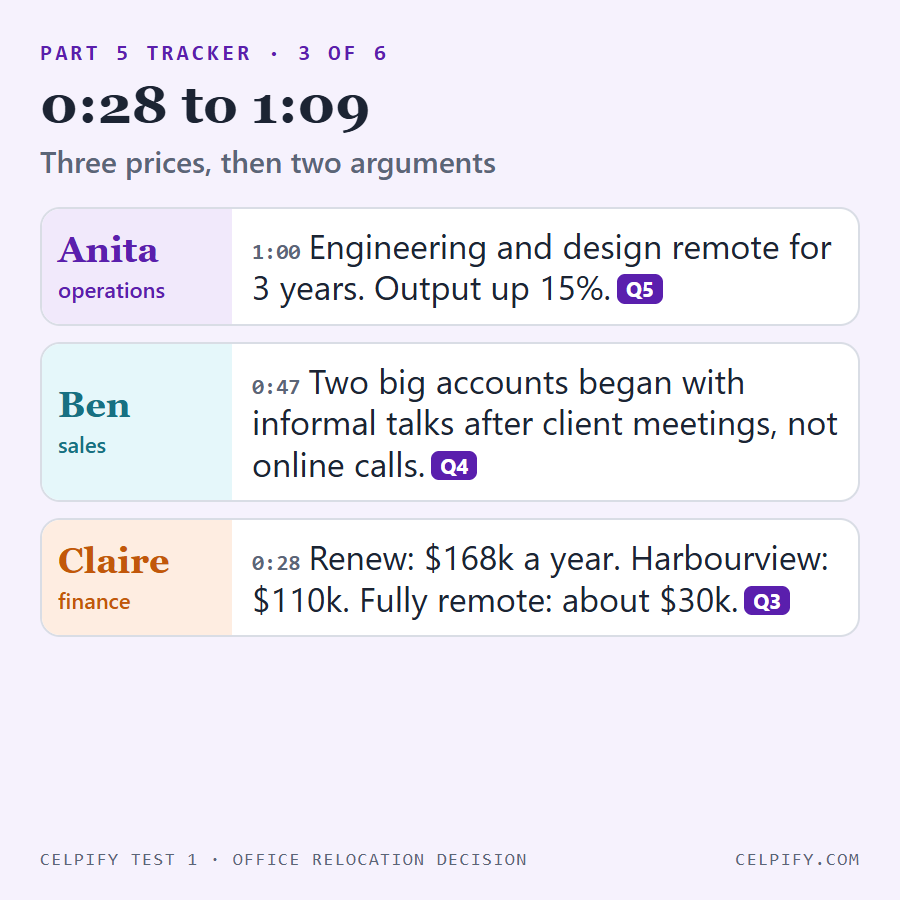
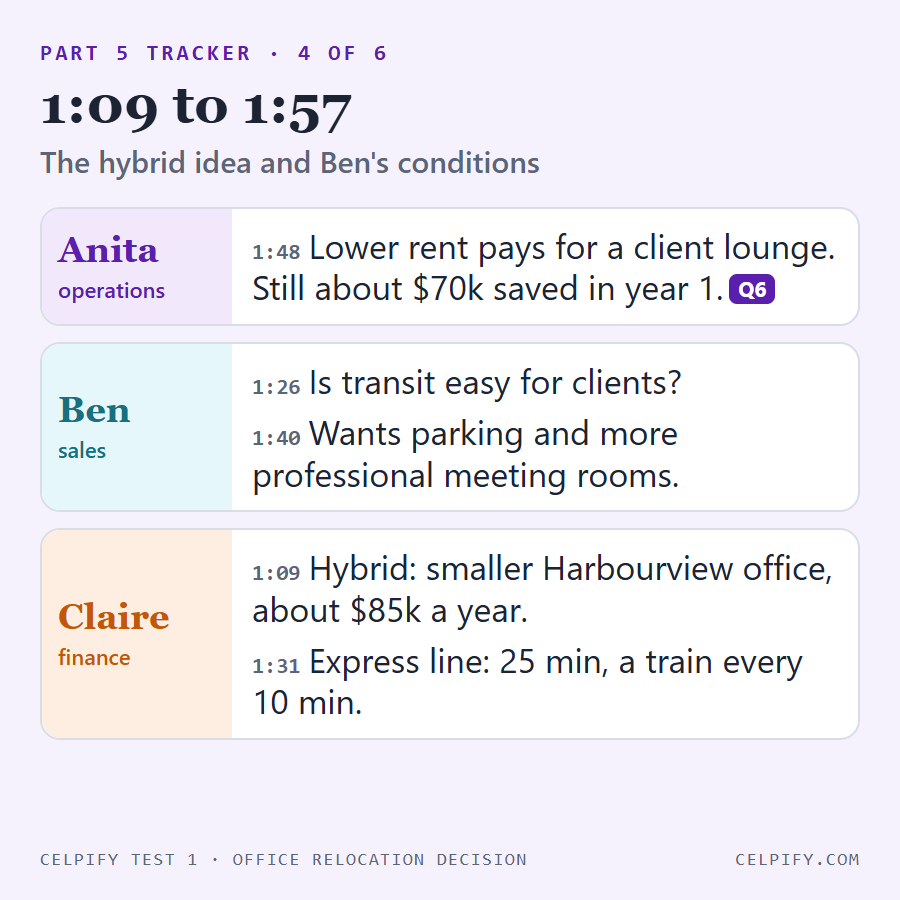
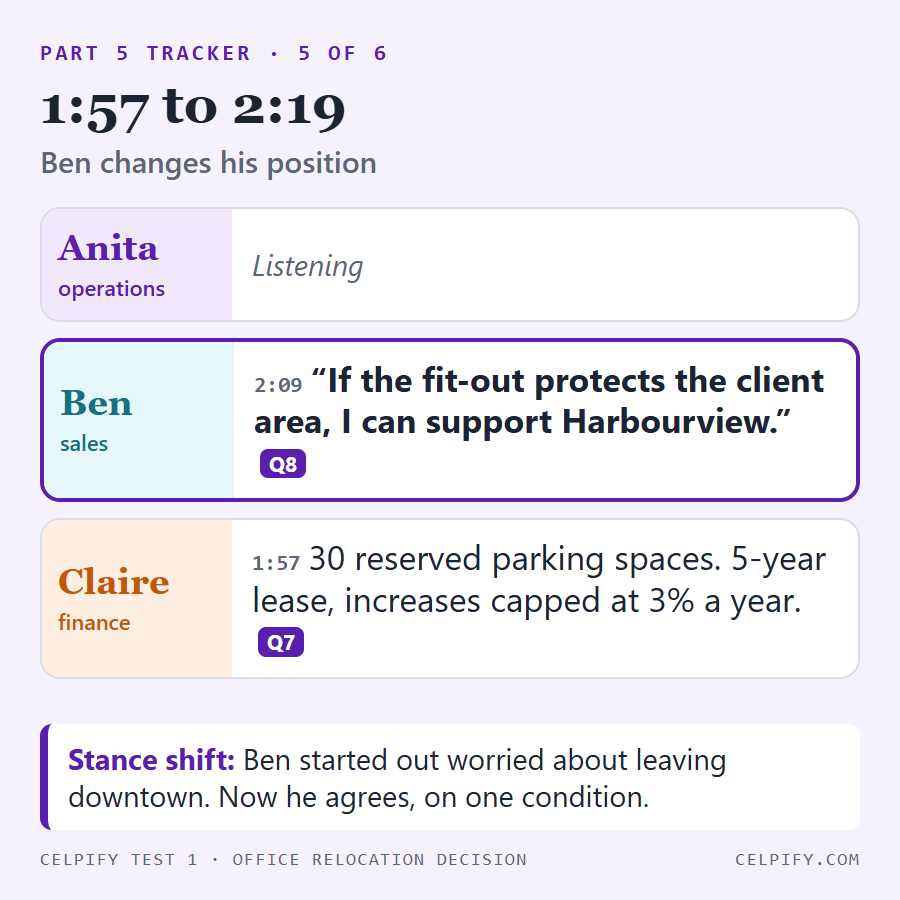
Who said what: a Part 5 tracker
Check your notes against this, turn by turn. Times come from the Test 1 recording, and each note shows the question it answers.
Show the Part 5 transcript
Anita: I'm Anita from operations. We need a recommendation for the executive team by Friday. Our lease ends in eight months, and the landlord wants a twenty-two percent increase. Comparable offices are rising by about eight percent, so renewing here is difficult to justify.
Ben: Ben here, from sales. I agree that increase is excessive, but moving away from downtown has a cost too. Most of the sales team's client meetings happen face to face, and the central address makes those visits easy.
Claire: This is Claire from finance. I priced three basic options. Renewal would cost one hundred and sixty-eight thousand dollars a year. A similar office in Harbourview is about one hundred and ten thousand. Fully remote work, including rented meeting rooms, would be close to thirty thousand.
Ben: The remote figure is attractive, but it misses how sales actually develops business. Two of our largest accounts last quarter began with informal conversations after client meetings, not with scheduled online calls.
Anita: That matters for sales. It does not mean every department needs a desk. Engineering and design have worked remotely for three years, and their measured output is up fifteen percent.
Claire: Then a hybrid office may be the fair comparison. Harbourview has a smaller suite that can hold sales, reception, and several meeting rooms. Engineering and design could remain remote. That version costs about eighty-five thousand a year.
Ben: Harbourview used to be awkward for clients. Has the transit situation improved?
Claire: The express line opened last year. The trip from downtown is about twenty-five minutes, with trains every ten minutes during business hours.
Ben: That is better than I expected. I would still want convenient parking and meeting rooms that feel more professional than the ones we have now.
Anita: The lower rent leaves room for that. Even after furnishing a dedicated client lounge, we would save roughly seventy thousand dollars in the first year.
Claire: The building includes thirty reserved parking spaces. The proposed five-year lease also limits annual increases to three percent, so we would not face another sudden jump.
Ben: If the fit-out protects the client area, I can support Harbourview. Sales would keep a shared office, while teams that are already productive remotely would not be forced back.
Anita: That sounds like our recommendation: the Harbourview hybrid option, with the client space listed as a condition rather than an optional extra.
Claire: I will show renewal, remote work, and the hybrid plan in the comparison so the executive team can see the trade-offs. I can circulate the full numbers on Thursday.
Ben: Good. I will add a short note on client access and the kind of meeting space sales needs.
The same discussion is in Test 1 Part 5 in Celpify's free practice, and our CELPIP Listening Part 5 guide has more on three-speaker notes.
CELPIP Listening Part 6 Practice: Listening to Viewpoints
A single speaker walks through three views on a social issue, then gives a conclusion. Six sentences to complete follow.
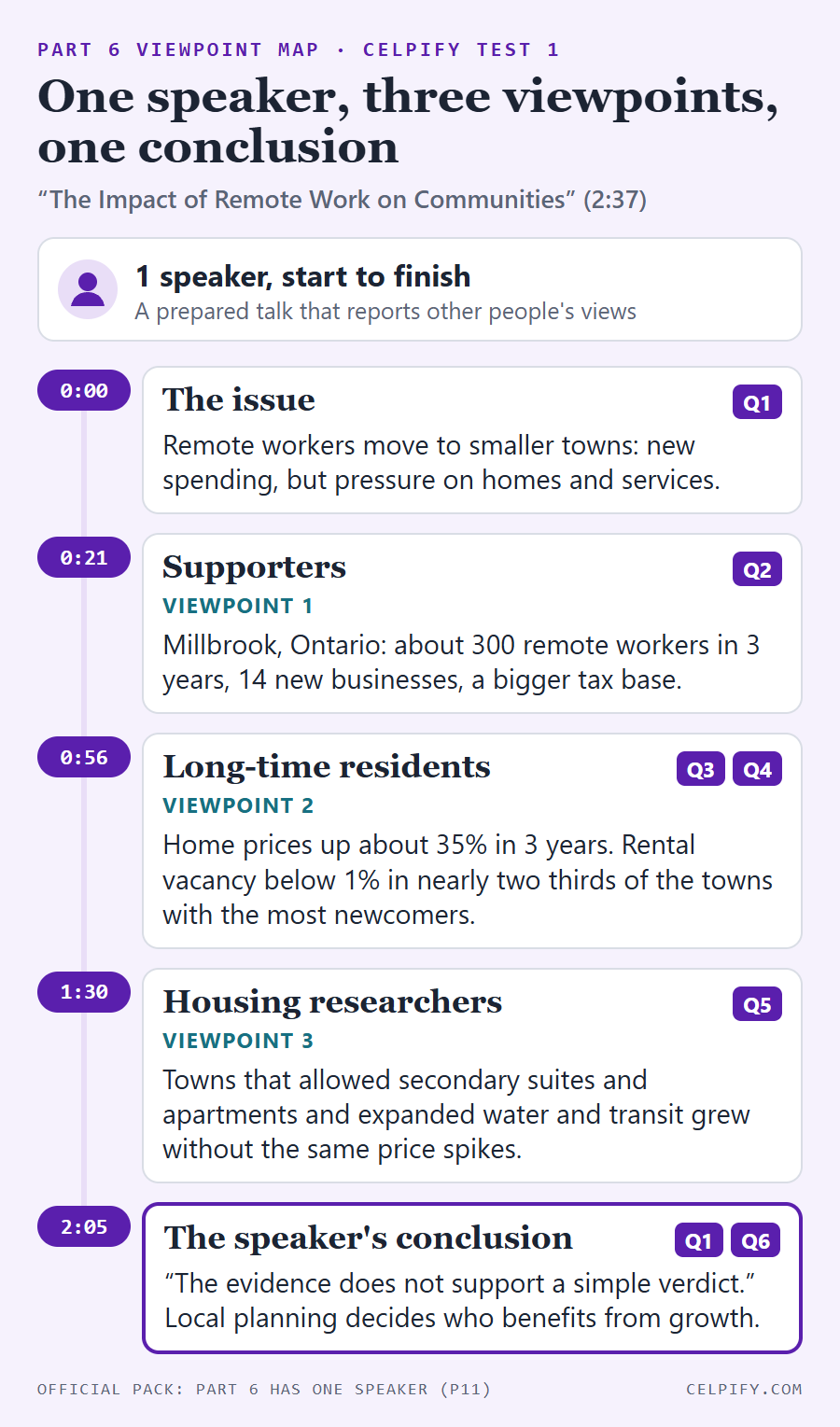
Part 6 has one speaker. If you've seen advice to label "Speaker A" and "Speaker B" here, it doesn't fit this part: the pack lists "one speaker," one clip of about 3 minutes and about 6 questions, with about 8 minutes in total. The talk is "formal, not improvised (prepared in advance)," and the speaker "will use low-frequency and specialized language." The pack's examples include a speech about climate change and a description of a community issue with different proposed solutions.
So who are you tracking? The people the speaker talks about. The pack's strategy is to "Identify who is mentioned, what their opinions are, and why." Give each group one line with its evidence, and keep a separate line for the speaker's own conclusion. Don't skip the numbers, either: two of the six questions below depend on them.
The Test 1 talk runs 2 minutes 37 seconds. Before it plays, the screen says: "You will hear a report presenting different viewpoints on a social issue."
Part 6: The Impact of Remote Work on Communities
2 minutes 37 seconds, one speaker. The same recording as Celpify's free Test 1 Part 6. AI-generated voice, not official CELPIP audio. The six questions follow below.
Part 6 questions: complete the sentences
On the real test these six appear together after the talk, each with a drop-down menu. Pick an option to check it.
Blank 1. Overall, the report presents remote-work migration as ___.
Show the answer to blank 1
Answer: C. a mixed change shaped by local response. The speaker gives benefits (new businesses, a bigger tax base) and harms (higher prices, people pushed out), then says "The evidence does not support a simple verdict" and that local governments can still shape the outcome. Mixed, and shaped by how towns respond.
- A.Employers aren't blamed, and "may slow or change" isn't the same as calling the movement temporary.
- B.Much of the talk is about the cost: home prices up about 35%, vacancy below 1% and workers who can't rent near their jobs.
- D.The researchers and the conclusion both say towns can influence the outcome, mainly through housing and planning.
Blank 2. The Millbrook example shows that newcomers can ___.
Show the answer to blank 2
Answer: B. support new businesses through additional local spending. About 300 remote workers arrived in Millbrook over three years, and 14 businesses opened in the same period. Town officials say the added customers helped fill empty storefronts.
- A.It's the reverse. Fourteen businesses opened and helped fill empty storefronts.
- C.Officials say the tax base expanded, so municipal revenue went up.
- D.The Millbrook example doesn't say that, and the rest of the talk argues that planning matters.
Blank 3. Critics' housing evidence suggests that migration can ___.
Show the answer to blank 3
Answer: D. worsen an existing shortage for lower-paid residents. Critics say newcomers "did not create the existing shortage," but their ability to pay more "intensified competition," and young families and service workers then struggled to find homes. An existing shortage got worse for people with lower pay.
- A.No one says remote workers want to move back to big cities.
- B.The evidence runs the other way: prices went up and vacancies fell below 1%.
- C.Critics say higher incomes "intensified competition." Newcomers' money didn't add homes.
Blank 4. The vacancy-rate finding indicates that rentals became ___.
Show the answer to blank 4
Answer: A. extremely scarce in many high-growth towns. A vacancy rate below 1% means almost no rentals were free, and that was true in nearly two thirds of the towns with the largest influxes.
- B."Two thirds" counts towns. It says nothing about rents falling, and a vacancy rate measures empty units, not prices.
- C.A vacancy rate below 1% means fewer free units, not more.
- D.These are the people who "struggled to find homes near their jobs."
Blank 5. The researchers' comparison implies that towns should ___.
Show the answer to blank 5
Answer: D. expand housing and infrastructure as demand grows. Towns that allowed secondary suites, approved apartments and expanded water and transit capacity grew "without the same price spikes." The researchers say increasing supply and planning infrastructure deal with the real problem.
- A.The researchers don't talk about businesses. Business growth was the supporters' point, and it was presented as a benefit.
- B.Towns that "delayed those decisions" saw demand rise while the number of homes barely changed. Waiting is the mistake.
- C.Empty storefronts are a detail from the Millbrook example, not part of the researchers' comparison.
Blank 6. The conclusion suggests that the narrator believes ___.
Show the answer to blank 6
Answer: A. local planning shapes who benefits from growth. The speaker ends by saying local governments can influence "whether growth broadens opportunity or deepens inequality," and calls preparation "the central policy choice."
- B.The speaker says the movement "may slow or change."
- C.The conclusion keeps both sides: growth can help businesses and can also push residents out. Nothing is automatic.
- D.The speaker talks about choices for local governments, and the researchers call restricting newcomers treating "the symptom."
Show the Part 6 transcript
Remote work has changed not only how many people work, but also where they live. Some employees have left expensive cities for smaller communities with lower housing costs. Their arrival can bring new spending and skills, yet it can also place pressure on homes and services. The debate therefore concerns both economic renewal and who can afford to remain in a growing town.
Supporters point first to local business activity. In communities that had been losing population, newcomers often spend city-level salaries at nearby shops, restaurants, and trades. Millbrook, Ontario, reports that about three hundred remote workers arrived over three years. During the same period, fourteen businesses opened, including two cafes, a fitness studio, and a shared workspace. Town officials say the added customers helped fill empty storefronts and expanded the municipal tax base. Supporters add that a broader tax base can help small municipalities maintain libraries, roads, and recreation services.
Long-time residents describe a different effect. In several fast-growing rural regions, home prices rose by roughly thirty-five percent in three years. A regional housing survey also found rental vacancy rates below one percent in nearly two thirds of the towns receiving the largest influxes. Higher-income newcomers did not create the existing shortage, critics say, but their ability to pay more intensified competition. Young families and service workers then struggled to find homes near their jobs. Some employers report that staff now commute from neighbouring towns because they cannot rent near the communities they serve.
Housing researchers argue that migration alone does not explain why outcomes differ from town to town. Communities that allowed more secondary suites, approved apartment construction, and expanded water and transit capacity added residents without the same price spikes. Towns that delayed those decisions saw demand rise while the number of homes barely changed. From this perspective, restricting newcomers treats the symptom, whereas increasing supply and planning infrastructure addresses the underlying constraint. The comparison also found that permitting changes worked best when towns approved several types of housing rather than relying only on detached homes.
The evidence does not support a simple verdict. Remote workers can strengthen businesses and public revenue, but rapid growth can displace residents when housing and services do not keep pace. The towns most likely to benefit are those that plan before shortages become severe and direct some new revenue toward housing and infrastructure. Movement to smaller communities may slow or change, but local governments can still influence whether growth broadens opportunity or deepens inequality. That makes preparation, rather than simple acceptance or rejection of newcomers, the central policy choice.
Answer it with a timer in Test 1 Part 6 in Celpify's free practice, or read our CELPIP Listening Part 6 guide for a full note-taking method.
How to Review a Parts 4 to 6 Practice Set
Checking answers is quick. Working out why you got one wrong takes longer, and that's where you learn something.
Start with your notes, not the transcript. For each question you missed, look for the line in your notes that should have answered it. Then open the transcript and find the sentence it came from. If the sentence isn't in your notes, you have a listening problem: you missed it or didn't write it down. If it is in your notes and you still chose wrong, the problem is in the options.
Most wrong options in these three sets are built in one of three ways. Some put a real number in the wrong place. In Part 4, Question 2, 65% is the senior governments' share and "half" is the bus plan's cost: both were in the report, and neither is the city's share. Some give a real point to the wrong person. In Part 5, Question 2, option A turns Anita's argument into Ben's worry, and in Part 6, Question 5, option A answers a question about the researchers with the supporters' topic. And some flip the right idea around, like Part 4, Question 4, option D, which gives rail's advantage to buses.
One habit catches most of them: before you pick an option, check who said it and what it was about. Most wrong options here use words you really heard, so "did I hear that?" isn't enough.
Each correct Listening answer is worth one point, and the pack says "Points are not deducted for incorrect answers." So never leave a drop-down empty. With one timer for the whole screen, answer the questions you're sure of first, as the pack suggests, and make a guess on the rest before time runs out. Your total out of 38 converts to a CELPIP level: our CELPIP listening score chart shows the ranges.
Sources & further reading
The official CELPIP sources behind the format facts on this page.
- CELPIP Listening Pro Study PackQuestion formats for Parts 1 to 3 and 4 to 6, timings and speakers for Parts 4, 5 and 6, the Part 5 visual-details rule and scoringOfficial CELPIPcelpip.ca
- CELPIP Test Format and ScoringOfficial names of the six Listening partsOfficial CELPIPcelpip.ca
- CELPIP Free Practice TestsOfficial practice tests with the real test screensOfficial CELPIPcelpip.ca