How to Get CLB 9 (or 10) in CELPIP

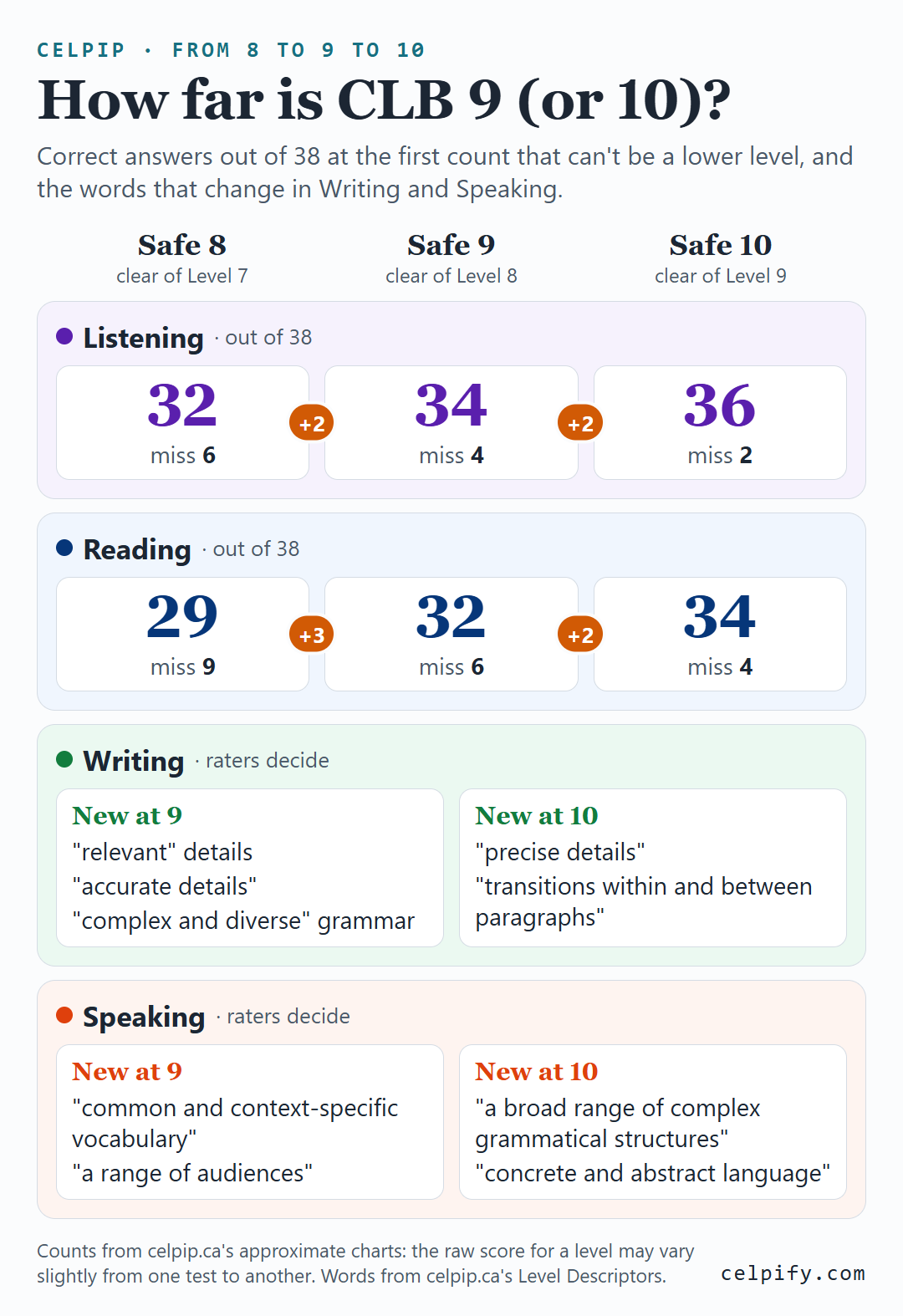
CLB 9 in CELPIP means a 9 in Listening, Reading, Writing and Speaking on one test. On celpip.ca's approximate charts, that's 34 of 38 correct answers in Listening and 32 of 38 in Reading if you want to be clear of Level 8. Writing and Speaking need a 9 from the raters. CLB 10 in CELPIP is 36 and 34, and 10s from the raters.
From a safe 8, the gap is smaller than it looks: two more Listening answers, three more Reading answers, and a few specific changes in how you write and speak. Below are those changes, the CRS points for CLB 9 and 10, a four-week plan and a check for when you're ready to book.
First, a correction. A search summary we read on November 17, 2026 says later Listening questions carry more weight. celpip.ca doesn't say that. It says every Listening and Reading answer is scored as either correct or incorrect, and its charts turn the number of correct answers out of 38 into a level. For the full bands at each level, see the raw scores for CLB 7, 8 and 9.
How Far Is CLB 9 From Your Score Right Now?
Measure before you plan. Each skill gets its own level, and the lowest one decides.
Use a test you haven't seen. Not the one you've already done twice. Do one full, timed Listening section and one full Reading section, 38 questions each. Then write both Writing tasks, record all eight Speaking tasks, and compare them with the descriptor lines in the Writing and Speaking sections below. A practice AI estimate works too, as long as you treat it as practice and not as an official score.
Why all four? celpip.ca's blog is clear about it: "IRCC considers the four language skills separately rather than calculating an average." Its own example report has Listening 9, Reading 8, Writing 7 and Speaking 9, and it tells that test taker to work on Reading and Writing first. Your lowest skill decides whether you have CLB 9.
CLB 9 and CLB 10 in CELPIP: the gap per skill, from one safe count to the next
| Skill | CLB 8 to CLB 9 | CLB 9 to CLB 10 |
|---|---|---|
| Listeningcorrect out of 38 | 32 to 34+2 answers | 34 to 36+2 answers |
| Readingcorrect out of 38 | 29 to 32+3 answers | 32 to 34+2 answers |
| Writing | rater level 8 to 9see the Writing section | rater level 9 to 10 |
| Speaking | rater level 8 to 9see the Speaking section | rater level 9 to 10 |
So the CLB 9 Listening score to aim for is 34 out of 38, and the CLB 9 Reading score is 32. Why "safe"? The bands on celpip.ca's charts overlap, so a Listening 33 can come back as an 8 or a 9. celpip.ca also says the raw score for a level "may vary slightly from one test to another", because questions differ in difficulty and each test form is equated. And every test includes some unscored questions that look just like the scored ones. The safe count is the first count that can't be the lower level. Our CELPIP Listening score chart and CELPIP Reading score chart list every count.
The calculator below opens on a safe CLB 8 in all four skills. Type in your own counts, or set the target to 10 and watch the numbers move.
Listening
Level 8
32 sits in one band. 34 correct clears the overlap for Level 9.
Reading
Level 8
29 sits in one band. 32 correct clears the overlap for Level 9.
Writing
Speaking
Writing and Speaking have no answer count. Raters give a level, so pick the one on your score report or your practice feedback.
Your result · approximate
| Skill | CELPIP level | CLB | CRS points |
|---|---|---|---|
| Listening32 / 38 correct | 8 | CLB 8 | 23 |
| Reading29 / 38 correct | 8 | CLB 8 | 23 |
| Writing | 8 | CLB 8 | 23 |
| Speaking | 8 | CLB 8 | 23 |
CRS language points
92
First official language, single applicant (no spouse or partner), out of 136.
Lowest skill
CLB 8 (Listening, Reading, Writing, Speaking). Programs read each skill on its own, so this is the number that has to clear a minimum. Express Entry (Federal Skilled Worker) asks for CLB 7 in every skill.
Counts that clear the overlap
- Listening: 34 correct or more for CLB 9 on the chart. You're 2 answers short.
- Reading: 32 correct or more for CLB 9 on the chart. You're 3 answers short.
- Writing and Speaking need a 9 from the raters.
Approximate, from the chart on celpip.ca
The bands come from the "example chart" on the CELPIP Test Results page. Test forms differ a little in difficulty and are equated, so celpip.ca says the raw score needed for a level "may vary slightly from one test to another".
Treat this as an estimate. Your official level comes from the form you sit.
How close are most people? In Celpify practice from August 1 to mid-October 2026, 10% of Listening sections and 13% of Reading sections ended just one or two answers short of a safe 9 (95 learners in Listening, 109 in Reading). Speaking looked very different: none of 27 learners averaged 9 on their first tries, by Celpify's AI estimate. These are practice results, not official ones.
So for many learners the Listening and Reading gap really is about two answers. In our data, Speaking is the skill most likely to hold back the fourth 9. The full table is in how often learners reach CLB 7, 8 and 9, and our data on the hardest part of CELPIP shows where the points go, part by part.
How to Get 9 (or 10) in CELPIP Listening and Reading
There are no raters here. The job is to stop losing the same two or three answers.
Listening: the four misses you can afford
A safe 9 leaves room for 4 wrong answers out of 38, and a safe 10 leaves room for 2. celpip.ca's own guide to moving from Level 7 to Level 9 suggests capturing what matters rather than every word, following how the conversation develops, and listening "beyond the words" for tone and attitude.
What it doesn't give you is a way to find your own weak spot. Keep a miss log for two weeks. Give every wrong answer one label: paraphrase (the answer used different words from the audio), who said what, detail, or tone and attitude. Whichever label comes up most becomes next week's drill.
Watch the last two parts for "who said what" misses. Part 5 is a discussion between three speakers, with direct questions, and Part 6 is one speaker presenting viewpoints on an issue. And answer every question: celpip.ca says a blank is scored as incorrect, so a guess can't hurt you. The CELPIP Listening tips go through each part.
Reading: six misses at 9, four at 10
Reading gives you a little more room: 6 wrong answers at a safe 9 and 4 at a safe 10. celpip.ca's advice is to "look for meaning, not just matching words" and to check each answer in the context of the passage. An option that repeats a word from the text can still say something the text doesn't. Use the same miss log, with one more label: ran out of time.
At CLB 10 the margin is 2 Listening misses and 4 Reading misses, so every question about what a writer means, not just what they say, counts. You can practise on all 38 Test 1 Reading questions, with a reason for every option, and the CELPIP Reading tips cover each part.
CELPIP Writing: What Changes From 8 to 9, and From 9 to 10
Raters decide your Writing level, and celpip.ca publishes what each level can do. Only a few words change from one level to the next.
Here's how celpip.ca's Level Descriptors for Writing move from one level to the next. Read across a row and look for the word that changes.
celpip.ca's Writing Level Descriptors at 8, 9 and 10 (short quotes)
| Area | Level 8 | Level 9 | Level 10 |
|---|---|---|---|
| Support | "Develop a main idea with supporting details" | "Support key ideas with relevant facts, descriptions, details, or quotations" | "Support key ideas with a range of facts, descriptions, details, or quotations" |
| Words | "Use common or context-specific words to communicate meaning" | "Choose words and phrases to provide accurate details, descriptions, and comparisons" | "Choose words and phrases to provide precise details, descriptions, and comparisons" |
| Grammar and flow | "good control of complex grammatical structures, spelling, and punctuation" | "control of a range of complex and diverse grammatical structures" | "Connect ideas and make transitions within and between paragraphs"; "good control of a range of complex and diverse grammatical structures" |
| Tone and reader | "common writing conventions" for "a familiar or clearly defined audience" | "some formal and most informal writing conventions" for "a defined audience" | "most formal and informal writing conventions" |
The official Writing Pro: Target 9+ Study Pack (2026) gives a Level 9 writer three things to work on: "Fully develop my ideas in writing", "Increase my ability to use context-specific vocabulary" and "Reduce the number of grammar and vocabulary errors".
The same pack has some good news. Its Level 9 sample email still uses one word six times and has few transitions, and even its Level 12 email has a wrong word form. A 9 doesn't have to be perfect. The CELPIP Writing score chart covers every descriptor from 7 to 10.
One paragraph, from 8 to 9 to 10
A survey answer written for this page, revised one descriptor at a time. Orange marks the problems, and green shows what changed.
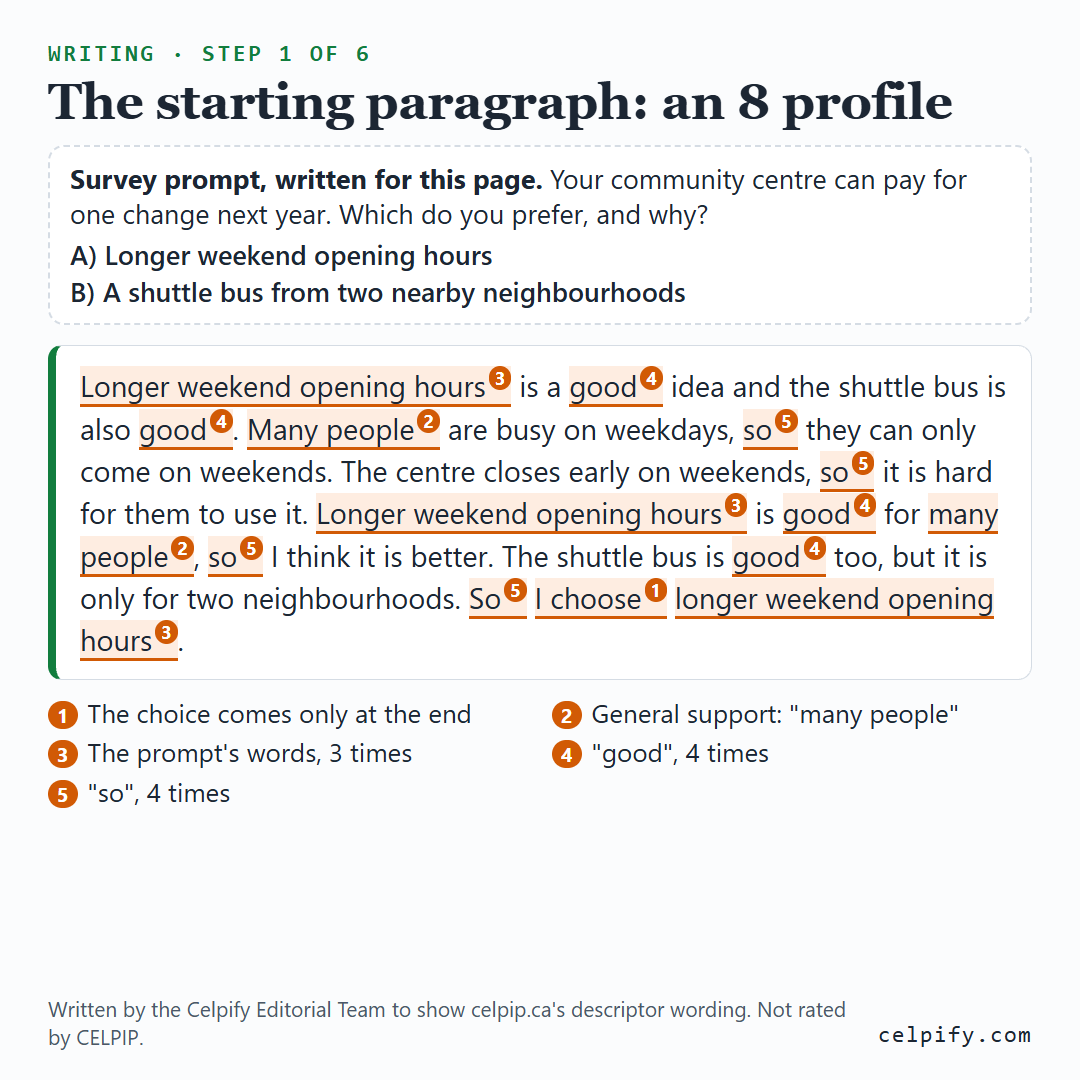
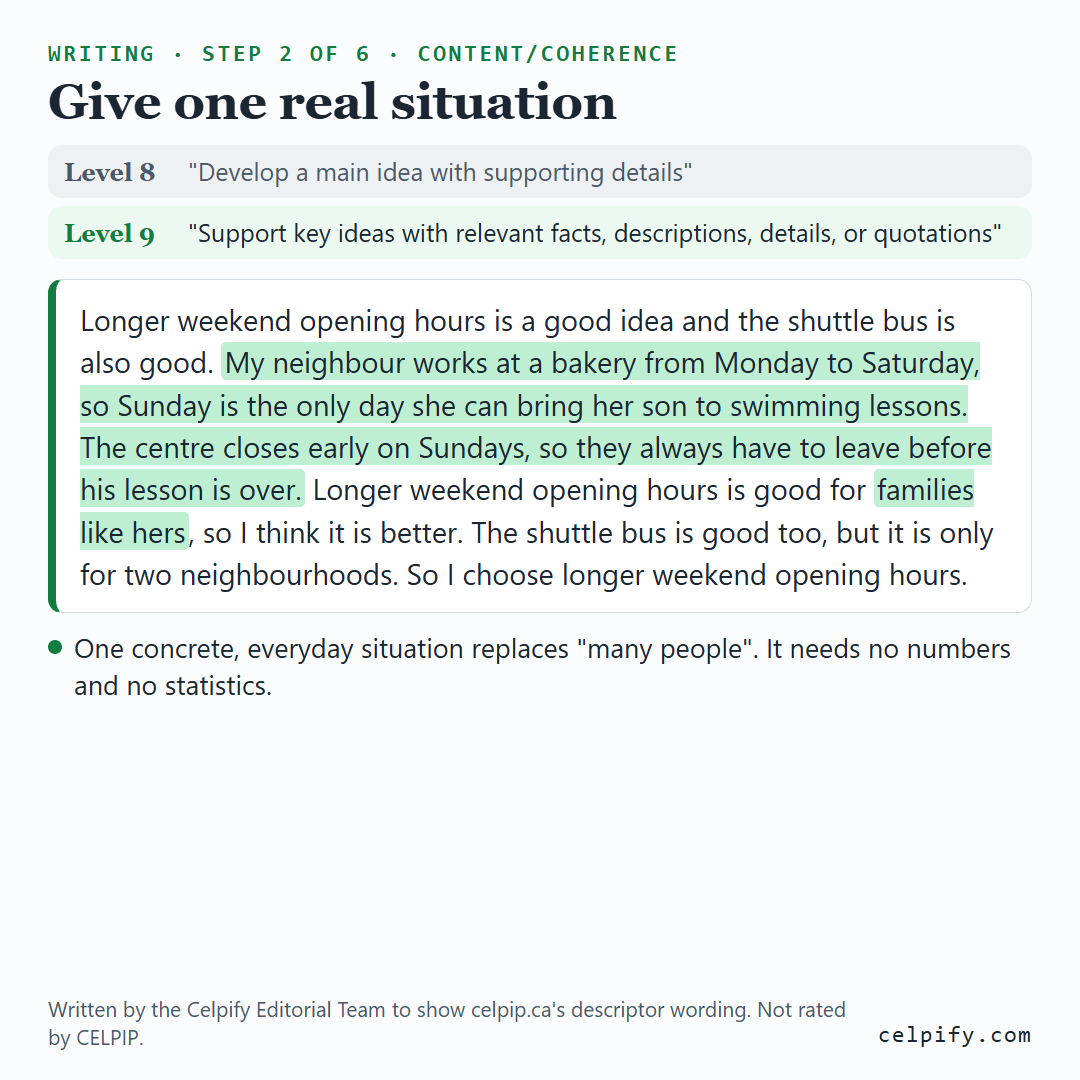
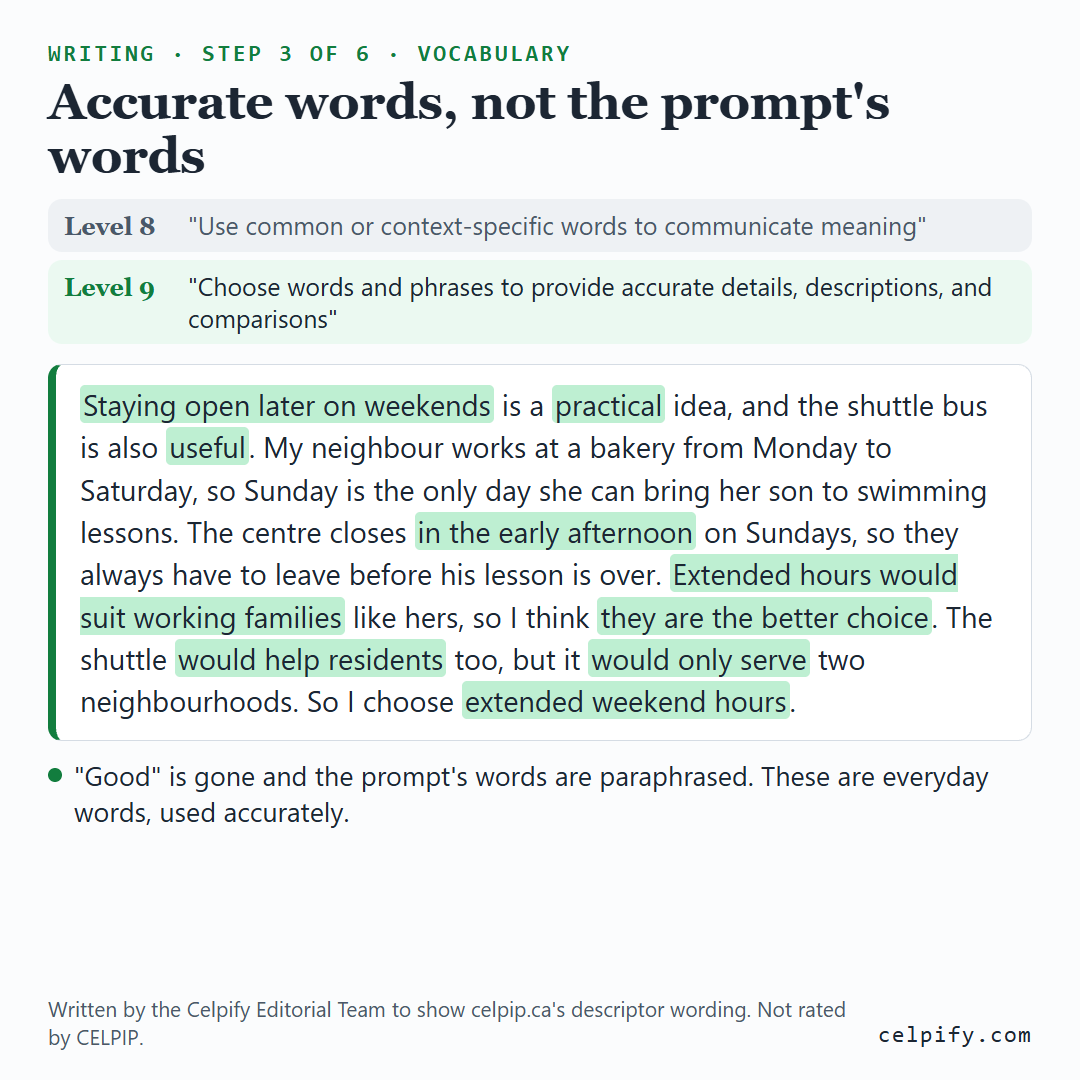
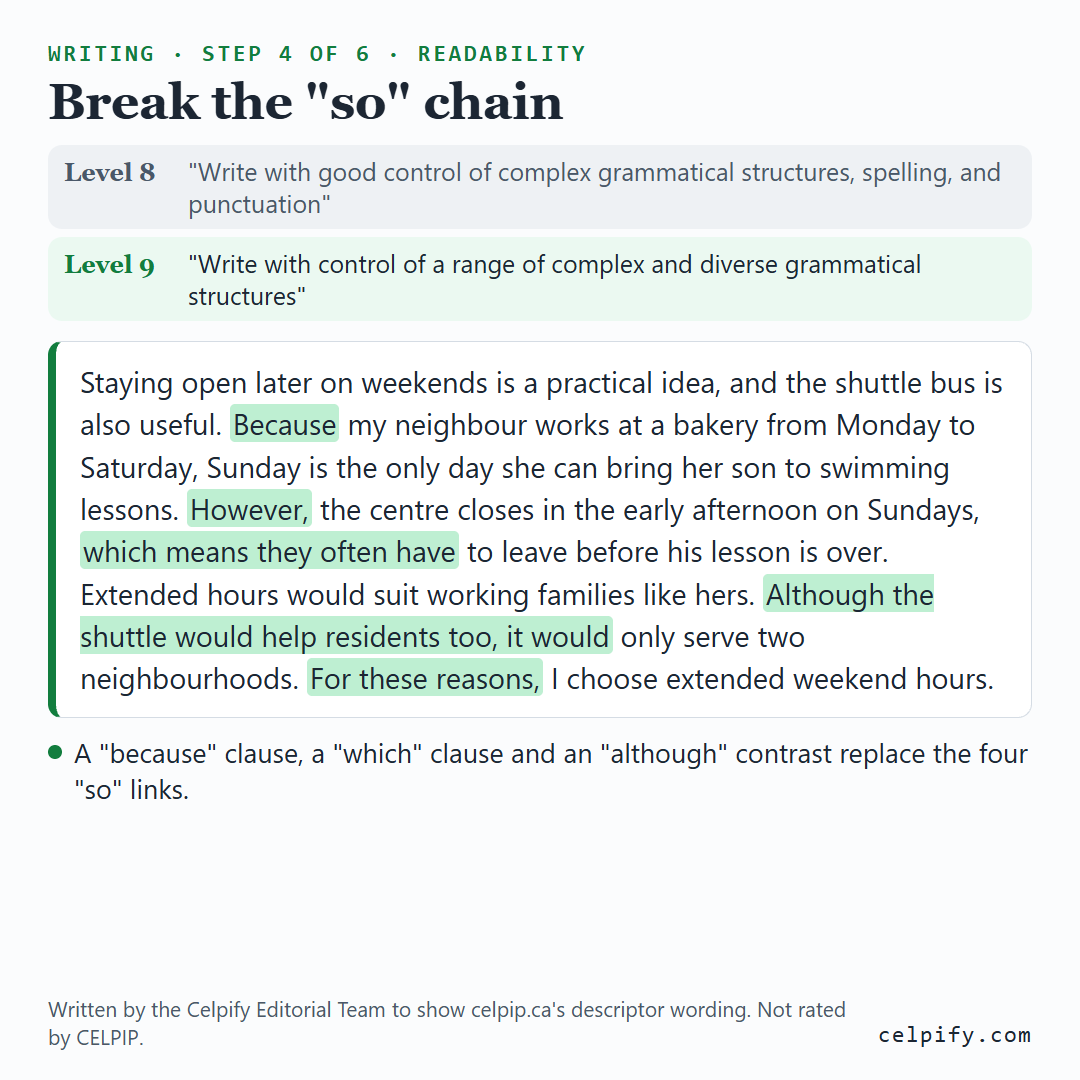
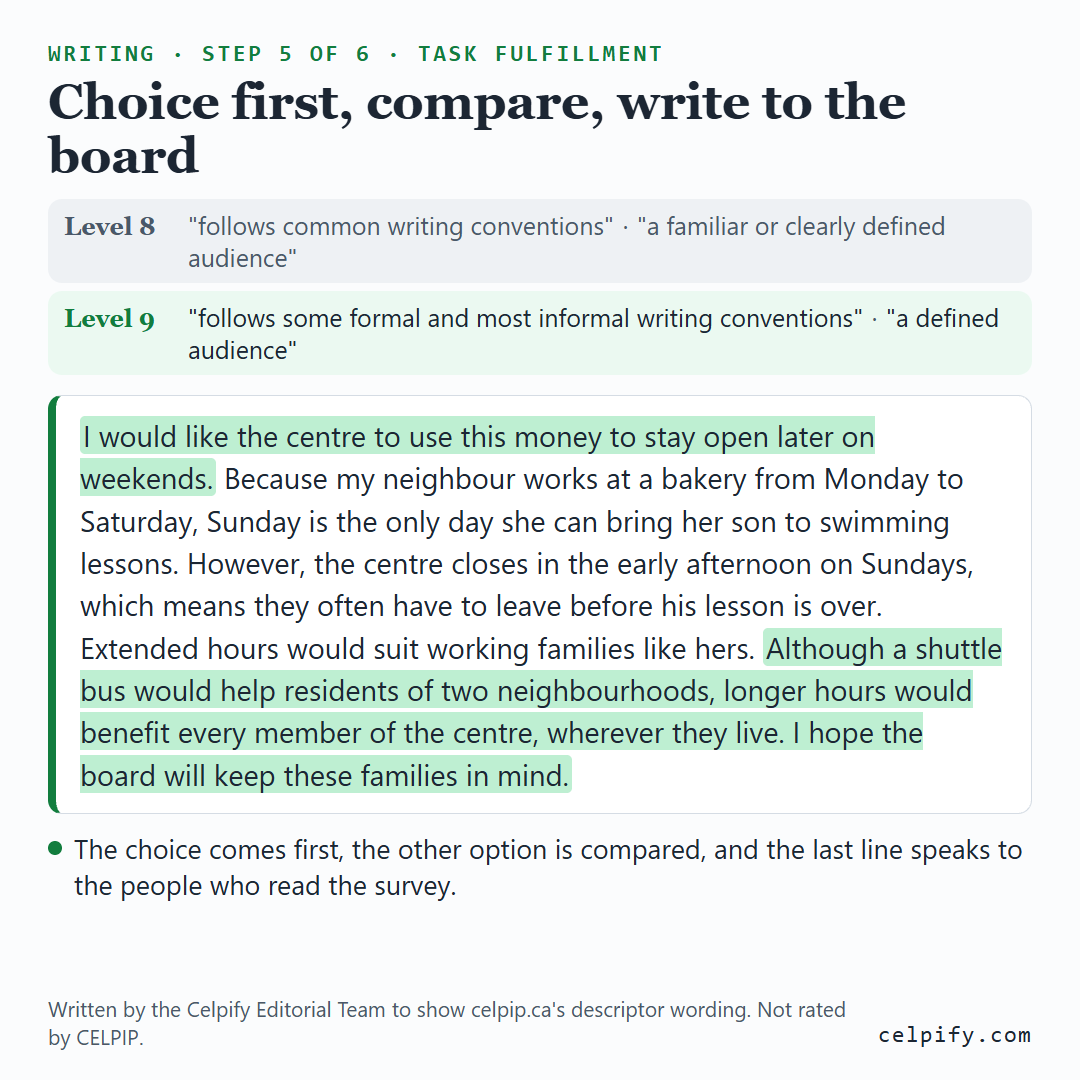
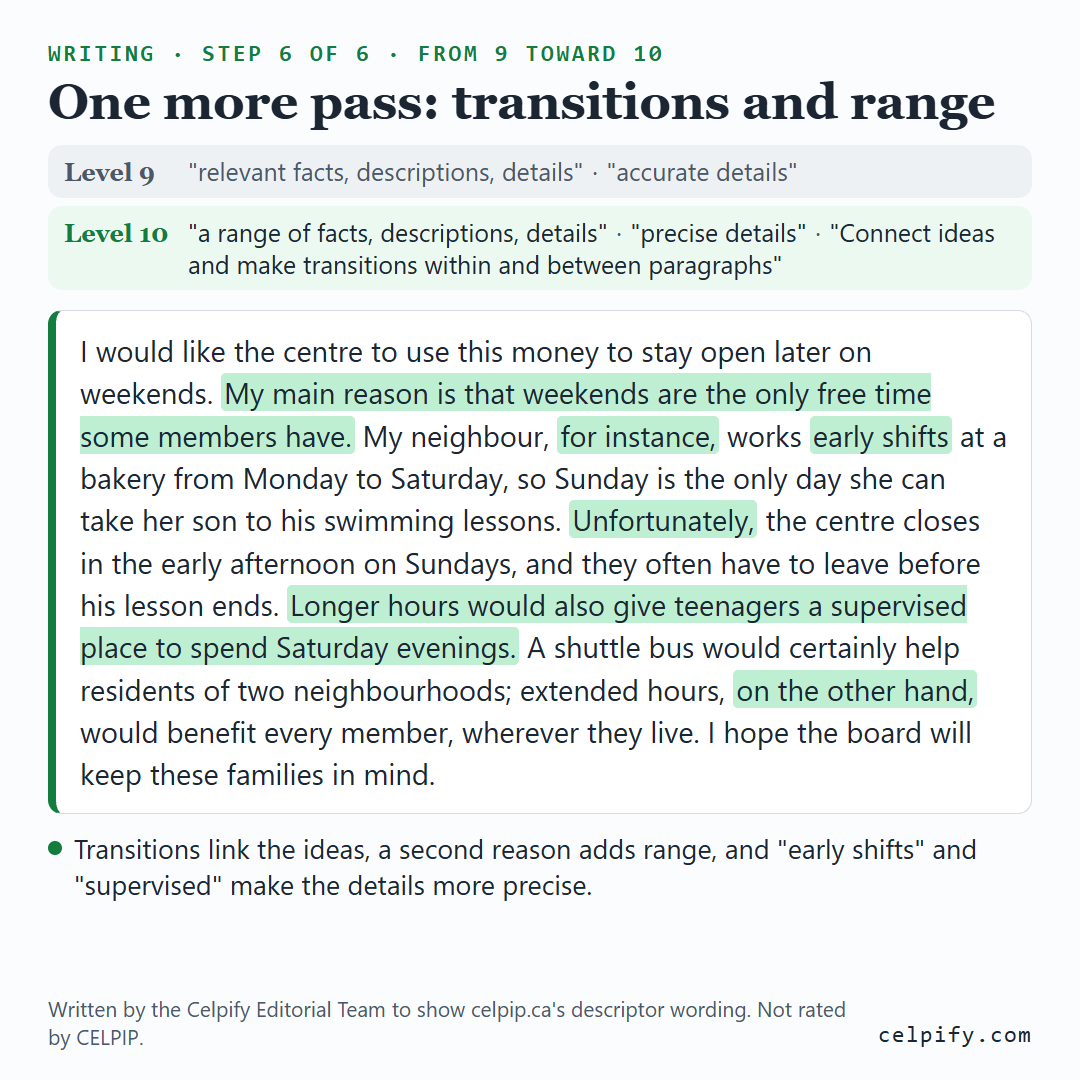
How to get 9 in CELPIP Writing: one paragraph a day
The slideshow changes one thing per pass. Do the same with your own writing. Take one body paragraph from your practice and revise it once a day, in the same order: a real detail first, then accurate words, then sentence variety, and last the choice, the comparison and the reader. You'll soon notice which pass is hardest for you, and that's the one to practise most.
Then write full tasks on the real clock, 27 minutes for Task 1 and 26 for Task 2. The Writing Pro pack suggests about 4-5 minutes of planning and about 3 minutes of checking for each response.
Don't chase rare words. In celpip.ca's words, "Strong writing isn't about using the most complicated words you know." Some prep guides tell you to memorise impressive vocabulary, but the descriptors ask for accurate and precise words, and every new word in the slideshow is an everyday one. Our guides to CELPIP Writing Task 1 and Task 2 cover each format, and you can practise both Writing tasks with feedback, or work through a full CELPIP Writing practice test.
CELPIP Speaking: What Changes From 8 to 9, and From 9 to 10
The official Speaking descriptors barely move from 8 to 9. The official sample answers show what does.
In celpip.ca's Level Descriptors, Speaking changes in only two places from 8 to 9. Vocabulary goes from "common words and some context-specific vocabulary" to "common and context-specific vocabulary". Style and tone go from "some audiences and situations" to "a range of audiences and situations", and Level 9 adds speaking "with peers or authority figures". From 9 to 10, the new lines are "good control of a broad range of complex grammatical structures", "a range of concrete and abstract language" and "a broad range of audiences and situations".
Those lines are short, so the Speaking Pro: Target 9+ Study Pack (2026) helps more here. It pairs answers rated 8 and 9 on the same tasks and explains each one. In the Level 8 answers, some ideas are "not clearly developed", "Interjections and self-corrections sometimes interfere with flow", and the sentences are "mostly simple" or keep repeating "so". The Level 9 answers give "many details" and use "many suitable and precise phrases" and "some complex sentence structures". They still have "Minor grammar errors".
Here's what that sounds like on a real task. Test 1 Speaking Task 7 asks: "Do you think remote work should become the permanent standard, or should employees return to traditional office settings? Explain your reasons." You get 30 seconds to prepare and 90 seconds to speak. The two answers below take the same side with the same three reasons, in the same AI-generated voice. Only the language changes.
Test 1 Task 7, answered at an 8 level
AI-generated voice. Written by the Celpify Editorial Team to follow the Level 8 patterns in the official Speaking pack. Not an official CELPIP rating. 197 words, 1:12 of the 90 seconds.
Answer it yourself first
Take 30 seconds to plan and 90 seconds to answer the same question out loud. Record it, then play both clips and compare.
Show transcript
Test 1 Task 7, answered at a 9 level
AI-generated voice. Written by the Celpify Editorial Team to follow the Level 9 patterns in the official Speaking pack. Not an official CELPIP rating. 193 words, 1:24 of the 90 seconds.
Show transcript
What changed between the two answers
Both speakers want people back in the office, for teamwork, for new employees and for a clear line between work and home. The 8 only names those reasons: teamwork is "better", and new employees "can learn more". The 9 shows them. You walk over to a colleague's desk and solve a problem on the spot, and a new employee learns by sitting next to a senior colleague.
The flow is different too. The 8 restarts in the middle ("I think the home... I mean"), and most of its sentences are joined with "so". The 9 keeps going, and it builds sentences with "when" and "if". It also turns to the other side with "Of course" and answers it with "However". It isn't perfect, though. Listen for "the benefits of working side by side outweighs that cost", a small grammar slip of the kind the pack's Level 9 answers still have.
What would a 10 add? The official list for a Level 9 speaker starts with "Use a variety of complex grammatical structures" and also says "Reduce the number of grammar, word choice, and pronunciation errors." The Level 10 descriptor also asks for "a range of concrete and abstract language".
To work on this yourself, use celpip.ca's own method: record an answer, listen for anything unclear, record a revised answer and compare the two. Our practice data points at the same skill. On Celpify first tries from August 1 to mid-October 2026, answers rated 8 overall (50 learners) and 9 overall (23 learners) were lowest in Vocabulary of the four dimensions. Those are Celpify AI estimates, but they match the line the official descriptors change from 8 to 9.
For timed model answers to all eight tasks, see the CELPIP Speaking test sample. The CELPIP Speaking tips cover each task, and you can answer this Task 7 on the real clock.
What CLB 9 and CLB 10 Add in Express Entry, and Where the Points Stop
Language earns CRS points skill by skill, and the biggest jump comes when the last skill reaches 9.
canada.ca's CRS criteria give core points for each ability (reading, writing, speaking and listening) in your first official language:
CLB 8 to CLB 9 adds 8 points per ability for a single applicant, from 23 to 31 (22 to 29 with a spouse or common-law partner).
CLB 9 to CLB 10 adds 3, from 31 to 34 (29 to 32 with a spouse).
Above 10 there's nothing more. The top row is "CLB 10 or more", so a CELPIP 11 or 12 earns the same as a 10.
A celpip.ca blog post confirms the ceiling: "CLB 10 is the highest scoring band for core first-official-language points." Core points aren't the whole story, though. In skill transferability, language combines with your education and your foreign work experience, and canada.ca has two columns: CLB 7 or more with one or more abilities under 9, and "CLB 9 or more on all four". The second column pays about double, and you only reach it when your fourth skill gets to 9.
canada.ca changed the CRS on November 3, 2026, for Canadian work experience and job offers. The language rows stayed the same.
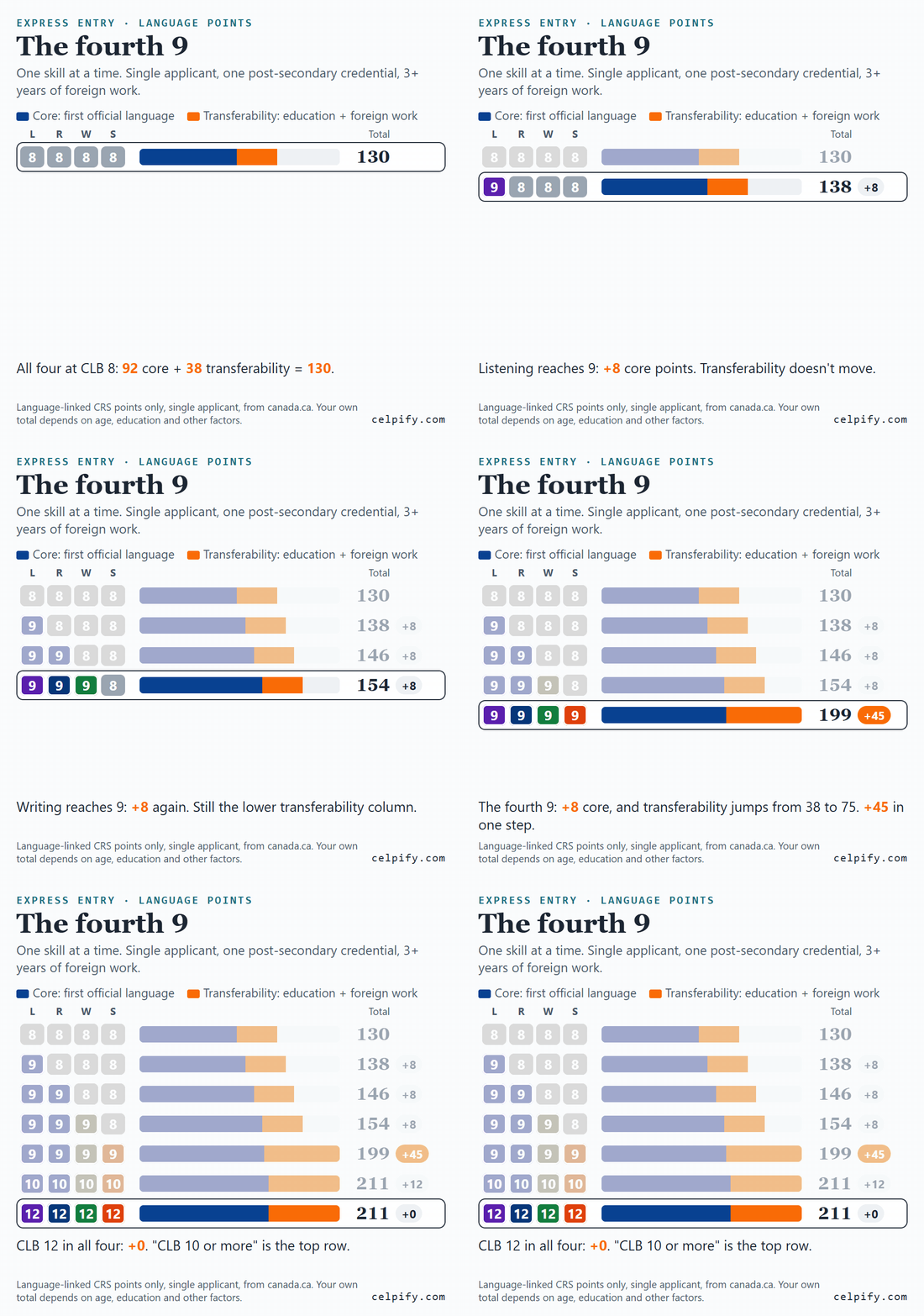
In this example, the first three 9s add 8 points each. The fourth adds 45. So bring your lowest skill to a safe 9 first, and chase 10 only once all four skills are safe 9s. When you do, start with the skill that's closest.
How to get CLB 10 in CELPIP
CLB 10 in CELPIP means a 10 in every skill: 36 of 38 in Listening and 34 of 38 in Reading to be clear of Level 9 on celpip.ca's charts, plus 10s from the raters. The descriptors put that level in a few words: "precise" details and ideas connected "within and between paragraphs" in Writing, and good control of "a broad range of complex grammatical structures" in Speaking. It's worth 3 more core points per ability than CLB 9, or 12 across all four for a single applicant. A CELPIP 10 in every skill is as high as core language points go, and CELPIP 11 and 12 add nothing. For the minimum each program asks for, see CELPIP score requirements for Express Entry.
A 4-Week Plan From CLB 8 to CLB 9
Four weeks fits a gap of a few answers and one rater level. A bigger gap needs more weeks, but the order stays the same.
- Week 1: measure. Do one unseen, timed section per skill, using the free Test 1 on Celpify practice or celpip.ca's free sample tests. Write down your four levels and your Listening and Reading counts, start the miss log, and pick your lowest skill.
- Week 2: work on the gap skill every day. For Listening or Reading, do one part a day on its official clock and label every miss. For Writing, do the one-paragraph revision. For Speaking, do one 90-second task a day: record it, play it back, record it again. The official Speaking pack suggests answering Task 7 once for each side. Give your other skills one short session every other day.
- Week 3: full tasks under time. Write both Writing tasks in 27 and 26 minutes, keeping time to plan and to check. Record all eight Speaking tasks back to back. Do two more unseen Listening and Reading sections, and check each Writing and Speaking answer against the Level 9 descriptor lines.
- Week 4: two full runs, then decide. Do two unseen full tests on different days, with Celpify Tests 2 to 60 or a full mock test (both are on paid plans). Then use the readiness check below. Book the test, or go back to Week 2 for any skill that's still short.
How to Tell You're Ready to Book
One good practice score isn't enough, because test forms differ and some questions don't count.
This is Celpify's rule of thumb, not an official CELPIP rule:
In Listening and Reading, reach the safe count (34 and 32 for CLB 9, or 36 and 34 for CLB 10) on two different unseen tests in a row.
In Writing and Speaking, get 9 or higher in every dimension on unseen prompts, twice in a row.
Why twice? One good score can flatter you. celpip.ca says the raw score for a level can vary slightly between tests, every test includes some unscored questions, and a practice estimate isn't an official rating. Two clean runs on material you haven't seen tell you much more than one.
If an official result comes back one level short in Writing or Speaking, read about CELPIP re-evaluation before you book again. For Listening and Reading, celpip.ca says a re-evaluation "is unlikely to result in a change". Our page on the CELPIP retake policy covers booking another test.
Keep an eye on dates, too. CELPIP scores are valid for two years from the date your score report is issued. For Express Entry, canada.ca says your results must be less than 2 years old when you complete your profile and when you submit your application for permanent residence.
Sources & further reading
The official pages behind the counts, descriptors and points on this page, read on November 16 and 17, 2026. The practice numbers are Celpify's own.
- CELPIP Test ResultsApproximate Listening and Reading scores out of 38 and the 'may vary slightly' note, right-or-wrong scoring, blanks scored as incorrect, unscored items, raters, the level descriptors and the two-year validityOfficial CELPIPcelpip.ca
- CELPIP Test Format and ScoringThe CELPIP level to CLB chartOfficial CELPIPcelpip.ca
- CELPIP Score Comparison ChartLevel descriptors and rated sample responses for Writing and SpeakingOfficial CELPIPcelpip.ca
- CELPIP Level Descriptors (May 2026)The 'At this level, I can' wording quoted for Writing and Speaking at 8, 9 and 10Official CELPIPcelpip.ca
- From CELPIP (CLB) Level 7 to Level 9 (CELPIP blog)Official advice for each skill, free sample tests, and the record-and-compare method for SpeakingOfficial CELPIPcelpip.ca
- CLB Scores Explained (CELPIP blog)Skills assessed separately, the L9 R8 W7 S9 example, and CLB 10 as the top band for core pointsOfficial CELPIPcelpip.ca
- CELPIP Writing Pro: Target 9+ Study PackThings to work on at Level 9, rated sample answers, and the planning and checking timeOfficial CELPIPcelpip.ca
- CELPIP Speaking Pro: Target 9+ Study PackPaired Level 8 and Level 9 analyses, Things to work on at Level 9, and Task 7 timingOfficial CELPIPcelpip.ca
- Express Entry: CRS criteriaCore language points per CLB level and the skill transferability columns for education and foreign workIRCC · Government of Canadacanada.ca
- Express Entry: Language test resultsResults must be less than 2 years old when you complete your profile and when you applyIRCC · Government of Canadacanada.ca
- CELPIP Writing Pro: Target 9+ webinar (official CELPIP YouTube)The recorded webinar that goes with the Writing Pro: Target 9+ packOfficial CELPIP · YouTubeyoutube.com
CLB 9 and CLB 10 in CELPIP: Common Questions
Short answers based on celpip.ca, canada.ca and the official study packs.