CELPIP Reading Practice Test with Answers (All 4 Parts)

This CELPIP reading practice test is the whole Reading section of Celpify's free Test 1: four parts, 38 questions, and a reason for every option. The real CELPIP-General Reading test also has 38 scored questions, and celpip.ca gives it 43 to 56 minutes. The parts below come in the same order as on the real test, with the same number of questions in each.
You can take it two ways. To run it as a CELPIP reading mock test, do each part on its own clock on the Test 1 practice pages, starting with Part 1 under the real clock, one part straight after another, then come back here for the reasons. The practice timer warns you when the official time is up but lets you keep going, so stop yourself. On test day the part simply ends.
Or answer right here, one question at a time. Each pick shows right or wrong at once and opens the reason every other option fails. You can't change a pick, so read the passage before you click.
We wrote Test 1 ourselves, wrong options included, and these are the same questions as on the free practice pages. You don't need to sign up or download anything.
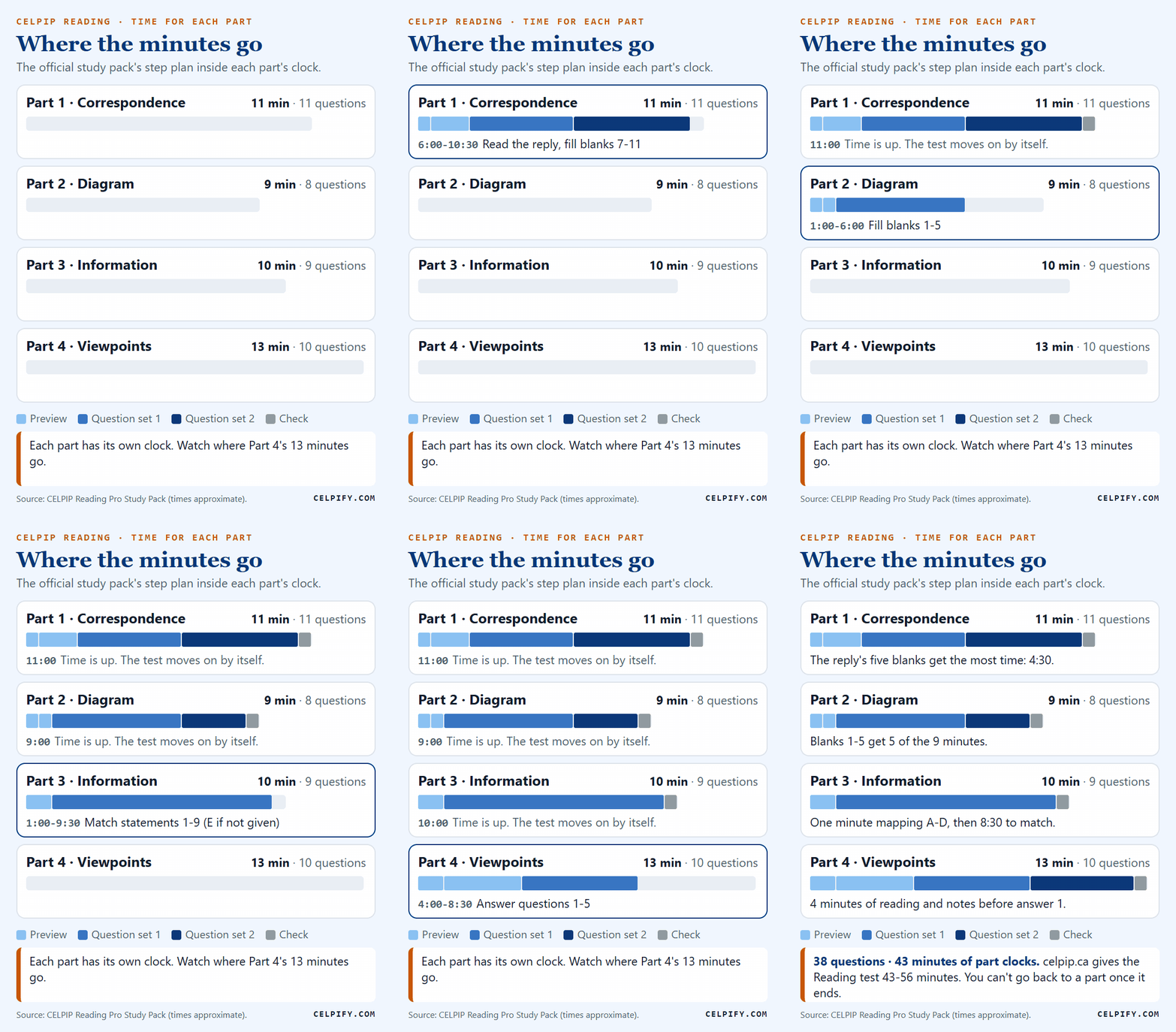
How long is each part of the CELPIP Reading test?
How many questions are in CELPIP Reading? 38, in four parts, and every part has its own clock. Here's the CELPIP Reading time for each part from the official Reading Pro Study Pack, which calls both numbers approximate:
| Part | Questions | Minutes |
|---|---|---|
| Part 1: Reading Correspondence | 11 | 11 |
| Part 2: Reading to Apply a Diagram | 8 | 9 |
| Part 3: Reading for Information | 9 | 10 |
| Part 4: Reading for Viewpoints | 10 | 13 |
| Total | 38 | 43 |
The four clocks add up to 43 minutes. celpip.ca gives the whole Reading test 43 to 56 minutes, and the pack warns that there may be one unscored part you won't be able to spot, so treat every part as if it counts. You'll see other numbers online, such as about ten minutes for Part 4 or 55 to 60 for the section. Go by the pack's 13 minutes for Part 4, the longest of the four, and celpip.ca's 43 to 56 for the whole Reading test.
Three rules change how you should practise:
A part ends with its clock. "When your time is up, the test will automatically move forward to the next part. You can't go back to a previous part," says the pack. Inside a part, you can change your answers until time runs out.
Notes go on paper. You get paper and a pen at the test centre. You can't highlight or write on the screen.
Answer everything. celpip.ca says blank questions are scored as incorrect, and there's no penalty for a wrong answer. On Test 1, 38% of the 102 Celpify learners who tried all four parts left at least one question blank on their first try (August 1 to mid-October 2026). Each of those blanks was a point they could have guessed at.
Part 4 is where the clock bites. On their first try in practice, 37% of 115 learners used all 13 minutes of Part 4, against 14% of 139 on Part 2 (same window; practice data, not official results).
Each question set below counts your score at the bottom. Write the four numbers down as you go, because you'll add them up in the score section.
Part 1: Reading Correspondence (11 Questions, 11 Minutes)
An email from one neighbour to another, then the reply with five blanks.
Part 1: Emergency Preparedness Workshop
The pack's plan for these 11 minutes: 30 seconds to preview the email (who writes, to whom, and why), 1.5 minutes to read questions 1 to 6 and mark keywords, 4 minutes to answer them, 4.5 minutes on the reply, and 30 seconds to check.
- From
- Arelis
- To
- Odran
Dear Odran,
I've kept thinking about our conversation at the September block cleanup, when several neighbours admitted they had not understood the public alert during last spring's windstorm. The message advised people to remain indoors, yet two families on Alder Lane assumed they had to leave immediately. No one was harmed, but the confusion showed that owning flashlights and bottled water is not the same as having a workable plan. Since I live only three blocks from you, beyond the east side of the park, I think we are seeing the same gap across our neighbourhood.
I contacted the city's community resilience team. They will provide a facilitator for a free 90-minute workshop, with space for up to 32 participants. Rather than giving a general lecture, the facilitator would use short scenarios to help us distinguish an information alert from an evacuation order, choose a family meeting point, and decide what belongs in a 72-hour kit. The coordinator also suggested that we ask participants about mobility, language, and apartment-access needs on the registration form, so the examples reflect the people who attend.
Two sessions are available: Saturday, November 7, from 2:00 to 3:30 p.m., or Thursday, November 12, from 6:30 to 8:00 p.m. The Maple Avenue library room costs $64. I can reserve it with my card this week, then invite optional contributions at the door. That way, we do not lose the room while waiting to see whether every participant is willing to pay.
Would you help with the part I am least equipped to do? You organized the spring clothing exchange, and you know many tenants in Birch Court, where notices left in the lobby are often missed. Could you build a short sign-up form and share it through the tenant groups? I will confirm the facilitator, book the room, and prepare a one-page summary to take home. I would also like our invitation to sound practical rather than alarming; the workshop should make people feel capable, not frightened.
If you are willing, tell me which date you prefer by Friday. I am hopeful that a small, well-planned session can turn last spring's confusion into something useful.
Best, Arelis
Odran's reply:
Hi Arelis,
Yes, I would be glad to help. After 7…, a workshop that explains how to interpret alerts feels much more useful than another checklist of supplies.
My vote is 8…. Families at Birch Court are easier to reach on a weekend, and the afternoon timing should also help residents who avoid evening travel. I can adapt the form from the clothing exchange, but I will add questions about 9… so the facilitator can plan examples people can actually use.
I especially like your idea of making the invitation 10…. Some neighbours were embarrassed about the windstorm, and a frightening message might keep exactly those people away. If you send me the facilitator's description, I can draft the notice and circulate it through the tenant groups before Monday.
Please reserve the room. I am also happy to contribute toward the 11…; paying first and collecting optional amounts later is the simplest way to protect the date.
Best, Odran
Question 1. Arelis lives ___.
Show the answer to question 1
Answer: D. in Odran's neighbourhood, a few blocks beyond the park. She says she lives "only three blocks from you, beyond the east side of the park" and then calls it "our neighbourhood". It's a specific-information question: the answer is one fact in one sentence.
- A.Alder Lane is where the two families who misread the alert live. She never says it's her street.
- B.Birch Court comes up later as the building where Odran knows tenants. It isn't her home.
- C.Maple Avenue is where the workshop room is, not where she lives.
Question 2. What moved Arelis from concern to planning was ___.
Show the answer to question 2
Answer: C. neighbours' confusion during the windstorm and their later discussion. Paragraph 1 joins two things: the alert people misread last spring and the talk at the September cleanup where neighbours admitted it. Together they showed her the gap, and then she started planning.
- A.The room comes up in paragraph 3, after she had already contacted the city and started planning.
- B.The registration questions were the coordinator's idea, and they improve a plan that already existed. They didn't start it.
- D.She mentions flashlights and water only to say that supplies aren't the same as a plan. Nobody is short of them.
Question 3. Arelis's preparations suggest that she ___.
Show the answer to question 3
Answer: D. reduces practical obstacles before requesting targeted help. Before she asks for anything, she has a free facilitator, two dates, a room and a way to pay for it. Then she asks Odran for the two jobs that fit his experience: the sign-up form and the tenant groups. "Suggest" makes this an inference question, because no single sentence says it.
- A.Close, but "every detail" is too strong. She leaves the date for Odran to choose and asks him to build the sign-up form.
- B.The form asks about mobility, language and apartment access, so people's needs are part of the plan.
- C.She keeps the facilitator, the room and the take-home summary for herself.
Question 4. Arelis offers to reserve the room with her own card because ___.
Show the answer to question 4
Answer: C. she does not want uncertainty about contributions to delay the booking. Paragraph 3: she'll pay now so that "we do not lose the room while waiting to see whether every participant is willing to pay."
- A.Nobody asks Odran to pay her back. Contributions at the door are optional.
- B.Her plan is the opposite: no payments in advance at all.
- D.No money has been collected yet. Contributions would come at the door.
Question 5. Arelis asks Odran to handle sign-up and outreach because he ___.
Show the answer to question 5
Answer: B. has organized an event and can reach Birch Court tenants. Right before she asks, she reminds him that he ran the spring clothing exchange and knows many tenants in Birch Court.
- A.Arelis contacted the city team herself. Odran's job is never mentioned.
- C.The people who misread the alert were two families on Alder Lane.
- D.The summary is Arelis's job. Odran is asked for the sign-up form.
Question 6. The message presents the workshop primarily as ___.
Show the answer to question 6
Answer: B. a constructive response to a shared weakness. The gap is "across our neighbourhood", and the last line hopes to "turn last spring's confusion into something useful". A question about the whole email is a general-meaning question.
- A.She blames nobody, and she wants people to feel "capable, not frightened".
- C.The city offers a facilitator. Nothing says the workshop is required.
- D.The only money involved is optional help with the $64 room.
Blank 7. After ___, a workshop that explains how to interpret alerts feels much more useful than another checklist of supplies.
Show the answer to blank 7
Answer: B. the confusion during last spring's windstorm. Odran links the workshop to reading alerts, and the misread windstorm alert is the event behind the whole plan.
- A.This mixes two events: the cleanup was in September and the clothing exchange was in spring. Neither is about alerts.
- C.No facilitator has visited anyone. The workshop hasn't happened yet.
- D.The Alder Lane families misread an alert. Nobody lost supplies.
Blank 8. My vote is ___.
Show the answer to blank 8
Answer: D. Saturday, November 7. The Saturday session runs from 2:00 to 3:30 p.m. A weekend afternoon fits both of Odran's reasons: weekends are easier for Birch Court families, and some residents avoid travelling in the evening.
- A.It's a weekend, but it isn't one of the two dates Arelis offered.
- B.This date was really offered, but it's a weekday evening. Odran's reasons point to a weekend afternoon.
- C.There's no Friday session. Friday appears only as the day Arelis wants his answer by.
Blank 9. I can adapt the form from the clothing exchange, but I will add questions about ___ so the facilitator can plan examples people can actually use.
Show the answer to blank 9
Answer: A. mobility, language, and apartment access. These are the three needs the coordinator suggested asking about on the registration form.
- B.The form is about what people need to take part, not what they buy.
- C.Contributions are for the room and are collected at the door. They aren't on the form.
- D.The workshop isn't looking into who made the mistake.
Blank 10. I especially like your idea of making the invitation ___.
Show the answer to blank 10
Answer: B. practical rather than alarming. Arelis wrote that she wants the invitation "to sound practical rather than alarming". Odran's next sentence, about a frightening message keeping people away, agrees with her.
- A.Nothing is compulsory, and an order would scare off the hesitant neighbours they want to reach.
- C.Odran says some neighbours are embarrassed about the windstorm. Dwelling on it would keep them away.
- D.The workshop is for people whose plans and kits aren't finished yet.
Blank 11. I am also happy to contribute toward the ___; paying first and collecting optional amounts later is the simplest way to protect the date.
Show the answer to blank 11
Answer: A. library room fee. The $64 room is what Arelis will pay for first, before asking for optional contributions.
- B.The city provides the facilitator at no cost.
- C.The form goes out through tenant groups. No printing cost is mentioned.
- D.32 is the number of places in the workshop, not a number of kits.
Question 3 was the hardest question in Part 1. On their first try, 35% of 165 Celpify learners chose D, and 31% chose A, "prefers to settle every detail before involving another resident" (August 1 to mid-October 2026).
A is tempting because Arelis really has done a lot of work. But "every detail" goes too far: she leaves the date for Odran to pick and asks him to build the sign-up form. When an option takes a fair idea and makes it absolute, look for the thing the passage leaves open.
It's also the set's inference question. "Suggest" means no single sentence holds the answer, so you build it from what Arelis does. Our CELPIP Reading Part 1 strategy guide has more on reading the email and the reply, and you can redo this set on the Part 1 practice page with its 11-minute timer.
Part 2: Reading to Apply a Diagram (8 Questions, 9 Minutes)
Read the camp's diagram, then fill in the director's email to a parent.
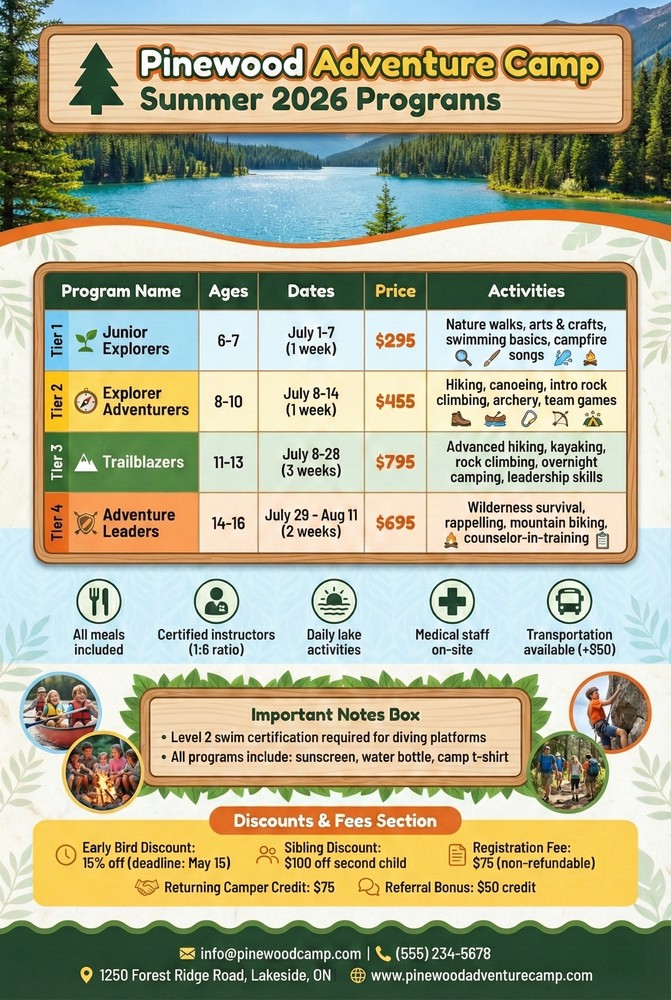
Part 2: Summer Camp Program
The pack's plan for these 9 minutes: 30 seconds on the diagram, 30 seconds on the email, 5 minutes on blanks 1 to 5, 2.5 minutes on questions 6 to 8, and 30 seconds to check.
- From
- Sumiya Calder, Camp Director
- To
- Solene Varga
- Subject
- Re: Summer camp registration for Liora and Bram
- Date
- May 22, 2026
Dear Ms. Varga,
Thank you for describing what Liora and Bram hope to do at camp. I can confirm both placements, although one differs from the program you first requested.
Liora is 13, so Adventure Leaders is not available until next summer; its age range begins at 14. The closest match is 1…. Its advanced hiking, rock climbing, overnight camping, and leadership activities fit the interests you listed. You also said your family will be away during the first week of July. This program runs 2…, so it starts after you return and gives Liora our longest session.
Nine-year-old Bram belongs in Explorer Adventurers. That one-week program shares the July 8 start date, but its introductory climbing and team games are better suited to his age group. The children will therefore attend different programs, even though their first week overlaps.
Because your message arrived after the May 15 early-bird deadline, the 15% reduction has expired. As first-time campers, they do not qualify for the returning-camper credit either. Registering two siblings does qualify your family for the 3…, applied to the second child.
Please note two practical details. All meals are included, and the camp provides each child with sunscreen, a water bottle, and a T-shirt. You said Liora hopes to use the diving platforms. Her Bronze Cross certification is useful for general swimming, but platform users must show 4…. The $75 registration fee is 5…. Transportation is optional and costs $50, so let me know whether you will drive them or add the service.
Once I receive your transportation choice and Liora's swim document, I can finalize both files.
Warmly, Sumiya Calder Camp Director
Blank 1. The closest match is ___.
Show the answer to blank 1
Answer: C. Trailblazers. Liora is 13 and wants advanced activities. The Trailblazers row is for ages 11 to 13, with advanced hiking, rock climbing, overnight camping and leadership skills.
- A.Ages 6 and 7 only, with basic activities.
- B.Ages 8 to 10. That's Bram's program.
- D.It starts at 14, as the email itself says.
Blank 2. This program runs ___, so it starts after you return and gives Liora our longest session.
Show the answer to blank 2
Answer: C. July 8-28. Trailblazers runs July 8 to 28: it starts after the family's trip and lasts three weeks, the longest on the diagram.
- A.Junior Explorers' week, when the family is away.
- B.The right start date, but only one week. These are Bram's dates.
- D.These are the Adventure Leaders dates, and Liora is too young for that program.
Blank 3. Registering two siblings does qualify your family for the ___, applied to the second child.
Show the answer to blank 3
Answer: B. $100 sibling discount. The diagram lists a sibling discount of "$100 off second child".
- A.The deadline was May 15, and the email is dated May 22.
- C.Both children are first-time campers.
- D.It's on the diagram, but nobody mentions a referral.
Blank 4. Her Bronze Cross certification is useful for general swimming, but platform users must show ___.
Show the answer to blank 4
Answer: B. Level 2 swim certification. The Important Notes box says Level 2 swim certification is required for the diving platforms.
- A.The email mentions it only to say it's enough for general swimming, not for the platforms.
- C.That's about a $75 credit, not swimming.
- D.Transportation has nothing to do with the platforms.
Blank 5. The $75 registration fee is ___.
Show the answer to blank 5
Answer: B. non-refundable. The diagram reads "Registration Fee: $75 (non-refundable)".
- A.The diagram lists the fee separately from all four program prices.
- C.No surcharge like this appears anywhere on the diagram.
- D.The fee is $75 and transportation is $50.
Question 6. Which charge can the family avoid by arranging its own travel?
Show the answer to question 6
Answer: A. the $50 transportation charge. Transportation is an optional $50 extra on the diagram, and the email says the parent can drive the children instead.
- B.The registration fee is due either way.
- C.Bram's program price is due however he gets to camp.
- D.Liora's program price is due however she gets to camp.
Question 7. Sumiya's approach to the family's requests is best described as ___.
Show the answer to question 7
Answer: B. welcoming while consistently applying the camp's limits. Her tone is warm and her placements are careful, yet every rule stays: the age limit, the deadline, the returning-camper credit, the swim rule and the fee.
- A.She doesn't bend a single rule.
- C.She lists what the camp includes and leaves transportation up to the parent. She never pushes an extra.
- D.Every detail she gives matches the diagram.
Question 8. What will the parent most likely do before registration is finalized?
Show the answer to question 8
Answer: B. choose whether to add transportation and send Liora's swim document. The last line names exactly these two things as what Sumiya still needs before she can finish both files.
- A.The email already says that discount has expired.
- C.The email explains that placement goes by age.
- D.They're first-time campers, so that credit doesn't apply.
Look at the wrong options in blanks 1 to 3. Every one of them is a real detail from the diagram, attached to the wrong child, week or condition. None of those traps is made up.
The question Celpify learners missed most was 7, about Sumiya's approach. On first tries, 57% of 143 learners got it, and 28% (40 learners) chose "promotional because she recommends every optional service" (August 1 to mid-October 2026). She does list what the camp includes, but she leaves transportation up to the parent and never pushes an extra.
The Part 2 walkthrough has a map of where each answer sits on the diagram, and this part under the real clock has the real drop-down menus.
Part 3: Reading for Information (9 Statements, 10 Minutes)
Match each statement to paragraph A, B, C or D, or choose E if the passage doesn't say it.
Part 3: The Construction of the Panama Canal
The pack's plan for these 10 minutes: 1 minute to find the main idea of each paragraph, 8.5 minutes to match the statements, and 30 seconds to check. Choose E only when the information isn't in the passage.
The Construction of the Panama Canal
A. The prospect of a water route across Panama appeared centuries before excavation began. In 1534, Charles V of Spain ordered the regional governor to survey a passage to the Pacific along the Chagres River. The route resembled part of today's canal, but the governor judged the project impossible with the means then available. Interest revived after California's 1848 gold discovery increased travel across the isthmus and the Panama Railroad began carrying passengers and freight. In 1869, the United States ordered new surveys of several Central American routes. Those studies improved knowledge of the terrain, although an early commission still preferred a route through Nicaragua.
B. Ferdinand de Lesseps, celebrated for promoting the Suez Canal, organized a French company to build at Panama. Contractors began sustained excavation in 1881. De Lesseps favoured a sea-level channel, but Panama posed different obstacles: heavy rain and thick vegetation slowed movement, while yellow fever and malaria struck the expanding workforce. Technical advisers eventually argued that a high-level canal with locks offered a more realistic path. De Lesseps resisted that change and accepted it only after costly delays. Work on the revised design started in 1888, too late to rescue the company. With subscriptions failing and funds exhausted, its shareholders placed it in receivership in 1889.
C. The United States took over the project in 1904 and adopted a lock canal. Rather than cut the entire channel at sea level, the design would raise vessels to Gatun Lake, carry them across the interior, and lower them toward the opposite ocean. Construction depended on public health as well as engineering. Chief sanitary officer William Gorgas led a coordinated campaign against mosquitoes: teams drained standing water, applied larvicides, screened buildings, and fumigated homes. These measures virtually eliminated yellow fever from the work zone and sharply reduced malaria. A healthier workforce could continue the immense excavation, dam building, and lock construction needed to cross the continental divide.
D. The canal opened on August 15, 1914, when the steamship Ancon made the first official transit. The approximately 80-kilometre waterway let ships move between the Atlantic and Pacific without sailing around South America. The United States initially operated both the canal and the surrounding Canal Zone. Control of the Zone passed to Panama in 1979, while control and responsibility for the canal itself transferred fully in 1999. Panama later expanded the route for vessels too large for the original locks. In June 2016, new lock complexes opened on the Atlantic and Pacific sides, creating another traffic lane and greatly increasing the size of ships the waterway could serve.
Question 1. A ruler commissioned a route study later judged infeasible.
Show the answer to question 1
Answer: A. Paragraph A. Charles V of Spain (the ruler) ordered the governor to survey a route in 1534, and the governor judged the project impossible.
- B.B is about a company that started building. Nobody judges a study there.
- C.C is the US takeover and disease control, with no ruler and no study.
- D.D covers the opening and the later handovers.
- E.It is given, in paragraph A.
Question 2. A distant mineral boom increased pressure for easier crossings.
Show the answer to question 2
Answer: A. Paragraph A. "California's 1848 gold discovery" is the distant mineral boom, and it "increased travel across the isthmus".
- B.B's problems are rain, plants and disease, not a boom.
- C.C's pressure is health, not a boom.
- D.D mentions bigger ships in 2016, not a mineral boom.
- E.It is given, in other words: gold is a mineral, and California is far from Panama.
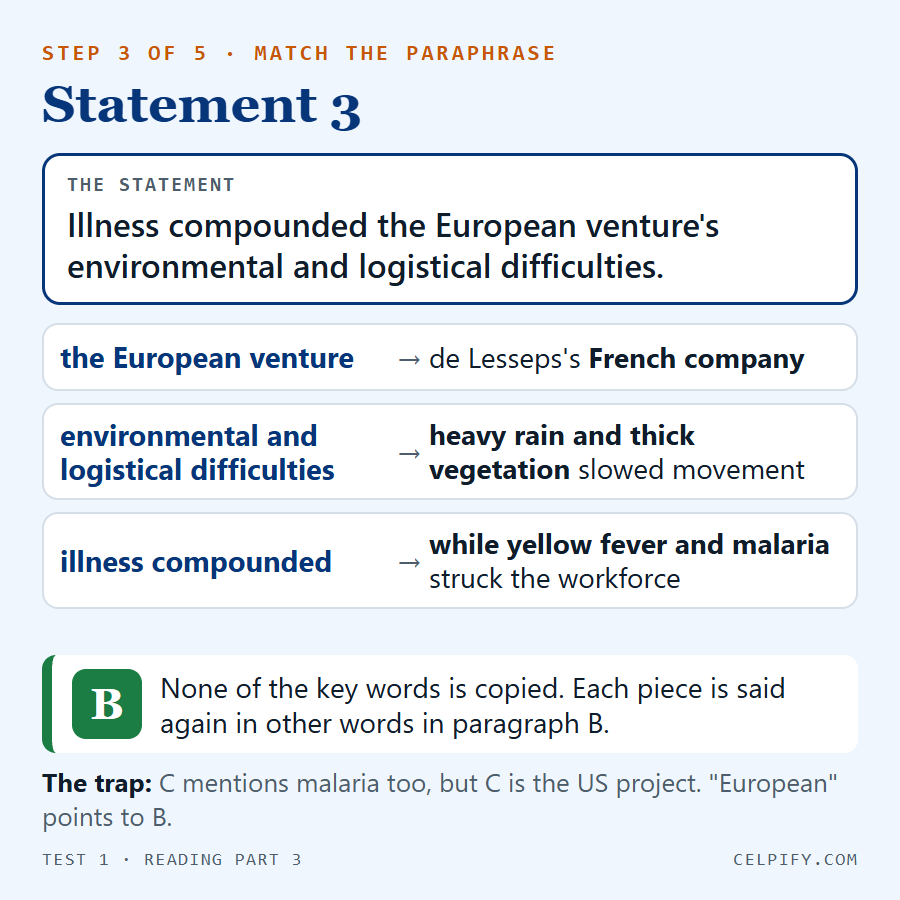
Question 3. Illness compounded the European venture's environmental and logistical difficulties.
Show the answer to question 3
Answer: B. Paragraph B. The French company (the European venture) faced rain and thick vegetation, "while yellow fever and malaria struck the expanding workforce". Illness came on top of the other problems.
- A.A has surveys, not a venture with sick workers.
- C.C mentions malaria too, but it's the US project, and there the disease is being controlled.
- D.D has no illness.
- E.Paragraph B says it in other words.
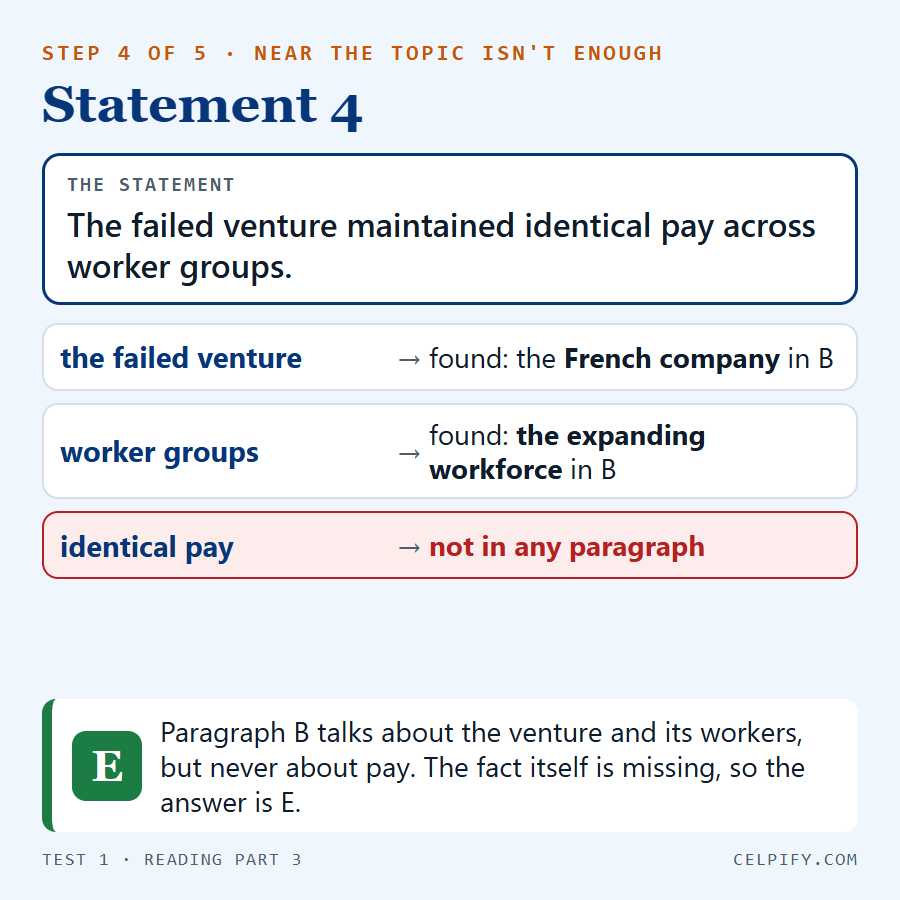
Question 4. The failed venture maintained identical pay across worker groups.
Show the answer to question 4
Answer: E. Not given in the passage. Paragraph B mentions the failed venture and its workforce, but never pay. If the passage touches the topic but not the exact fact, the answer is still E.
- A.No workers or wages in A.
- B.B is about the failed venture and mentions its workers, which makes it tempting. It never mentions wages.
- C.C's workforce is the US one, and pay isn't mentioned there either.
- D.D says nothing about workers.
Question 5. The project leader accepted a more practical design too late.
Show the answer to question 5
Answer: B. Paragraph B. De Lesseps "resisted that change and accepted it only after costly delays", and work on the new design started "too late to rescue the company".
- A.A's governor rejects a route. He doesn't accept a design.
- C.The US chose a lock canal from the start in 1904. Nothing came too late.
- D.D is about the finished canal.
- E.Paragraph B states it.
Question 6. Disease control improved conditions for the later construction effort.
Show the answer to question 6
Answer: C. Paragraph C. Gorgas's mosquito campaign "virtually eliminated yellow fever" and "sharply reduced malaria", so a healthier workforce could keep building.
- A.There's no disease in A.
- B.B has disease but no control of it. Illness is part of why the French failed.
- D.D starts once construction is over.
- E.Paragraph C states it.
Question 7. An official voyage marked the waterway's transition into service.
Show the answer to question 7
Answer: D. Paragraph D. The canal opened on August 15, 1914, "when the steamship Ancon made the first official transit".
- A.A's travellers cross the isthmus long before any canal exists.
- B.B ends with the company's collapse. The canal never opened under it.
- C.C covers construction, not the opening.
- E.Paragraph D states it.
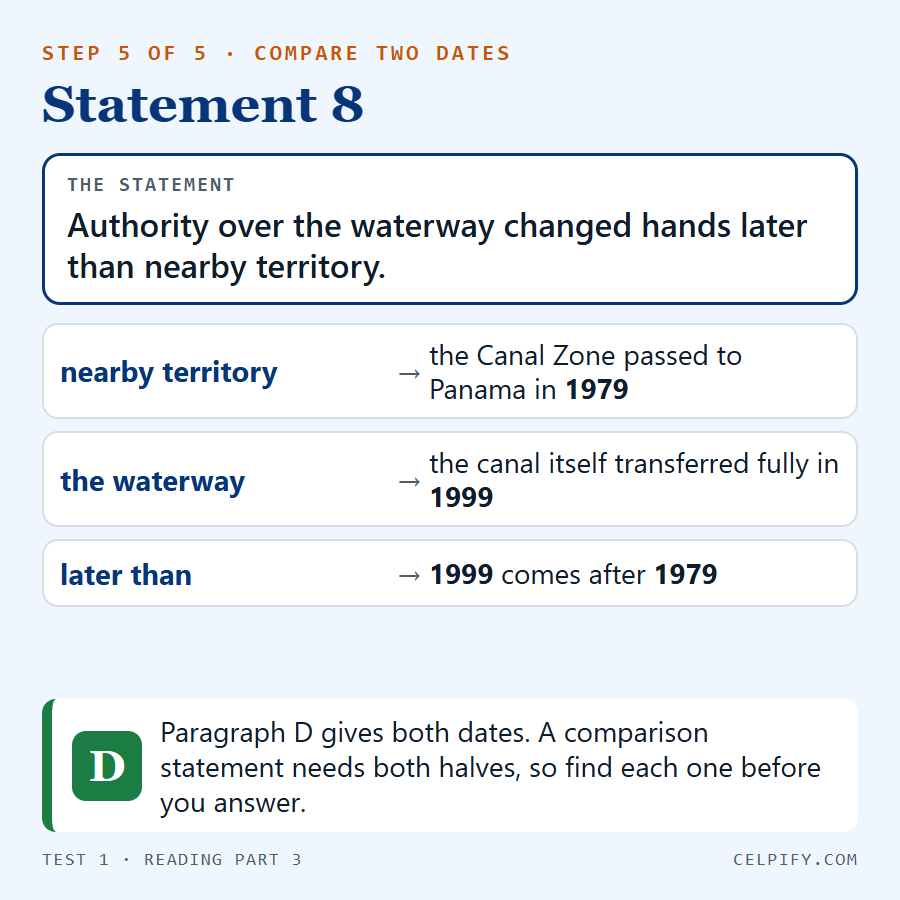
Question 8. Authority over the waterway changed hands later than nearby territory.
Show the answer to question 8
Answer: D. Paragraph D. The Canal Zone (nearby territory) passed to Panama in 1979, and the canal itself (the waterway) in 1999. 1999 is later.
- A.Nothing changes hands in A.
- B.In B a company goes into receivership. That isn't the waterway changing hands.
- C.The US takes over the project in 1904, but C says nothing about nearby territory.
- E.Paragraph D gives both dates.
Question 9. The expansion doubled the canal's capacity for daily vessel traffic.
Show the answer to question 9
Answer: E. Not given in the passage. Paragraph D says the 2016 locks created "another traffic lane" and served bigger ships. It never says capacity doubled, and it gives no daily numbers. The jump from one more lane to double the traffic is yours. The passage never makes it.
- A.A is centuries before any canal.
- B.The French never finished a canal, so there was nothing to expand.
- C.C is construction, with no expansion.
- D.D is the paragraph about the expansion, so it pulls hard. But it never says "doubled". The topic being there isn't enough: the exact fact has to be there too.
Solving Part 3, step by step
Four statements from the set above, worked through the way the study pack suggests. Swipe or use the arrows.
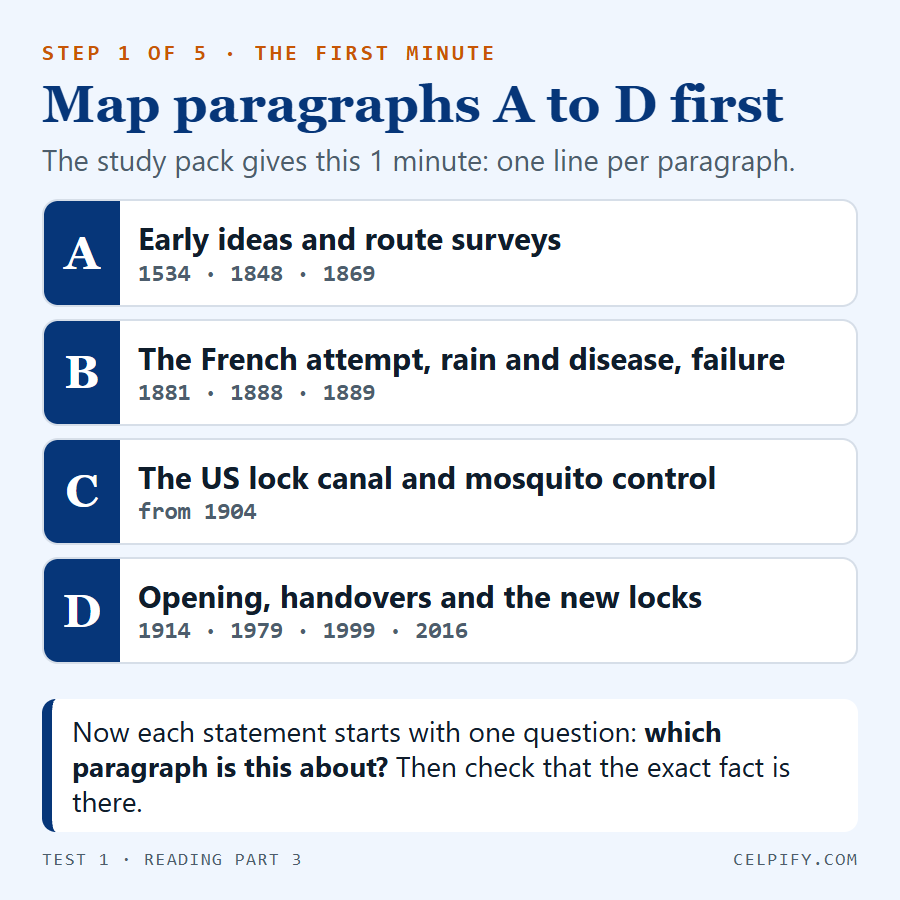
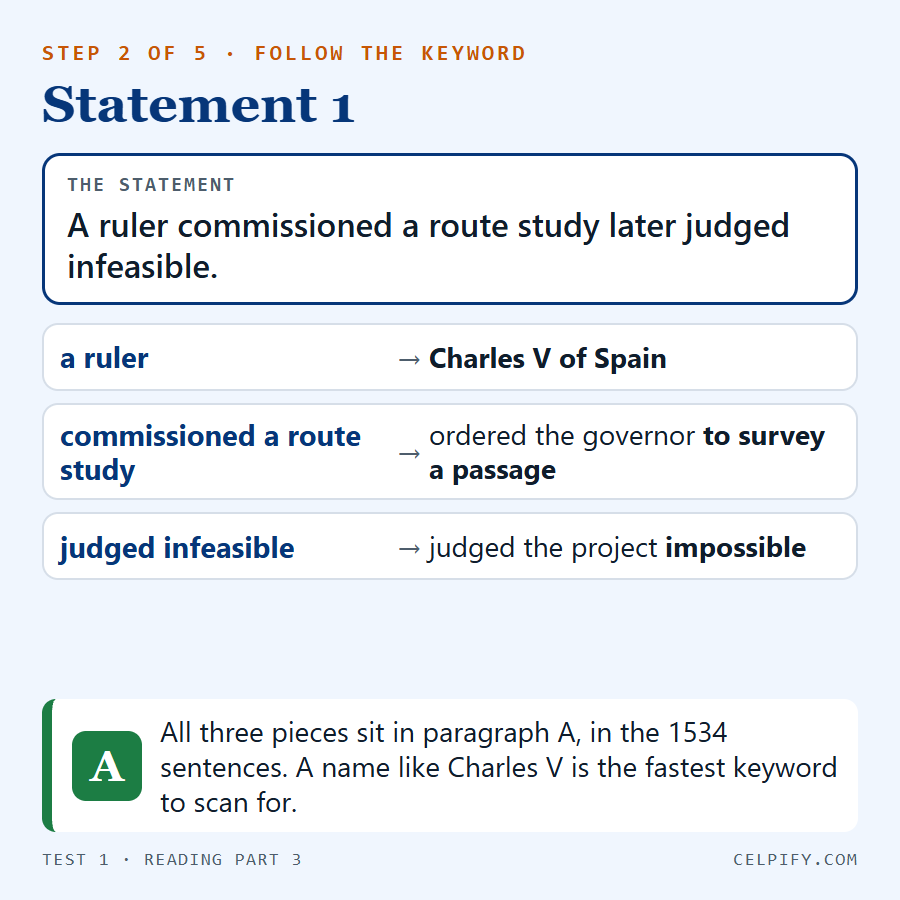
Why "not given" catches so many people
Statement 9 was the most-missed question in all of Test 1 Reading. On first tries, only 19% of 137 Celpify learners chose E, and 66% chose D (August 1 to mid-October 2026). Paragraph D is about the 2016 expansion, so it feels right. It says the new locks created "another traffic lane" and served bigger ships. It never says capacity doubled. Reading "twice the traffic" into "one more lane" is your own inference, and a statement needs a stated fact.
That's the "not given" trap: the topic is in the passage, but the exact fact isn't. Statement 4 works the same way with pay. Before you pick a paragraph, find the words that prove the whole statement, not just its subject.
Statement 2 catches people the opposite way: the fact is there, in very different words. Our look at the hardest part of CELPIP covers both statements, and the Part 3 paragraph-matching guide has more on when to choose E. You can also try this part under the real clock.
Part 4: Reading for Viewpoints (10 Questions, 13 Minutes)
An article with several opinions on one issue, then a reader's comment with five blanks.
Part 4: The Four-Day Work Week Revolution
The pack's plan for these 13 minutes: 1 minute reading questions 1 to 5, 3 minutes noting who thinks what and why, 4.5 minutes answering, 4 minutes on the comment, and 30 seconds to check.
The Four-Day Work Week Revolution
A 70-person design agency recently completed a six-month trial of a four-day week at full pay. The directors did not compress 40 hours into longer days; they reduced scheduled time and kept project targets unchanged. The experiment began after a demanding quarter in which late handoffs, correction work, and resignations all increased even though staff were spending more time online. Managers summarized their concern bluntly: "Simply extending the week was no longer improving the work."
Friday closure was only the most visible change. Meetings needed an agenda and ended after 25 minutes, routine approvals moved to shared boards, and teams set two daily periods for answering internal messages. Each client had a designated contact from Monday to Thursday, while one rotating employee monitored genuinely urgent requests on Friday. Staff could decline low-priority tasks when accepting new work, which made workload decisions explicit instead of allowing every request to appear equally urgent.
An operations consultant challenged the trial's wider significance. "A design agency can move some tasks without interrupting a physical service, but hospitals, factories, and transit systems require continuous coverage," the consultant argued. Shortening each employee's week in those settings may demand overlapping crews or more hires. The consultant also warned that a client who needs an immediate answer may judge availability rather than the quality produced per hour.
The agency's internal review reported that project completion remained steady, while sick days, late handoffs, and correction requests declined. Client complaints did not rise. "I returned after the three-day break with fewer unfinished tasks," one senior designer reported. However, the directors changed the schedule and the workflow at the same time, so the review cannot show which change produced each improvement. Some employees also reported cramming work into Thursday until managers adjusted deadlines and limited new assignments.
The trial therefore offers evidence for a conditional claim, not a universal rule. A shorter week can work when an organization removes low-value activity, protects essential coverage, and watches for work being squeezed into fewer days. It does not prove that every workplace can close on Friday, or that recovery time alone creates productivity. The useful lesson is less about subtracting a day than about redesigning work without quietly transferring the cost to clients or employees.
Reader comment:
The article is persuasive about the agency's improvement, but the comparison stops where continuous production begins. Its employees could postpone non-urgent work, while 6…. The article also admits that meetings, approvals, and handoffs were redesigned at the same time. Therefore, 7…, even if the trial result is genuine.
In my packaging plant, it is crews with 8… who keep equipment and safety checks covered when demand changes. Customers likewise expect 9… whenever a shipment problem appears. Shorter hours might still help our planning office, and I would rather test that possibility than dismiss it. On the production floor, however, staffing is the issue, not enthusiasm.
I would support a small trial in roles where work can move between days. Assuming the agency's arrangement 10… ignores the very limitation the consultant raised. Any experiment here would need a coverage plan and a check that overtime had not simply shifted to someone else.
Question 1. The article focuses mainly on ___.
Show the answer to question 1
Answer: B. what one reduced-week trial achieved and what limits its broader use. The article follows one agency's trial, its results and its weak points, adds the consultant's doubts, and ends on a limited conclusion. A question about the whole article is a general-meaning question.
- A.The last paragraph says the trial doesn't prove "that every workplace can close on Friday".
- C.Complaints "did not rise", and the five-day week never comes back.
- D.Shared boards are one small detail, not the topic.
Question 2. What prompted the agency to test a different schedule?
Show the answer to question 2
Answer: B. More time online was coinciding with errors, delays, and departures. Paragraph 1: late handoffs, correction work and resignations rose "even though staff were spending more time online". Delays, errors and departures are the same three things in other words.
- A.The directors chose not to squeeze 40 hours into longer days, and no request from staff is mentioned.
- C.The consultant doubts the trial and promises nothing.
- D.It went the other way: shorter meetings, and approvals moved onto shared boards.
Question 3. The consultant's central objection is that ___.
Show the answer to question 3
Answer: D. continuous-service workplaces may need added staffing to reduce hours. Hospitals, factories and transit "require continuous coverage", so shorter weeks there "may demand overlapping crews or more hires".
- A.The consultant doesn't question how the agency measured its results.
- B.The consultant says any client who needs a fast answer may judge availability. "Only" makes this wrong.
- C.Thursday cramming is in paragraph 4, it happened to some agency staff, and managers fixed it. The consultant doesn't say it.
Question 4. Why can the trial not identify the cause of every improvement?
Show the answer to question 4
Answer: A. The schedule and the working methods changed together. Paragraph 4: "the directors changed the schedule and the workflow at the same time", so the review can't say which change did what.
- B.The review reports complaints, so they were recorded.
- C.Project completion "remained steady".
- D.No disagreement is reported. The problem is two changes at once.
Question 5. The author's position on shorter work weeks is ___.
Show the answer to question 5
Answer: C. cautiously favourable when coverage and workload are redesigned. A shorter week "can work when" an organization cuts low-value work, protects essential coverage and watches for work being squeezed into fewer days. That's a yes, with conditions.
- A.Urgent requests were still covered on Fridays, and complaints didn't rise.
- B.The last paragraph draws a clear, practical lesson.
- D.The author says the trial doesn't prove that every workplace can do it.
Blank 6. Its employees could postpone non-urgent work, while ___.
Show the answer to blank 6
Answer: B. our production line needs staffed handoffs across every operating day. "While" sets up a contrast: the agency's work could wait, and the commenter's plant can't stop. "Our production line" puts the sentence in the commenter's own workplace.
- A.The contrast after "while" is about whether work can wait, not about meetings.
- C.It's true in the article, which is why it pulls. But after "while" the commenter needs the other side of the contrast, their own plant, not the agency again.
- D.Neither text compares how easy work is to evaluate.
Blank 7. Therefore, ___, even if the trial result is genuine.
Show the answer to blank 7
Answer: A. the schedule alone cannot receive credit for every reported gain. The sentence before says meetings, approvals and handoffs changed at the same time, so the shorter week can't take all the credit.
- B.Nobody questions the figures, and "even if the trial result is genuine" accepts them.
- C.The commenter agrees with the consultant.
- D.The commenter doesn't object to the workflow changes.
Blank 8. In my packaging plant, it is crews with ___ who keep equipment and safety checks covered when demand changes.
Show the answer to blank 8
Answer: B. predictable overlap between incoming and outgoing shifts. Overlapping shifts are how a plant that never stops stays covered. It's the consultant's "overlapping crews" point, seen from the plant floor.
- A.The commenter's whole point is that the plant can't put work off the way the agency can.
- C.No such breaks are mentioned, and they wouldn't keep anything covered.
- D.A plant depends on its machines. That's the commenter's point.
Blank 9. Customers likewise expect ___ whenever a shipment problem appears.
Show the answer to blank 9
Answer: D. a reachable contact during each scheduled shift. It echoes the consultant's warning that clients judge availability, applied to a plant that runs in shifts.
- A.Approval boards are the agency's internal tool, not something a customer expects.
- B.Customers need someone they can reach, not one particular person.
- C.The sentence is about problems that do appear, so it can't promise there will be none.
Blank 10. Assuming the agency's arrangement ___ ignores the very limitation the consultant raised.
Show the answer to blank 10
Answer: A. can transfer unchanged to a continuous-operation workplace. The consultant's limitation is exactly this: what works in a design agency may not work where coverage never stops.
- B.The commenter accepts the result for the agency. The doubt is about other workplaces.
- C.Fresh ideas aren't part of the consultant's point.
- D.That's about design work, not about moving the idea to a plant.
Who believes what in this article
| Who | What they think | Paragraph |
|---|---|---|
| The agency's directors and managers | Longer weeks had stopped improving the work, so they cut scheduled time, kept the project targets and changed how work flows. | 1 and 2 |
| An operations consultant | A design agency can move tasks around, but hospitals, factories and transit need continuous coverage. Clients who need a fast answer may judge availability. | 3 |
| A senior designer | Came back from the three-day break with fewer unfinished tasks. | 4 |
| The author | A shorter week can work under conditions, but one trial doesn't prove every workplace can close on Friday. | 5 |
Getting those four voices onto paper is the 3-minute step in the pack's plan. It pays off in the comment, where every blank depends on who is speaking.
Parts 3 and 4 were the hardest parts of Test 1 for Celpify learners. On first tries, 55% of Part 3 answers were right (137 learners) and 57% of Part 4 answers (120 learners), against 80% in Part 2 (143 learners), all from August 1 to mid-October 2026.
Blank 6 was the hardest item in Part 4: 36% of 120 learners got it, and 40% (48 learners) chose "the agency kept one employee available for urgent Friday requests." The article does say that. But the sentence reads "Its employees could postpone non-urgent work, while ___," and after "while" the commenter turns to their own plant, where work can't wait. The option is true, but it describes the wrong side of the contrast.
The CELPIP Reading Part 4 guide works through this same blank with three stance signals, and this part under the real clock is on the practice pages.
Your Score Out of 38: What Reading Level Is It?
Add up your four part counts and read the total on celpip.ca's Reading chart.
Part 1 out of 11, plus Part 2 out of 8, Part 3 out of 9 and Part 4 out of 10: that's your total out of 38. Here is celpip.ca's approximate Reading chart, with the CLB level that matches each CELPIP level:
| CELPIP level | Reading score /38 | CLB |
|---|---|---|
| 10-12 | 33-38 | 10-12 |
| 9 | 31-33 | 9 |
| 8 | 28-31 | 8 |
| 7 | 24-28 | 7 |
| 6 | 19-25 | 6 |
| 5 | 15-20 | 5 |
| 4 | 10-16 | 4 |
| 3 | 8-11 | 3 |
| M | 0-7 | below 3 |
The bands overlap. From 24 up, these counts sit in two bands: 24 and 25 (Level 6 or 7), 28 (7 or 8), 31 (8 or 9) and 33 (9 or 10-12). If your total lands on one, plan for the lower level. The counts that clear the overlaps are 26 for Level 7, 29 for Level 8, 32 for Level 9 and 34 for 10-12.
So what is 34 out of 38 in CELPIP Reading? Level 10 or higher. 34 sits only in the 10-12 band, and celpip.ca says CELPIP 10, 11 and 12 are CLB 10, 11 and 12. celpip.ca also warns that the raw score needed for a level "may vary slightly from one test to another", because official test forms are equated. A practice count isn't equated at all, so treat your level as a rough guide. The CELPIP Reading score chart explains the bands in more detail.
How Celpify learners did on Test 1
102 learners did all four Test 1 Reading parts on a first try between August 1 and mid-October 2026. Their median total was 28 out of 38, right on the overlap between Levels 7 and 8, and the middle half scored from 23 to 31. 53% reached 28 or more, 27% reached 31 or more, and 12% reached 34 or more. These are practice first tries, not official results, and Test 1 is often the first test a new learner opens.
Type your own total into the Reading box below. It starts at 28, the Test 1 median, and the note under it shows the count that clears the overlap. Fill in the other three skills if you want CLB levels and Express Entry CRS points for all four. The same calculator is on the CELPIP score calculator page, with more on how the bands work.
Listening
Level 7 or 8
30 sits in two bands. You're at Level 7 or higher, and 32 correct clears the overlap for Level 8.
Reading
Level 7 or 8
28 sits in two bands. You're at Level 7 or higher, and 29 correct clears the overlap for Level 8.
Writing
Speaking
Writing and Speaking have no answer count. Raters give a level, so pick the one on your score report or your practice feedback.
Your result · approximate
| Skill | CELPIP level | CLB | CRS points |
|---|---|---|---|
| Listening30 / 38 correct | 7 or 8 | CLB 7 or 8 | 17 or 23 |
| Reading28 / 38 correct | 7 or 8 | CLB 7 or 8 | 17 or 23 |
| Writing | 8 | CLB 8 | 23 |
| Speaking | 8 | CLB 8 | 23 |
CRS language points
80 to 92
First official language, single applicant (no spouse or partner), out of 136.
Lowest skill
CLB 7 or 8 (Listening, Reading). Programs read each skill on its own, so this is the number that has to clear a minimum. Express Entry (Federal Skilled Worker) asks for CLB 7 in every skill.
Counts that clear the overlap
- Listening: 32 correct or more for CLB 8 on the chart. You're 2 answers short.
- Reading: 29 correct or more for CLB 8 on the chart. You're 1 answer short.
- Writing and Speaking need a 8 from the raters.
Approximate, from the chart on celpip.ca
The bands come from the "example chart" on the CELPIP Test Results page. Test forms differ a little in difficulty and are equated, so celpip.ca says the raw score needed for a level "may vary slightly from one test to another".
Treat this as an estimate. Your official level comes from the form you sit.
After This Test: Redo It, Then New Passages
You've checked your answers. The same 38 questions still have more to teach before you move on to new passages.
The study pack suggests ways to get more out of a practice test after you've checked it. Start by redoing one part with no timer, as slowly as you like, and notice what held you up. That's the skill to train before your next timed run. Then label each question as general meaning, specific information or inference. On this test, Part 1's question 3 and Part 2's question 7 are inference, Part 2's question 6 is specific information, and Part 4's question 1 is general meaning. If one type keeps costing you points, go back and work out why each right answer is right.
Two more ideas from the pack. Take notes on the Part 4 article with no time limit, then do it again under a timer: 5 minutes to start, working toward one or two. And keep a list of new words from the passages, such as receivership, isthmus, larvicides and handoffs. Before you look one up, guess its part of speech and whether it sounds positive or negative.
Then move on to passages you haven't seen:
the timed Test 1 pages, one per part, if you only used this page;
celpip.ca's free practice tests, which open after a short form, and its free online sample test, which shows the correct answers for Listening and Reading;
Tests 2 to 60, which come with Celpify's paid plans. You'll find all 60 Reading tests in one place.
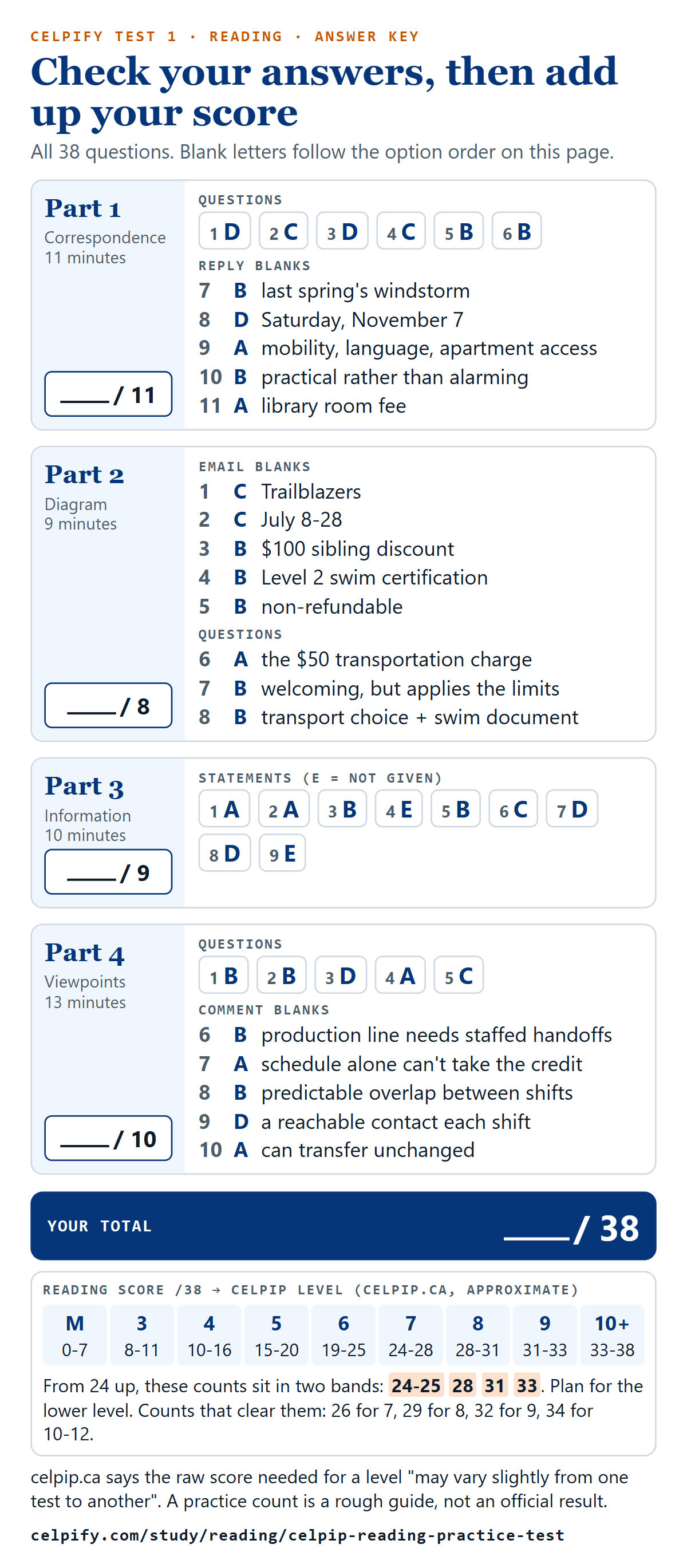
Looking for a CELPIP reading test with answers as a free PDF? We don't make one. The answer key below prints on one page, and the passages work better on a screen, which is how you'll read them on test day. Our guide to the free CELPIP practice test with answers explains what most of the PDFs online really are. For strategy across all four parts, see how to prepare for CELPIP Reading.
Sources & further reading
The official sources behind the format, timing and scoring facts on this page. The practice numbers are Celpify's own.
- CELPIP Test Format and ScoringReading time (43-56 minutes), the four Reading part names, unscored items and the CELPIP-to-CLB chartOfficial CELPIPcelpip.ca
- CELPIP Test ResultsApproximate Reading scores out of 38 for each level, the note that the count can vary between tests, and blanks scored as incorrectOfficial CELPIPcelpip.ca
- CELPIP Reading Pro Study Pack (2026)Questions and minutes for each part, the suggested steps, no going back, notes on paper, question types and study methodsOfficial CELPIPcelpip.ca
- CELPIP Free Practice TestsThe official free practice tests, opened with a short formOfficial CELPIPcelpip.ca
- CELPIP Tips and ResourcesNo penalty for incorrect answers on the Reading testOfficial CELPIPcelpip.ca
- CELPIP Reading Pro webinar (official CELPIP YouTube channel)CELPIP's own session on Reading format and strategyOfficial CELPIP · YouTubeyoutube.com
- Express Entry: CRS criteriaCRS points for each language ability, used by the calculatorIRCC · Government of Canadacanada.ca
- Express Entry: language test resultsThe CLB 7 minimum for the Federal Skilled Worker Program that the calculator mentionsIRCC · Government of Canadacanada.ca
CELPIP Reading Practice: Common Questions
Short answers based on celpip.ca, the official study pack and our Test 1 data.