What Is the Hardest Part of CELPIP? Our Practice Data

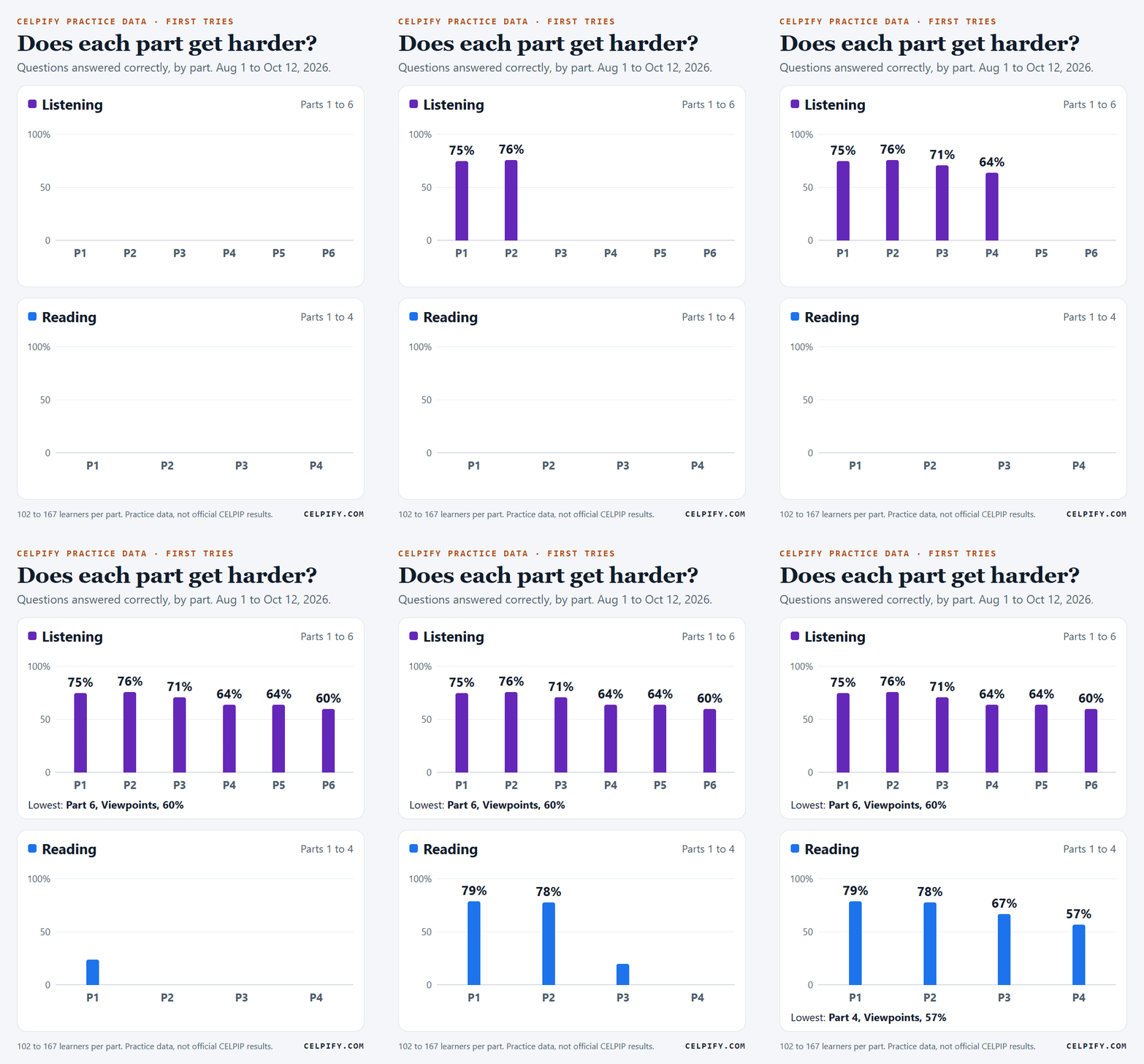
On Celpify, the hardest part of CELPIP is Speaking Task 8. Next come the two viewpoints parts, Listening Part 6 and Reading Part 4. That's what learners' first tries showed between August 1 and October 12, 2026, across every Listening and Reading part and every Speaking and Writing task.
Is the CELPIP test hard, and which part is hardest? Ask online and you'll mostly get opinions, from instructors and forum threads. We couldn't find anyone who publishes part-level numbers along with the method behind them. So here are ours, with the number of learners next to each figure and the limits set out in how we measured it.
| Skill | Hardest on Celpify | Result |
|---|---|---|
| Listening | Part 6, Listening to Viewpoints | 60% correct |
| Reading | Part 4, Reading for Viewpoints | 57% correct |
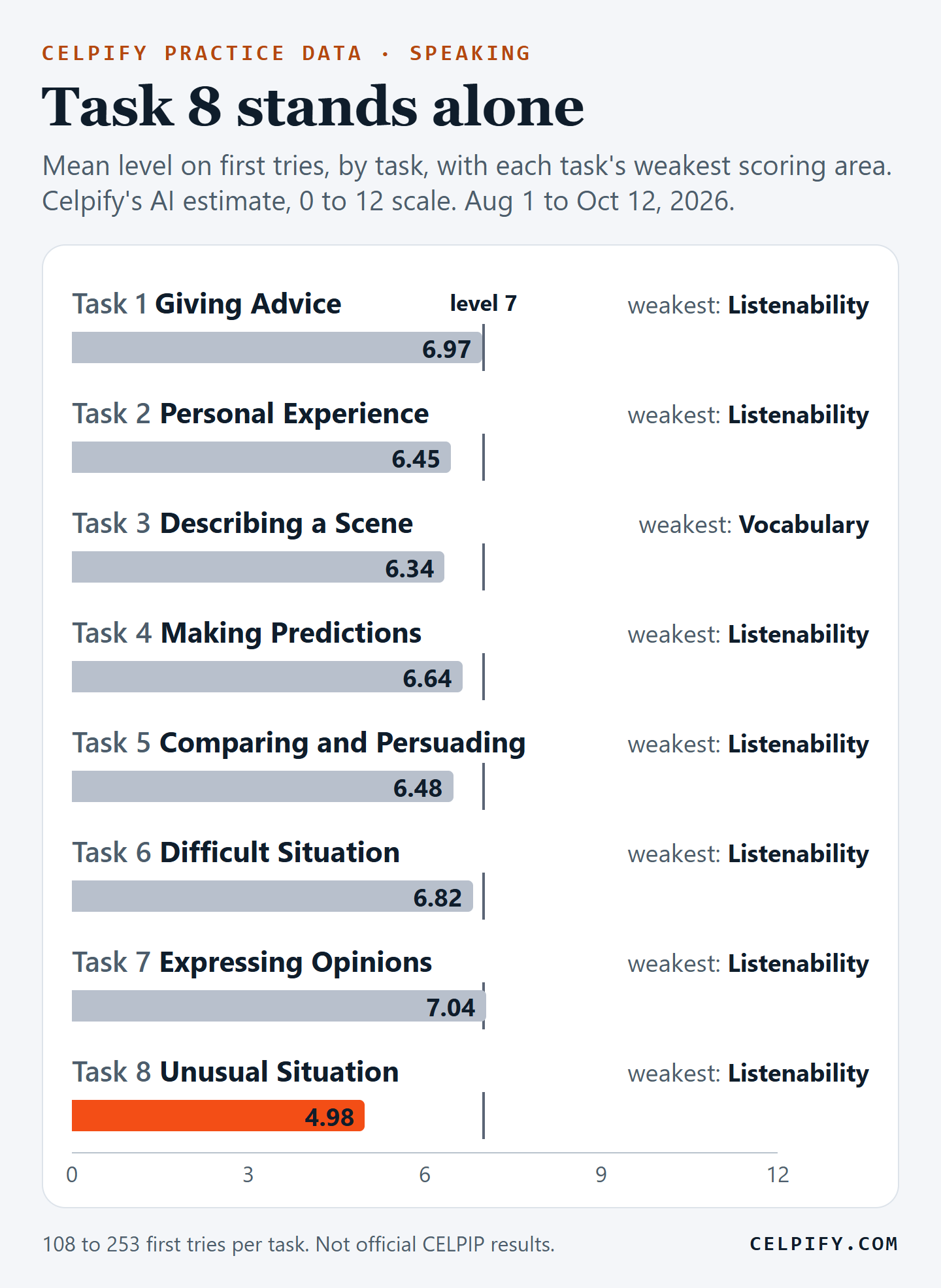
| Speaking | Task 8, Describing an Unusual Situation | level 4.98 (AI estimate) |
| Writing | Task 2, Responding to Survey Questions | level 7.57 (AI estimate) |
Your own weakest skill is a separate question. Of 29 learners who practised all four skills, Speaking was the lowest for 12. And if you're comparing CELPIP with IELTS instead, our CELPIP vs IELTS comparison covers that.
CELPIP Listening Gets Harder Part by Part
CELPIP's Listening Pro Study Pack says the audio and the questions "increase in difficulty" from Part 1 to Part 6. Our learners' results follow that design closely.
| Part | Learners | First tries | Correct |
|---|---|---|---|
| 1. Listening to Problem Solving | 165 | 357 | 75% |
| 2. Listening to a Daily Life Conversation | 139 | 290 | 76% |
| 3. Listening for Information | 133 | 281 | 71% |
| 4. Listening to a News Item | 121 | 267 | 64% |
| 5. Listening to a Discussion | 109 | 238 | 64% |
| 6. Listening to Viewpoints | 102 | 222 | 60% |
Part 2 is the only exception, and only by a point. From Part 3 on, each part scores lower than the one before, with Parts 4 and 5 almost tied.
Heard questions vs questions on screen
In Parts 1 to 3 you hear each question and choose from four answers, with 30 seconds per question. In Parts 4 to 6 you read all the questions on one screen and complete sentences. Learners got 74% of the heard questions right (5,992 answers from 173 learners) and 63% of the on-screen ones (4,571 answers from 126 learners).
The format isn't the whole story, because the later parts are harder by design. One habit stood out, though. Learners left 10% of on-screen questions blank, against 6% of heard ones. CELPIP scores a blank as wrong and takes nothing off for a wrong answer, so a guess always beats an empty box.
Why Part 6 is the hardest part of CELPIP Listening
Part 6, Listening to Viewpoints, is one speaker giving a prepared talk of about three minutes, the longest single clip on the test. The official pack describes it as formal, full of "concepts, possibilities, analysis" and "low-frequency and specialized language." Its advice is to note who is mentioned, what they believe and why, so there's a lot to keep track of at once.
Parts 4 and 5 sit just above it at 64%. Part 4 is a news report from one speaker. Part 5 is a discussion between three speakers who sometimes disagree; it's a video on the real test and audio only on Celpify. For note-taking on that talk, see the CELPIP Listening Part 6 guide.
CELPIP Reading: Part 4 Is the Wall
The Reading Pro Study Pack gives Reading the same design, harder from Part 1 to Part 4. Here the drop is steeper, and it comes in two steps.
| Part | Learners | First tries | Correct |
|---|---|---|---|
| 1. Reading Correspondence | 167 | 377 | 79% |
| 2. Reading to Apply a Diagram | 144 | 310 | 78% |
| 3. Reading for Information | 141 | 308 | 67% |
| 4. Reading for Viewpoints | 123 | 276 | 57% |
Parts 1 and 2 are level, at 79% and 78%. Then the share of right answers falls 11 points at Part 3 and another 10 at Part 4. At 57%, Part 4 had the lowest score of any part in Listening or Reading.
Why Part 4 is the hardest part of CELPIP Reading
Part 4, Reading for Viewpoints, is the longest Reading part: 10 questions in about 13 minutes. You read an article that gives two or more opinions on a community issue, then a reader's comment with blanks to fill. The pack calls the article formal, complex and conceptual, and its steps for this part tell you to use inference and to work out the commenter's opinion from context. Many answers aren't sitting in one sentence you can scan for.
Part 3 isn't far behind. You match nine statements to four paragraphs, or pick E when no paragraph gives the information. By question format, Part 3's paragraph matching had the lowest share right at 67%, against 70% for fill-in blanks, 72% for the Part 2 diagram questions and 75% for multiple choice. The Reading Part 4 guide has a timing plan for the last part.
Part 3 also holds the most-missed question on Celpify's free Test 1. Try it before you read on.
Try the question most people miss
Reading Part 3 from Celpify's free Test 1. Decide which paragraph contains the information in each statement, or choose E if none of them does. On first tries, 18% of 134 learners got statement 9 right and 31% got statement 2 right.
A. The prospect of a water route across Panama appeared centuries before excavation began. In 1534, Charles V of Spain ordered the regional governor to survey a passage to the Pacific along the Chagres River. The route resembled part of today's canal, but the governor judged the project impossible with the means then available. Interest revived after California's 1848 gold discovery increased travel across the isthmus and the Panama Railroad began carrying passengers and freight. In 1869, the United States ordered new surveys of several Central American routes. Those studies improved knowledge of the terrain, although an early commission still preferred a route through Nicaragua.
B. Ferdinand de Lesseps, celebrated for promoting the Suez Canal, organized a French company to build at Panama. Contractors began sustained excavation in 1881. De Lesseps favoured a sea-level channel, but Panama posed different obstacles: heavy rain and thick vegetation slowed movement, while yellow fever and malaria struck the expanding workforce. Technical advisers eventually argued that a high-level canal with locks offered a more realistic path. De Lesseps resisted that change and accepted it only after costly delays. Work on the revised design started in 1888, too late to rescue the company. With subscriptions failing and funds exhausted, its shareholders placed it in receivership in 1889.
C. The United States took over the project in 1904 and adopted a lock canal. Rather than cut the entire channel at sea level, the design would raise vessels to Gatun Lake, carry them across the interior, and lower them toward the opposite ocean. Construction depended on public health as well as engineering. Chief sanitary officer William Gorgas led a coordinated campaign against mosquitoes: teams drained standing water, applied larvicides, screened buildings, and fumigated homes. These measures virtually eliminated yellow fever from the work zone and sharply reduced malaria. A healthier workforce could continue the immense excavation, dam building, and lock construction needed to cross the continental divide.
D. The canal opened on August 15, 1914, when the steamship Ancon made the first official transit. The approximately 80-kilometre waterway let ships move between the Atlantic and Pacific without sailing around South America. The United States initially operated both the canal and the surrounding Canal Zone. Control of the Zone passed to Panama in 1979, while control and responsibility for the canal itself transferred fully in 1999. Panama later expanded the route for vessels too large for the original locks. In June 2016, new lock complexes opened on the Atlantic and Pacific sides, creating another traffic lane and greatly increasing the size of ships the waterway could serve.
Question 9. The expansion doubled the canal's capacity for daily vessel traffic.
Show the answer to question 9
Answer: E. Not given in any paragraph. E is right. Paragraph D says the 2016 locks created "another traffic lane" and greatly increased "the size of ships" the canal could serve. It never gives a number of ships per day, and it never says anything doubled. A second lane sounds like twice the traffic, but that's your inference, not the text. In Part 3 the information has to be stated, not just likely.
- A.Paragraph A covers the early route surveys, from 1534 to 1869. There's no expansion in it.
- B.Paragraph B is the French company's attempt, which ended in receivership in 1889. Nothing was expanded.
- C.Paragraph C describes the American lock design and the campaign against mosquitoes. It doesn't mention expansion or traffic.
- D.This is the trap. Paragraph D does describe the expansion: new locks in June 2016, another traffic lane and bigger ships. But it doesn't say daily traffic doubled, so the statement claims more than the paragraph does.
Question 2. A distant mineral boom increased pressure for easier crossings.
Show the answer to question 2
Answer: A. Paragraph A. A is right. Paragraph A says interest revived after "California's 1848 gold discovery increased travel across the isthmus." A gold discovery is a mineral boom, California is far from Panama, and more travel created the demand for an easier crossing. The statement shares almost no words with the paragraph, which is why so many people missed it.
- B.Paragraph B talks about money running out ("subscriptions failing and funds exhausted"), not a boom.
- C.Paragraph C mentions "immense excavation", which can sound like mining. It means digging the canal, not a mineral boom.
- D.Paragraph D covers the 1914 opening, the handovers and the 2016 expansion. No gold or minerals.
- E.The information is there, just in other words. "Gold discovery" is the mineral boom and "increased travel" is the pressure for an easier crossing.
Only 18% of the 134 learners who tried statement 9 chose E on their first try. Test 1 is the first test most new learners open, so take that as one question's result, not a typical Part 3 score.
The two statements catch people in opposite ways. Statement 9 adds a claim the passage never makes. Statement 2 repeats something the passage does say, in completely different words. When to choose E is covered in the Reading Part 3 guide, and you can try all nine statements in Celpify's free practice.
CELPIP Speaking: Task 8 Stands Alone
One Speaking task scores far below the others. These are Celpify's AI estimates of the CELPIP level, so read them as practice signals, not official scores.
| Task | Mean level | Below level 7 | First tries | Learners |
|---|---|---|---|---|
| 1. Giving Advice | 6.97 | 31% | 253 | 108 |
| 2. Talking about a Personal Experience | 6.45 | 42% | 193 | 74 |
| 3. Describing a Scene | 6.34 | 52% | 170 | 58 |
| 4. Making Predictions | 6.64 | 39% | 122 | 30 |
| 5. Comparing and Persuading | 6.48 | 46% | 120 | 27 |
| 6. Dealing with a Difficult Situation | 6.82 | 38% | 117 | 27 |
| 7. Expressing Opinions | 7.04 | 31% | 108 | 22 |
| 8. Describing an Unusual Situation | 4.98 | 85% | 113 | 23 |
Task 8 averaged 4.98. The next lowest, Describing a Scene, averaged 6.34. And 85% of Task 8 first tries came in below level 7, while no other task went above 52%.
The Task 8 group is small, though. Only 23 learners tried it in this window, against 108 for Task 1, so its numbers are less certain than the rest.
Why Task 8 is the hardest part of CELPIP Speaking
In Task 8 you look at a picture of an unusual item or situation and describe it to someone who can't see it, as if on a phone call. You get 30 seconds to prepare and 60 seconds to speak. The object is strange on purpose, so the exact word often isn't there when you need it. The official pack's advice is to "create phrases using common words to express precise meaning" when you can't find accurate vocabulary.
Task 8 was low in all four scoring areas: Content/Coherence 4.97, Vocabulary 4.75, Listenability 4.55 and Task Fulfillment 4.68. All four sit close to the task's overall 4.98, so no single area explains the drop. There's a 30-second plan for it in the Speaking Task 8 guide.
Listenability costs the most points almost everywhere
In seven of the eight tasks, Listenability was the weakest of the four scoring areas. Task 3 was the exception: there, Vocabulary was lowest, perhaps because a busy scene calls for a lot of specific nouns.
Listenability isn't only about accent. CELPIP's Speaking performance standards put rhythm, pronunciation and intonation under it, along with pauses, interjections and self-correction, and grammar and sentence structure. Long pauses, restarts and grammar slips all count against it.
No, you don't get 10 seconds to prepare
In October 2026, Google's AI Overview for "is CELPIP hard" said Speaking gives you "a very short prep time (around 10 seconds)." That's wrong. The official CELPIP Speaking Pro Study Packs give 30 seconds to prepare for Tasks 1, 2, 3, 4, 7 and 8, and 60 seconds for Tasks 5 and 6. Task 5 also gives you 60 seconds before that to choose between two options.
CELPIP Writing: Closer Than You'd Think
On Celpify, the two Writing tasks score about a quarter of a level apart.
| Task | Mean level | Below level 7 | Level 9+ | First tries | Learners |
|---|---|---|---|---|---|
| 1. Writing an Email | 7.83 | 16% | 24% | 267 | 130 |
| 2. Responding to Survey Questions | 7.57 | 25% | 23% | 163 | 89 |
Task 2 is a little harder. Its mean is lower, and more first tries fell below level 7: 25% against 16% for the email. At the top end there's no real gap, with close to a quarter of first tries at level 9 or higher on both tasks. In Task 2 you pick one of two options and argue for it, and our Writing Task 2 guide walks through planning that argument.
Readability was the weakest scoring area at 6.87. Content/Coherence averaged 7.82, Vocabulary 7.71 and Task Fulfillment 8.25 (427 evaluations from 132 learners). In CELPIP's Writing performance standards, Readability covers format and paragraphing, connectors and transitions, grammar and sentence structure, and spelling and punctuation. Learners usually had enough to say, and lost more points on how their writing read.
So Which Skill Is Hardest for You?
Averages show where the test is hard for most people. They can't tell you where it's hard for you.
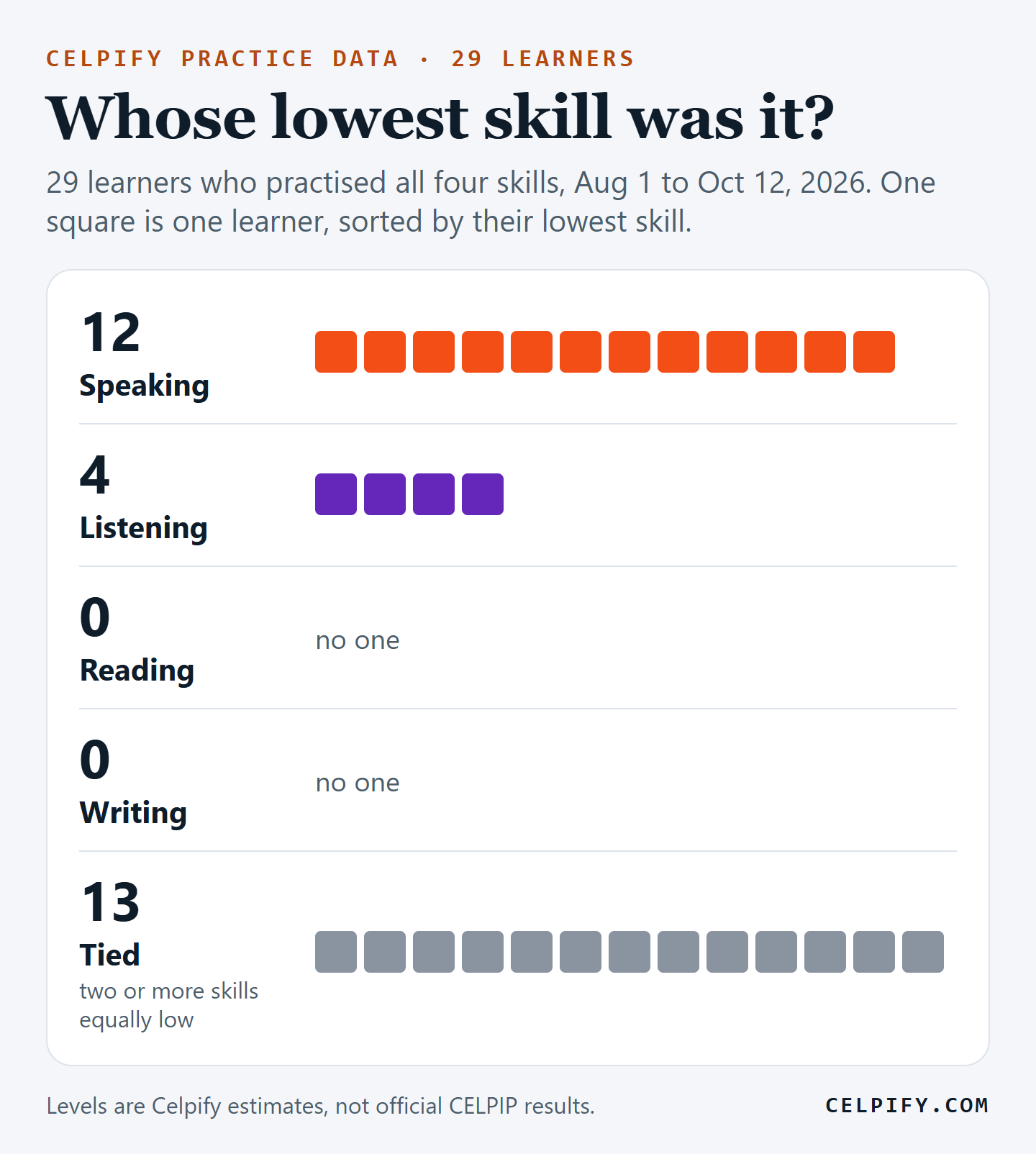
So which CELPIP section is hardest for one person? To get closer, we looked at the 29 learners who had practised all four skills. Speaking was the lowest skill for 12 of them and Listening for 4. Reading and Writing weren't anyone's single lowest skill. The other 13 had a tie, with two or more skills at the same lowest level.
Putting four skills on one scale takes a shortcut. For Listening and Reading, we turned each learner's share of right answers into a score out of 38 and read it against celpip.ca's approximate score chart, taking the lower level where the ranges overlap. For Writing and Speaking, we used the rounded average of Celpify's AI levels. Because the levels are whole numbers, ties are common. With 29 people, read these as counts, not as a rule.
How to find your weakest skill
Do all four skills under time and compare your levels side by side. Celpify's free Test 1 covers every part and task, and our guide on how to prepare for CELPIP by finding your weakest skill first explains what to do with the result.
Once you know it, start where this data says the points go. If Speaking is lowest, begin with Task 8 and record yourself so you can hear your own pauses and restarts. For Listening, spend your time on Parts 4 to 6 and answer every question before the timer runs out. Weak in Reading? Give Part 4 the most practice, and drill the E option in Part 3. And if it's Writing, look at Readability first: paragraphs and connectors, then a last check of spelling and punctuation.
How We Measured This
Celpify practice data, first tries only, from August 1 to October 12, 2026. Here's what that means and what it doesn't.
What these numbers are, and what they aren't
It's practice data, not official results. These learners were practising on Celpify, and Celpify's questions follow the official format without being CELPIP's questions. CELPIP also adjusts for differences in difficulty between test versions. We don't.
Learners choose what they practise, so group sizes vary: 165 learners for Listening Part 1 but 102 for Part 6, and 108 for Speaking Task 1 but 23 for Task 8. Every group in this article has at least 5 learners.
Listening and Reading results are the share of questions answered correctly, counted the way CELPIP counts them: right or wrong, with blanks as wrong. Writing and Speaking levels are Celpify's AI estimate of the CELPIP level, not ratings by CELPIP raters. A first try with a blank response or no usable speech is left out of those averages.
We count first tries only. Each learner counts once per passage or prompt, because people remember answers when they repeat a question. Answers given inside Celpify mock tests count too.
The window is August 1 to October 12, 2026. Some questions and answer keys changed before August, so older answers can't be checked against today's key. From August on, our recount matched the scores Celpify had stored for 100% of Listening and Reading attempts.
Admin, staff and test accounts are excluded. So is a same-sitting comparison from full mock tests, because too few learners completed one in this window. The weakest-skill count uses practice questions only, for learners with at least 3 Listening parts, 2 Reading parts and some Writing and Speaking.
Percentages are rounded to whole numbers. Mean levels keep two decimals so close tasks stay in order.
CELPIP Difficulty: Quick Answers
Short answers from the same Celpify practice data.
Sources & further reading
The official CELPIP sources behind the test-format and scoring facts on this page. The practice numbers are Celpify's own.
- CELPIP Test Format and ScoringNames of the Listening and Reading parts and the Speaking and Writing tasksOfficial CELPIPcelpip.ca
- CELPIP Test ResultsApproximate raw score to level chart, blanks scored as incorrect, and the Speaking and Writing scoring factorsOfficial CELPIPcelpip.ca
- CELPIP Listening Pro Study PackDifficulty rising from Part 1 to Part 6, question formats, speakers and Part 6 languageOfficial CELPIPcelpip.ca
- CELPIP Reading Pro Study PackDifficulty rising from Part 1 to Part 4, Part 3 option E and Part 4 format and timingOfficial CELPIPcelpip.ca
- CELPIP Speaking Pro Study Pack, Lesson 1Prep time for Tasks 1 to 4 and the Speaking performance standards, including ListenabilityOfficial CELPIPcelpip.ca
- CELPIP Speaking Pro Study Pack, Lesson 2Prep time for Tasks 5 to 8 and the Task 8 descriptionOfficial CELPIPcelpip.ca
- CELPIP Writing Pro: Target 9+ Study PackWriting time per task and what Readability coversOfficial CELPIPcelpip.ca