CELPIP vs IELTS: Score Conversion Skill by Skill
There's no single CELPIP to IELTS conversion. IRCC converts each IELTS skill to a Canadian Language Benchmark (CLB) on its own, and a CELPIP level counts as the same CLB number. So CELPIP 9 in every skill matches IELTS 8.0 in Listening and 7.0 in Reading, Writing and Speaking. Not 7.0 across the board.
You'll still find flat tables online where one IELTS band equals one CELPIP level, such as IELTS 7 = CELPIP 8. IRCC's chart doesn't work that way, and it's IRCC's chart that sets your Express Entry points.
There's also a second official answer. In 2025 the organisations behind CELPIP and IELTS published a concordance study of 1,089 people who took both tests. It agrees with IRCC at IELTS 5.5 and 6.0 in every skill and mostly splits above that. This page gives you IRCC's chart for CLB 4 to 10, the Listening trap in IELTS conversions, both answers side by side and what changes if you switch tests. If you're mainly wondering which test is harder, that's covered in Is CELPIP Easier Than IELTS?
Facts on this page were corrected against canada.ca and celpip.ca (read 2026-10-12). An earlier version gave IELTS Listening 8.0 for CLB 10. IRCC's chart says 8.5.
CELPIP to IELTS Conversion Chart, Skill by Skill
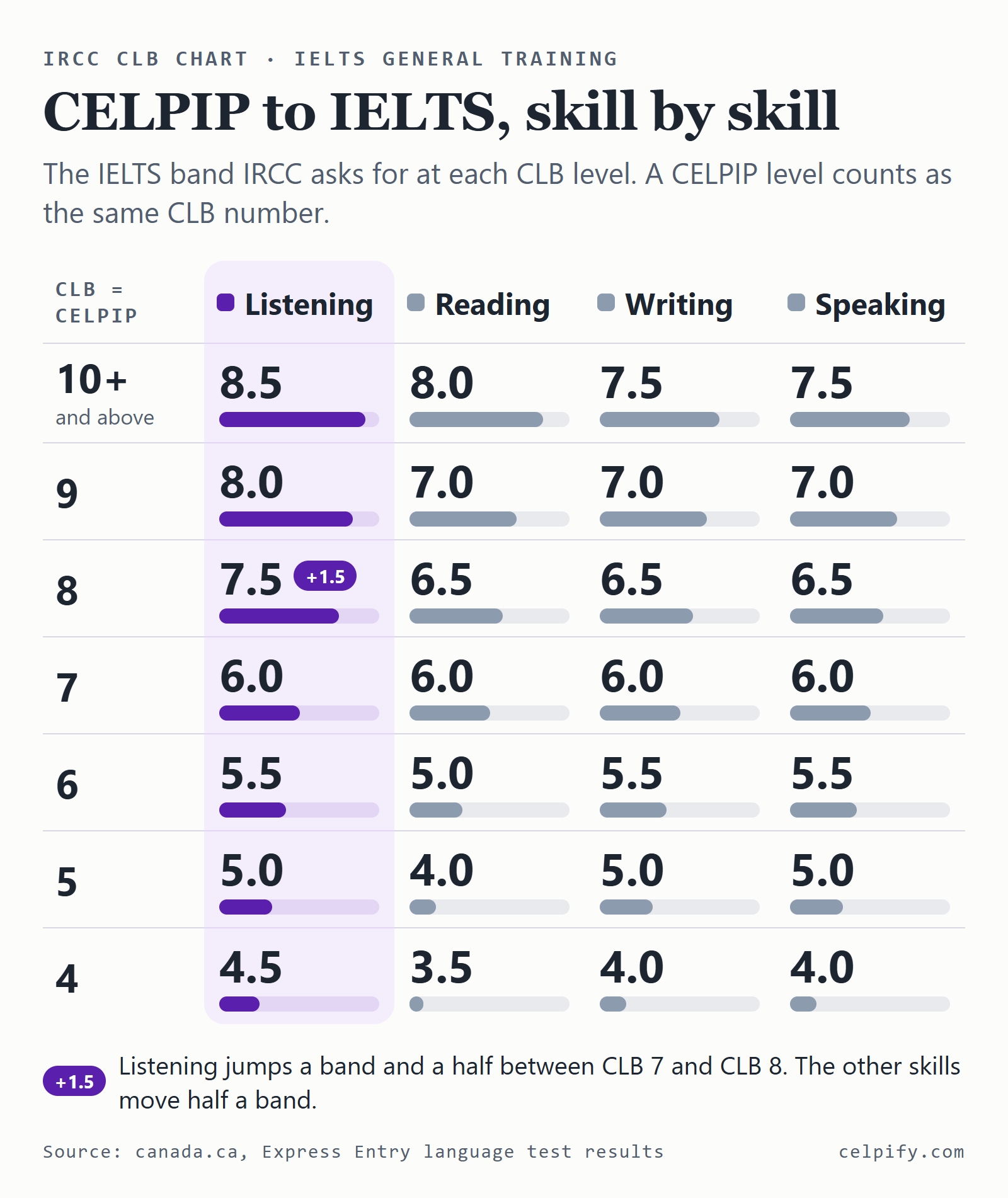
Find your CLB level on the left. The CELPIP level is the same number, while the IELTS General Training band changes from skill to skill.
CELPIP vs IELTS Score Comparison by CLB Level
| CLB | CELPIP level | IELTS Listening | IELTS Reading | IELTS Writing | IELTS Speaking | CRS points per skill* |
|---|---|---|---|---|---|---|
| 10 and above | 10 or higher | 8.5 to 9.0 | 8.0 to 9.0 | 7.5 to 9.0 | 7.5 to 9.0 | 34 |
| 9 | 9 | 8.0 | 7.0 | 7.0 | 7.0 | 31 |
| 8 | 8 | 7.5 | 6.5 | 6.5 | 6.5 | 23 |
| 7 | 7 | 6.0 | 6.0 | 6.0 | 6.0 | 17 |
| 6 | 6 | 5.5 | 5.0 | 5.5 | 5.5 | 9 |
| 5 | 5 | 5.0 | 4.0 | 5.0 | 5.0 | 6 |
| 4 | 4 | 4.5 | 3.5 | 4.0 | 4.0 | 6 |
*CRS points for one skill in your first official language, for an applicant without a spouse or common-law partner. With a spouse or partner coming along, it's 32, 29, 22, 16, 8, 6 and 6.
Each skill is converted on its own, and a band that falls between two rows counts at the lower row. IELTS Listening 7.0 sits between 6.0 (CLB 7) and 7.5 (CLB 8), so IRCC counts it as CLB 7. Reading 7.5 sits between 7.0 and 8.0, so it's CLB 9.
Read the chart from right to left for IELTS to CELPIP: find your band in a skill column, move to the left, and the CLB you land on is the CELPIP level that would count the same. Going the other way, CELPIP to IELTS, these are the levels people ask about most:
- CELPIP 7 to IELTS: 6.0 in every skill.
- CELPIP 8 to IELTS: 7.5 in Listening, 6.5 in Reading, Writing and Speaking.
- CELPIP 9 to IELTS: 8.0 in Listening, 7.0 in the other three.
- CELPIP 10 to IELTS: 8.5 in Listening, 8.0 in Reading, 7.5 in Writing and Speaking.
Our CLB converter uses the same IRCC table and does all four skills at once. For the CELPIP side on its own, see the CELPIP score chart.
The Listening Trap: Why IELTS 7.0 Isn't CLB 9 in Every Skill
IRCC asks for a higher IELTS band in Listening than in the other skills from CLB 8 up, so the same band can land on two different CLB levels.
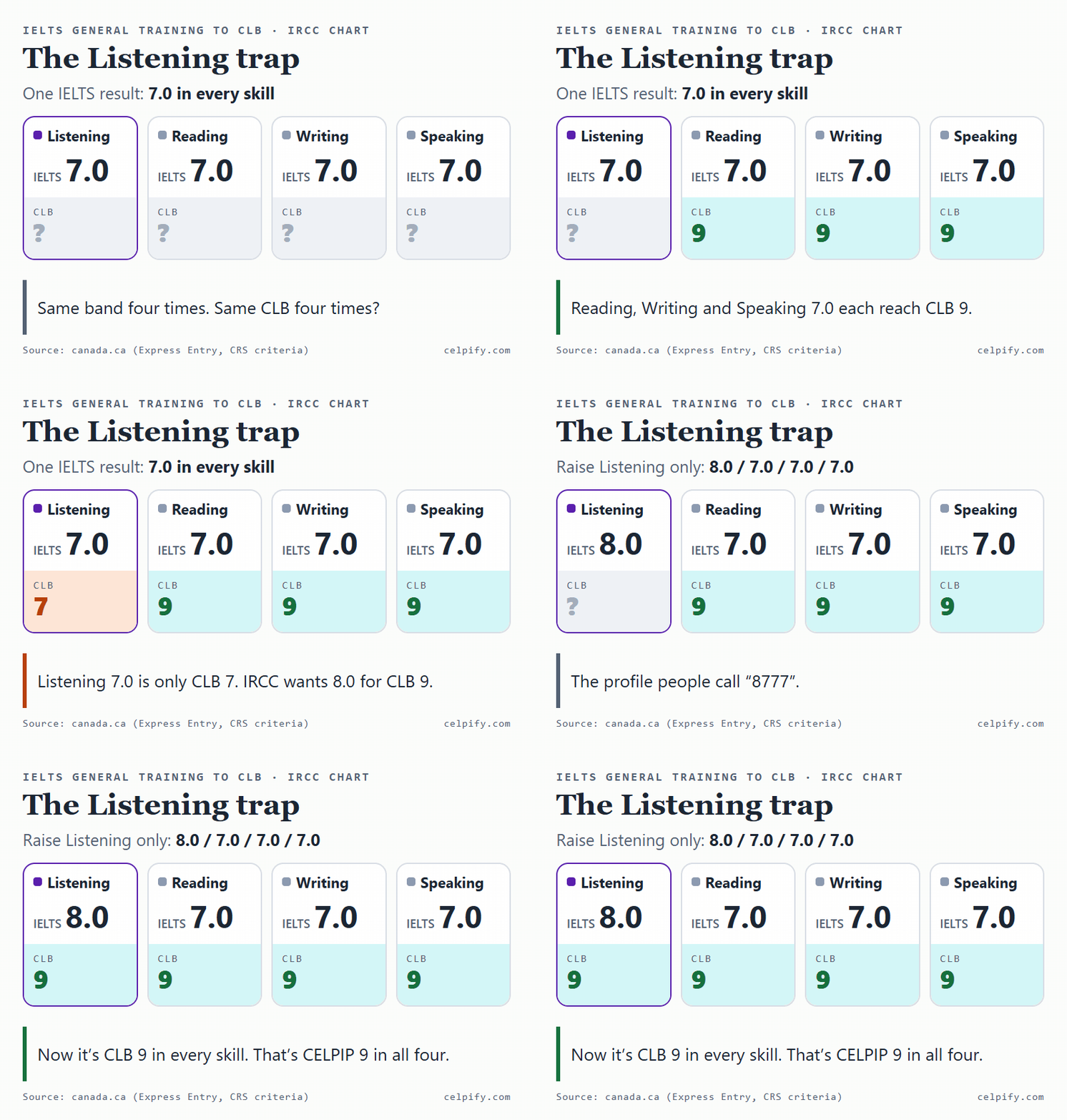
Here's how four IELTS results convert. The third is the worked example in our CLB calculator guide.
| IELTS result (L / R / W / S) | IRCC CLB | Same result on CELPIP |
|---|---|---|
| 6.0 / 6.0 / 6.0 / 6.0 | 7 / 7 / 7 / 7 | 7 in every skill |
| 7.0 / 7.0 / 7.0 / 7.0 | 7 / 9 / 9 / 9 | 7 / 9 / 9 / 9 |
| 7.5 / 6.5 / 6.0 / 6.5 | 8 / 8 / 7 / 8 | 8 / 8 / 7 / 8 |
| 8.0 / 7.0 / 7.0 / 7.0 | 9 / 9 / 9 / 9 | 9 in every skill |
The second row is the trap. Someone with 7.0 in everything has CLB 9 in three skills and CLB 7 in Listening, which still clears the Federal Skilled Worker minimum of CLB 7 in all four abilities. But it costs points. A single applicant gets 17 CRS points for CLB 7 in one skill and 31 for CLB 9, so that one Listening band is worth 14 points.
The fourth row is the result people call 8777. It's CLB 9 straight across, the same as CELPIP 9 in all four skills. A Listening 7.5 doesn't get you there, because it's CLB 8, and for a single applicant CLB 9 is worth 31 CRS points per skill against 23 at CLB 8. The minimums for each program are in our guide to CELPIP score requirements for Express Entry.
Two Official Answers: IRCC's Chart vs the CELPIP-IELTS Concordance Study
IRCC's chart sets your CLB for Canada. The concordance study answers a different question: which CELPIP level lines up with each IELTS band.
The study is A concordance study of CELPIP General and IELTS General Training by Ikeda, Chen and Clark (2025), and celpip.ca hosts the full report. The Australian Council for Educational Research (ACER) led the analysis. The organisations behind CELPIP and IELTS ran the project together, and the IELTS Partners (British Council, IDP: IELTS Australia and Cambridge University Press & Assessment) funded it.
Between May 2023 and August 2024, 1,089 people took both CELPIP-General and IELTS General Training. Of those, 98.4% said they took the tests for immigration. The researchers then matched the two sets of results by percentile, a method called equipercentile equating: if a certain share of the group was at or below IELTS Listening 7.0, the matching CELPIP level sits at the same point in the CELPIP results. The two tests' scores correlate at .71 in Reading and Listening, .72 in Speaking and .68 in Writing.
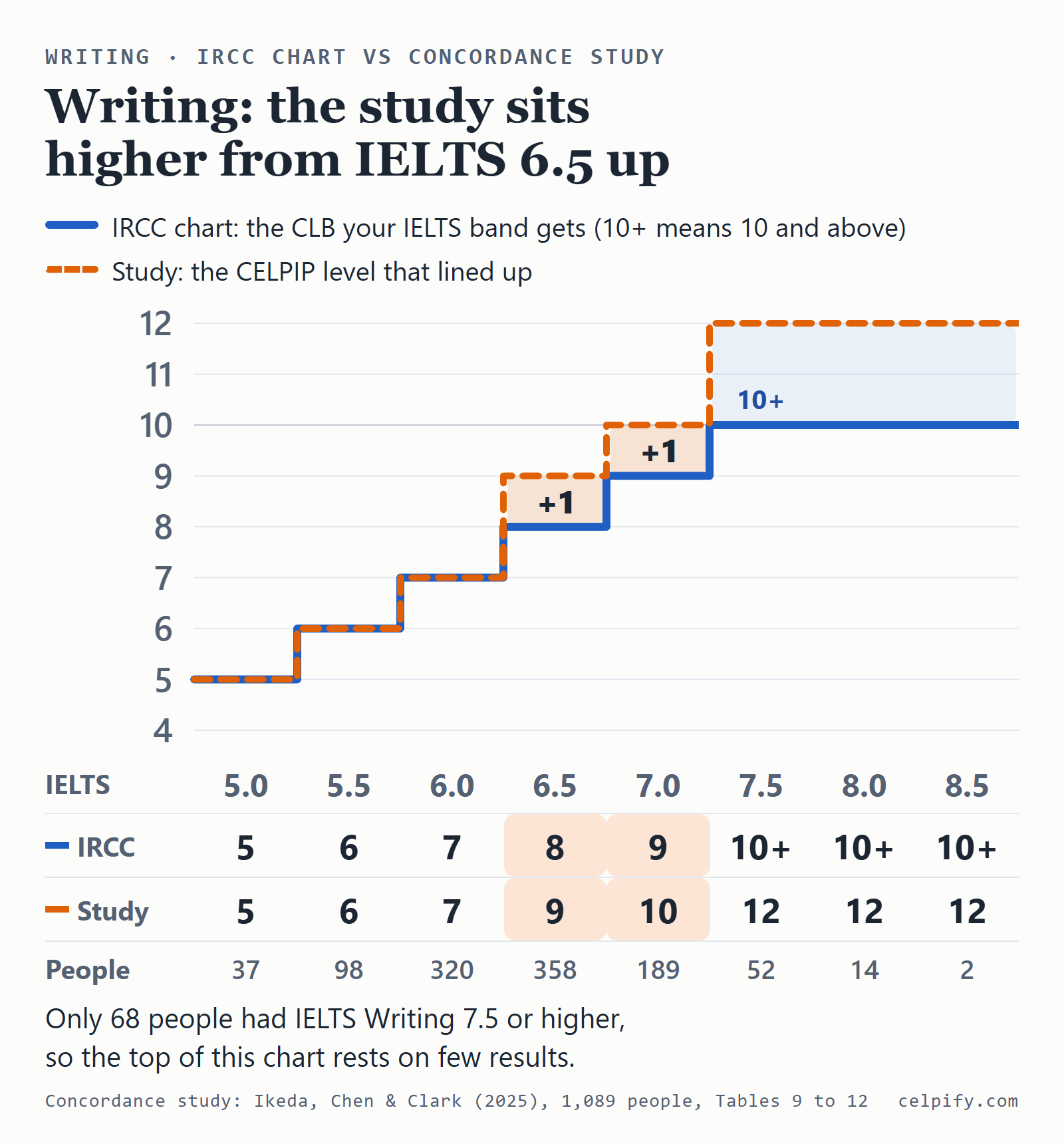
The study has limits, and its authors say so. It was set up for Australia, and its main tables use Australia's visa English levels. The authors warn against using the tables on their own and write that "scores from one test do not directly map to scores from another". And the top of some tables rests on few people. Only 68 had IELTS Writing 7.5 or higher.
IRCC chart vs the concordance study, one skill at a time
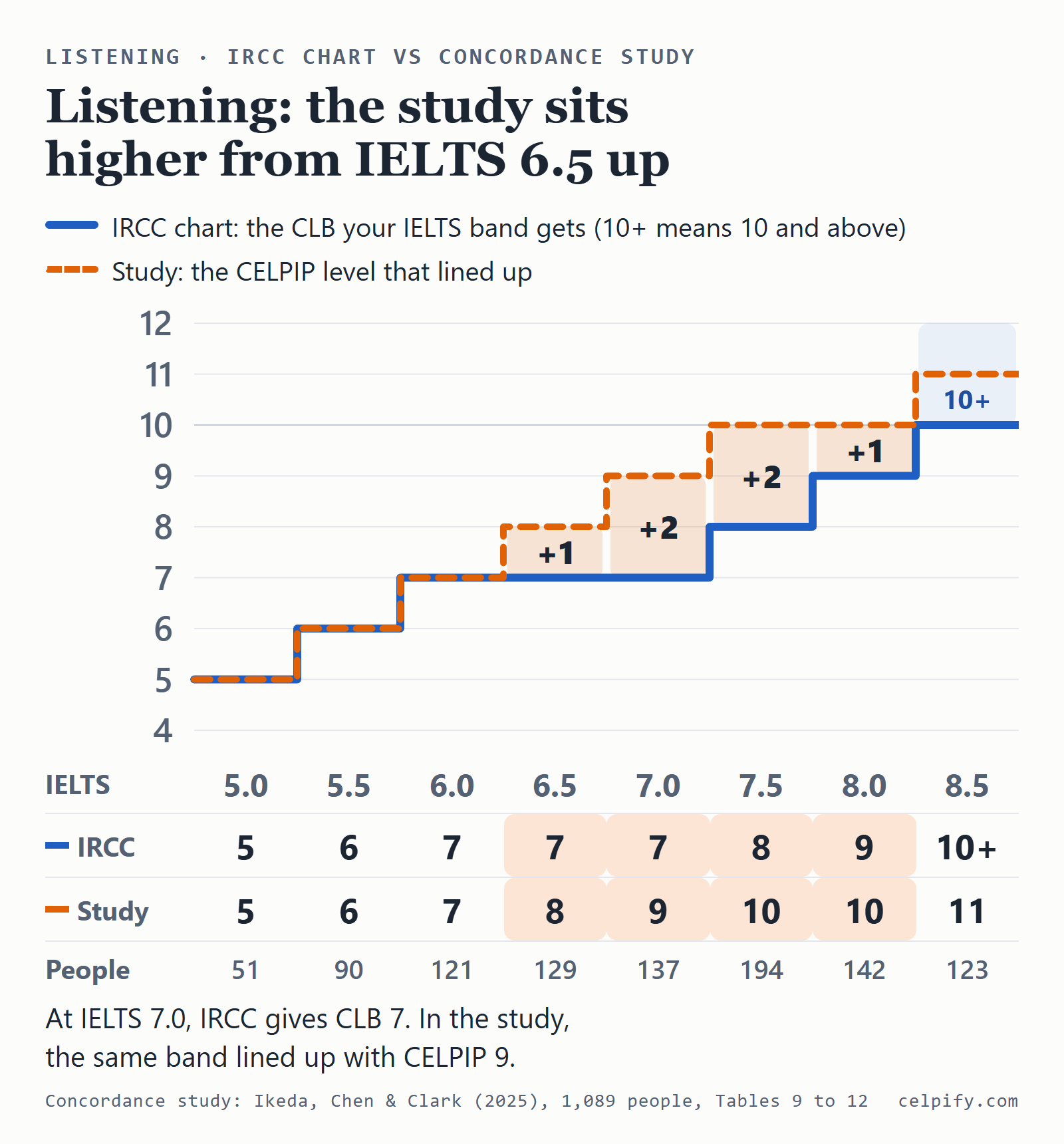
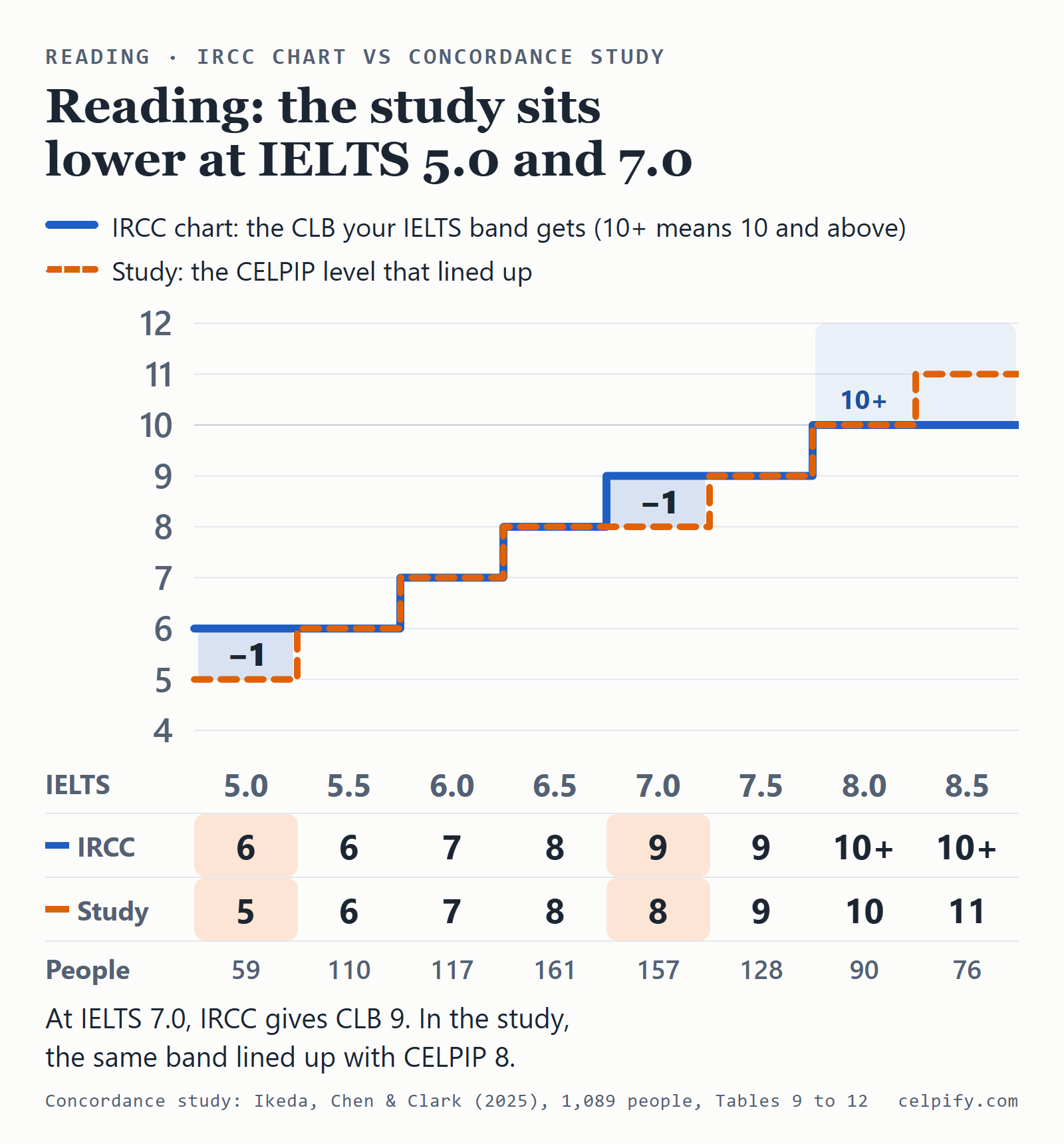
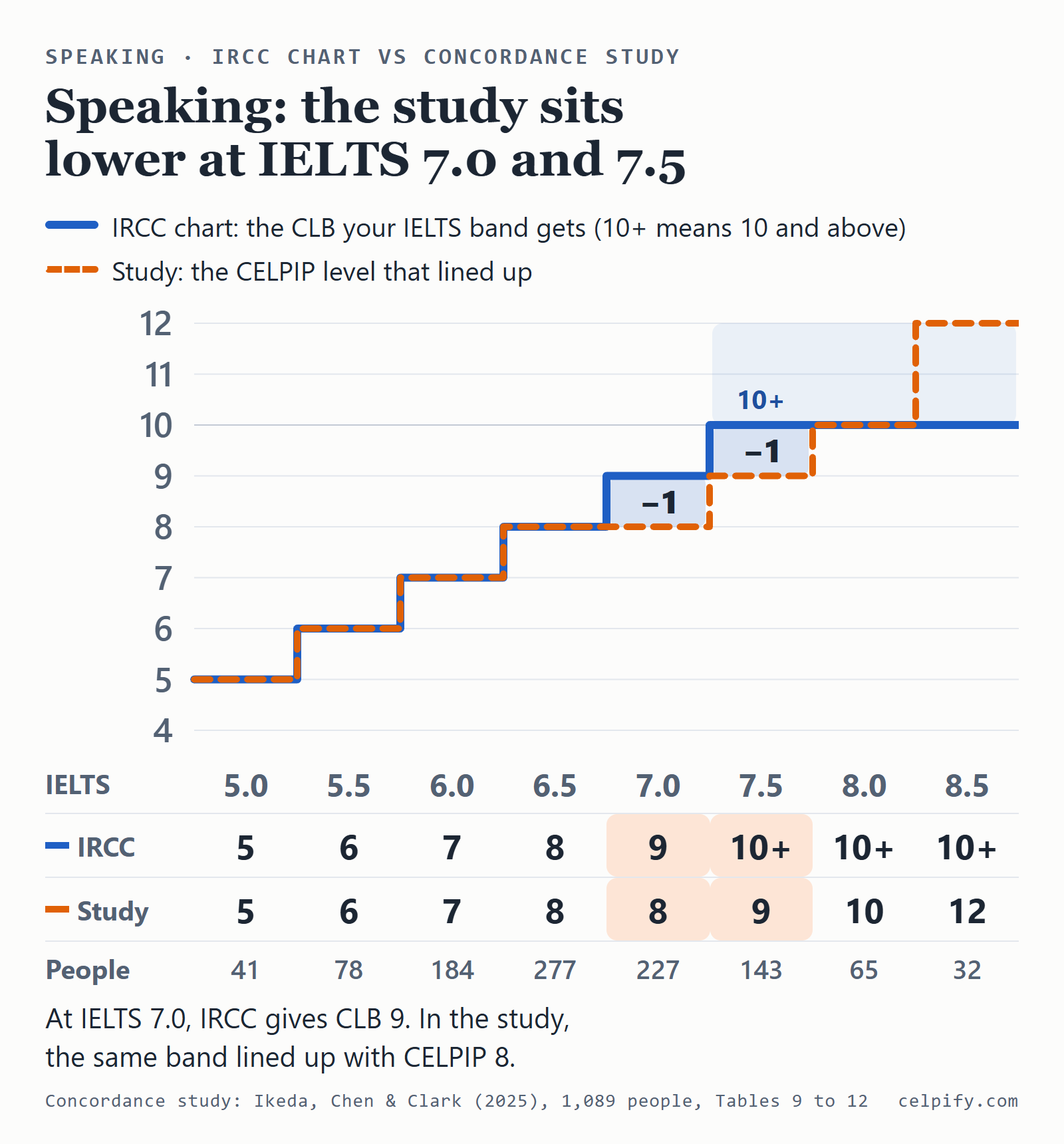
Solid blue line: the CLB IRCC gives each IELTS band. Dashed orange line: the CELPIP level the study lined up with it. Shaded boxes: where the two differ below CLB 10.
What the Gap Means If You're Thinking of Switching
The two answers agree at IELTS 5.5 and 6.0 in every skill. Higher up they split, and not in the same direction for every skill.
In Listening and Writing, the study's CELPIP level sits above IRCC's CLB from IELTS 6.5. Listening 7.0 is CLB 7 for IRCC but lined up with CELPIP 9, and Writing 6.5 is CLB 8 but lined up with CELPIP 9. Reading and Speaking go the other way at IELTS 7.0: CLB 9 for IRCC, CELPIP 8 in the study. Speaking 7.5 is CLB 10 for IRCC and CELPIP 9 in the study.
Run the two profiles from the trap through both answers. IELTS 7.0 in everything is CLB 7, 9, 9 and 9 for IRCC, and the study lines it up with CELPIP 9, 8, 10 and 8. The 8777 result, already CLB 9 everywhere, lines up with CELPIP 10, 8, 10 and 8, which is below CLB 9 in Reading and Speaking.
So if Listening at 7.0 or 7.5, or Writing at 6.5, is what holds your IELTS CLB down, the study gives some reason to think CELPIP might suit you better. If your CLB 9 rests on Reading or Speaking at 7.0, it gives no such sign, and switching could cost you a level there. Either way, these are group averages and can't predict your own result. A timed practice test will tell you more than any table, and Listening is where the two answers differ most, so the CELPIP listening sample test is a sensible first check.
For Canada, IRCC's Chart Is the One That Counts
Switching From IELTS? What Feels Different on CELPIP
The format is the first thing you'll notice. Start with what the Listening test sounds like.
Test 1, Listening Part 2: planning a weekend hike (first 30 seconds)
About 30 seconds from the start of the Part 2 conversation in Celpify's free Test 1, which we wrote to the official Part 2 format. Two friends who work together plan a hike. The voices are AI-generated, not official CELPIP audio. The full clip runs about a minute and 40 seconds, and the plan changes after this point.
Listen for times and reasons
Three times come up in 30 seconds. Note which one belongs to what, and why she wants Eagle Ridge.
Show transcript
That's the start of a Part 2 daily-life conversation. On the real test it's one man and one woman who know each other, about 1.5 to 2 minutes of audio, then about five questions. The first Test 1 question asks why she prefers Eagle Ridge at first. It's a tougher climb, but "the lookout should be worth it". The CELPIP Listening Part 2 guide covers the rest of the part.
A few things will feel new if you've only taken IELTS. The official CELPIP Listening study pack says every speaker uses English as a first language and has a Canadian accent. Its examples are everyday ones: coworkers sorting out a problem, a customer returning something, a couple planning the weekend. Each clip plays once, starts on its own and can't be paused. For every question you pick one of four options on the screen.
The whole test is one sitting on a computer, under 3 hours for all four skills. You type your Writing, and your Speaking answers are recorded and scored later by trained raters, so nobody sits across the table from you. Some people find that easier than an IELTS speaking interview, and some find talking to a screen strange. Which group are you in? A few recorded practice answers will tell you.
CELPIP vs IELTS General Training at a Glance
| CELPIP-General | IELTS General Training | |
|---|---|---|
| How you take it | On a computer at a test centre, all four skills in one sitting of under 3 hours | On paper or on a computer at a test centre |
| Section times | Listening 46 to 55 min, Reading 43 to 56, Writing 53, Speaking 15 | Listening 30 min, Reading 60, Writing 60, Speaking 11 to 14 |
| Speaking | 8 tasks, recorded on the computer and scored later by trained raters | A conversation with an examiner |
| Writing | 2 tasks: an email and a survey response, typed | 2 tasks: a reply to a given situation, then a discussion of a view, argument or problem |
| Scores | A level for each skill; from level 3 up, the CLB is the same number | Half bands from 1 to 9, converted to CLB skill by skill |
| Express Entry | Accepted (CELPIP-General) | Accepted (General Training only, and not One Skill Retake) |
| Booking again | No more than one test session within 5 calendar days | One Skill Retake is sold, but IRCC won't take it for Express Entry |
CELPIP details are from celpip.ca. IELTS details are from the test descriptions in the 2025 concordance report and IRCC's Express Entry page.
CELPIP-General costs $299 plus taxes in Canada, and prices outside Canada vary (see our CELPIP cost guide). Whichever test you take, IRCC needs the results to be less than 2 years old when you create your Express Entry profile and again when you apply. CELPIP scores are valid for two years, and how long CELPIP is valid explains the dates.
CELPIP vs IELTS Score Questions
Short answers to the conversion questions people search for most
Sources & further reading
The official pages behind every number on this page, read on 2026-10-12.
- Express Entry: Language test resultsAccepted tests, the One Skill Retake rule, the 2-year limit and the CLB to IELTS General Training tableIRCC · Government of Canadacanada.ca
- How to find your language level based on your test resultsIRCC's CLB 4 to 10 equivalency tables for CELPIP-General and IELTS General TrainingIRCC · Government of Canadacanada.ca
- Express Entry CRS criteriaCRS points per skill for each CLB levelIRCC · Government of Canadacanada.ca
- CELPIP-IELTS Concordance Reportcelpip.ca page for the 2025 concordance studyOfficial CELPIPcelpip.ca
- A concordance study of CELPIP General and IELTS General Training (PDF)Who ran the study, the 1,089-person sample, its caveats, the correlations and the half-band tables (Tables 9 to 13)Official CELPIPcelpip.ca
- CELPIP Test Format and ScoringSection times and the CELPIP to CLB chartOfficial CELPIPcelpip.ca
- CELPIP OverviewOne sitting of under 3 hours and the $299 plus taxes Canadian priceOfficial CELPIPcelpip.ca
- CELPIP Policies and FormsThe 5-day retake rule and re-evaluation within 6 monthsOfficial CELPIPcelpip.ca
- CELPIP Listening Pro Study PackCanadian-accented speakers, one play per clip, and the Part 2 formatOfficial CELPIPcelpip.ca