CELPIP Reading Part 3: Paragraph Matching Strategy
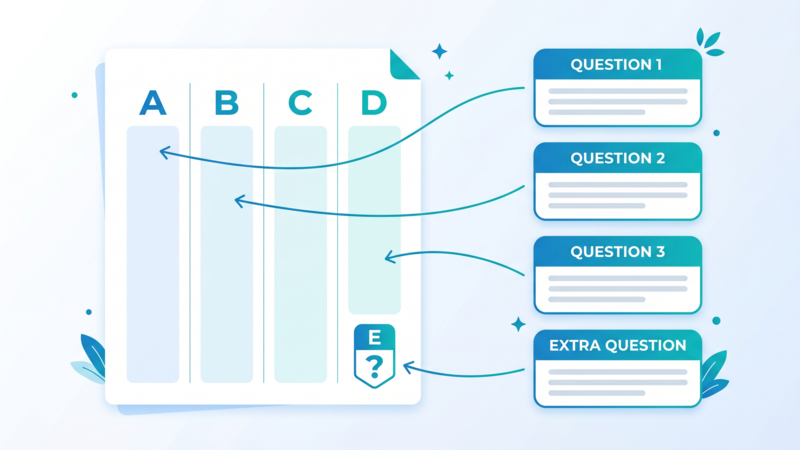
Part 3 of the Reading test does something the other parts don't. You read one passage, then you have to remember which corner of it each idea came from. Question 4 might be in paragraph B. Question 7 in paragraph D. Question 2 might not be in the passage at all.
That last possibility is what separates Part 3 from everything else on the test. Option E. Not given.
Most candidates lose marks here not because they didn't understand the text, but because they couldn't remember where they read what. Below: the 30-second text map, paraphrase recognition, the option E rule, and a timing budget that gets you through all nine questions in ten minutes.
What Part 3 Actually Looks Like
Before any strategy, you need to know exactly what's on the screen when the timer starts.
The official name is Reading for Information. You get one passage of roughly 350 to 450 words, split into four labelled paragraphs (A, B, C, D). Topics lean educational: a short biography, a natural phenomenon, the lifecycle of a Canadian songbird, the history of a public institution. Formal voice. No opinions. Just facts.
Below the passage sit nine numbered questions. Each one is a single statement of information. Your task: pick the paragraph it came from. Five options per question: A, B, C, D, or E.
| Element | Detail |
|---|---|
| Passage | One informational text, 4 paragraphs labelled A through D |
| Length | Around 350 to 450 words total |
| Questions | 9 statements, each matched to a paragraph or to E |
| Answer choices | A, B, C, D, or E (information not given) |
| Time | About 10 minutes on the visible timer |
Part 3 carries about a quarter of your Reading mark
The Option E Trap
The single biggest difference between Part 3 and any other reading task you've practised. Get this part wrong and the rest of your strategy can't save you.
Option E means the information in the question doesn't appear in any of the four paragraphs. Sounds simple. It isn't.
The trap works like this. A question mentions something that feels connected to the passage. The topic is right. The vocabulary overlaps. One or two surrounding details even line up. But the specific claim in the question? It's never actually stated. Your brain wants to assign the question to a paragraph because the vibe matches. That's how you lose the mark.
The rule that saves you
If the exact claim isn't stated, it isn't there. Not given is not the same as suggested, hinted, or probably true. The paragraph either says the thing or it doesn't.
One habit worth building. When you can't find a question's home paragraph after a 30-second search, suspect E before you start guessing. Test takers who never pick E almost always lose two to three questions per Part 3 to this trap alone.
The 30-Second Text Map
The single best habit you can build for Part 3. Skip it and you'll waste minutes flipping back and forth searching for things you already read.
Before you read a single question, run a fast pass over the passage and label each paragraph with two or three words. Use the noteboard. Labels don't have to be elegant. They have to be specific enough that when a question mentions a name, a year, or a stage in a process, you know which paragraph to start in.
Good labels for a passage on the history of Canadian rail look like this:
- A = early proposals, 1850s
- B = construction, Cdn Pacific
- C = workers, conditions
- D = legacy, modern impact
Bad labels are vague. A = intro, B = middle, C = more, D = end. Useless. You'll still have to re-skim every paragraph from scratch.
The first one or two sentences of each paragraph almost always announce the topic. That's where your label comes from. You're not reading the paragraph in detail. You're tagging it. Total time for the map: 60 to 90 seconds, and it pays itself back four times over once you start matching.
Why Paraphrase Recognition Wins Part 3
Once you have your map, the matching step starts. Almost every Part 3 question hides the answer behind a paraphrase.
Questions almost never reuse the exact words from the passage. Same meaning, different vocabulary. If you're hunting for a word match, you'll miss most of your answers.
What to do instead. Read the question, restate the claim in your own words, then search your text map for the paragraph that talked about that idea.
Passage says: Production halted in 1948 when raw materials became scarce.
Question says: Manufacturing stopped due to a shortage.
Production becomes manufacturing. Halted becomes stopped. Raw materials became scarce becomes a shortage.
Passage says: The species relies on dense forest cover for nesting.
Question says: The bird needs thick woodland to breed.
Species becomes bird. Relies on becomes needs. Dense forest cover becomes thick woodland.
Build the habit of recognising synonyms, verb-noun swaps, and abstract-to-concrete restatements. That's most of what Part 3 actually tests.
Mistakes That Cost CLB Levels on Part 3
Three patterns that show up over and over when test takers miss questions on Part 3.
1. Word matching instead of meaning matching
You see the word recession in paragraph C and the word recession in question 5, so you pick C. But the question is about a different consequence of the recession. Same vocabulary, different claim.
2. Avoiding (or overusing) option E
Many candidates go through nine questions without picking E once, even though most sets contain at least one E answer. The opposite mistake is just as costly: slapping E on every question you can't immediately find. Match all four paragraphs first, then trust E only when nothing fits.
3. Spending three minutes on one question
One stubborn question can eat your whole time budget. If a question fights you for more than 75 seconds, mark a guess, flag it on the noteboard, and come back if there's time. A wild guess is always better than a blank.
Don't carry leftover time into Part 4
A Working Time Budget for Part 3
Ten minutes feels different when you've decided in advance where each minute goes.
- 60-90 seconds: build the text map, label A-D
- 3-4 minutes: answer the 5-6 easy matches first
- 3-4 minutes: work the harder questions, decide on E if needed
- 30-60 seconds: review flags and fill any blanks with a best guess
Two principles drive this split. CELPIP doesn't penalise wrong answers, so a guess at 25% odds beats nothing. And the text map earns its keep on questions 4 through 9, where your eyes go straight to the right paragraph instead of scanning from scratch.
Sources & further reading
These official CELPIP pages confirm the Part 3 format and offer free practice with the same paragraph-matching style.
- CELPIP-General Test FormatOfficial source for the test's section structure and timingOfficial CELPIPcelpip.ca
- CELPIP Free Practice TestsOfficial free practice tests from CELPIPOfficial CELPIPcelpip.ca
CELPIP Reading Part 3: Common Questions
Answers to frequent questions about the paragraph-matching section of CELPIP Reading.