CELPIP Reading Sample Test: Part 2 Diagram with Answers

This CELPIP reading sample test is one complete Part 2 set: a summer camp diagram, an email with five blanks, and three questions after it. It's the same set as Part 2 of Celpify's free Test 1, so what you see here is what you'd practise with on the platform.
Set a timer for nine minutes and treat this CELPIP reading test sample like the real thing: finish it before you scroll down. The answers come after that, and each one shows where it sits in the diagram and why the other options fail.
Why use a real diagram? Part 2 is built around one. A lot of CELPIP reading examples online replace it with a text list or a stock photo, and that removes the hard part: moving your eyes between two sources while the clock runs.
How CELPIP Reading Part 2 Works
Part 2 gives you about nine minutes for eight questions spread over two texts.
Part 2's official name is Reading to Apply a Diagram. The main text is a diagram with point-form text and pictures, such as a schedule, a brochure, a flyer or a guide to an everyday task. The second text is a short email from one person to another about that diagram. The email has five blanks with drop-down menus, and three more questions sit under it, so you answer eight in total.
The official Reading Pro study pack suggests splitting the nine minutes like this:
| Step | Time | What you're doing |
|---|---|---|
| Preview the diagram | 30 seconds | What kind of visual it is, who made it, and how the pictures connect to the text |
| Preview the email | 30 seconds | Who wrote it, who it's for, and why |
| Fill blanks 1 to 5 | About 5 minutes | Find the keywords around each blank, then look for the clues in the email and the diagram. Watch for paraphrase. |
| Answer questions 6 to 8 | About 2.5 minutes | The second question set |
| Review | 30 seconds | Check that every question has an answer |
A few rules apply to the whole Reading test. It has four parts with 11, 8, 9 and 10 questions, 38 scored in total, and the current official guidebook gives it 43 to 56 minutes. One extra, unscored part may appear, and you won't know which one it is. You can change answers until a part's time runs out, but you can't go back to an earlier part. Wrong answers don't cost points, so never leave a question empty. You also can't highlight on screen; the test centre gives you paper and a pen for notes.
The Sample Test: Diagram, Email and Questions
Start your nine-minute timer now. Preview the diagram, then the email.
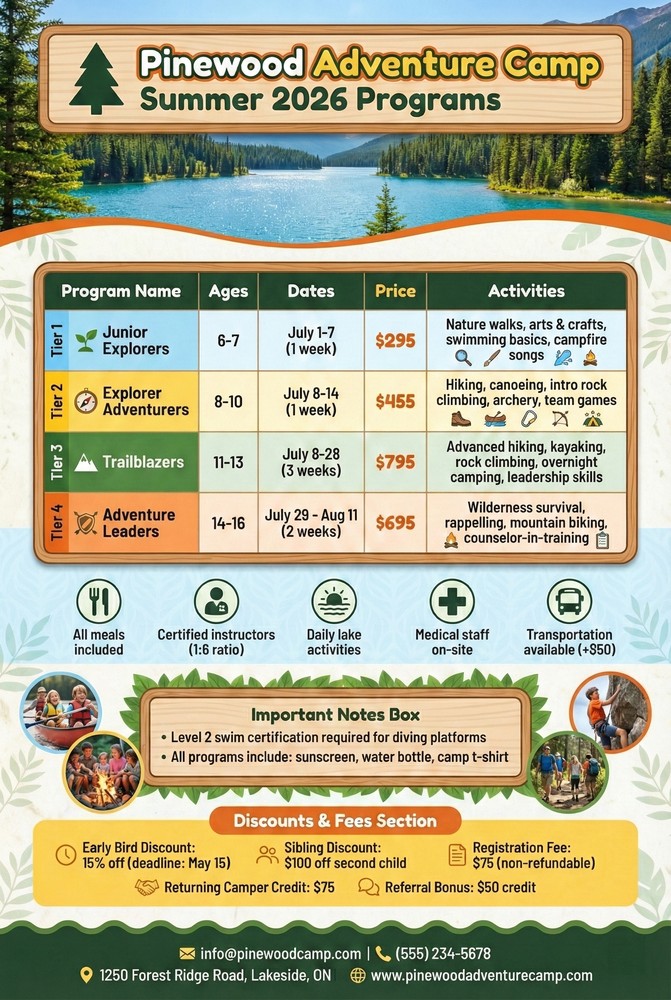
The email
From: Sumiya Calder, Camp Director
To: Solene Varga
Subject: Re: Summer camp registration for Liora and Bram
Date: May 22, 2026
Dear Ms. Varga,
Thank you for describing what Liora and Bram hope to do at camp. I can confirm both placements, although one differs from the program you first requested.
Liora is 13, so Adventure Leaders is not available until next summer; its age range begins at 14. The closest match is [1] ________. Its advanced hiking, rock climbing, overnight camping, and leadership activities fit the interests you listed. You also said your family will be away during the first week of July. This program runs [2] ________, so it starts after you return and gives Liora our longest session.
Nine-year-old Bram belongs in Explorer Adventurers. That one-week program shares the July 8 start date, but its introductory climbing and team games are better suited to his age group. The children will therefore attend different programs, even though their first week overlaps.
Because your message arrived after the May 15 early-bird deadline, the 15% reduction has expired. As first-time campers, they do not qualify for the returning-camper credit either. Registering two siblings does qualify your family for the [3] ________, applied to the second child.
Please note two practical details. All meals are included, and the camp provides each child with sunscreen, a water bottle, and a T-shirt. You said Liora hopes to use the diving platforms. Her Bronze Cross certification is useful for general swimming, but platform users must show [4] ________. The $75 registration fee is [5] ________. Transportation is optional and costs $50, so let me know whether you will drive them or add the service.
Once I receive your transportation choice and Liora's swim document, I can finalize both files.
Warmly,
Sumiya Calder
Camp Director
Choose one option for each blank
| Blank | Options |
|---|---|
| 1 | Junior Explorers / Explorer Adventurers / Trailblazers / Adventure Leaders |
| 2 | July 1-7 / July 8-14 / July 8-28 / July 29-August 11 |
| 3 | 15% early-bird discount / $100 sibling discount / $75 returning-camper credit / $50 referral bonus |
| 4 | Bronze Cross certification / Level 2 swim certification / proof of returning-camper status / a receipt for the transportation fee |
| 5 | included in each program price / non-refundable / subject to a first-time-family surcharge / the same as the transportation charge |
Questions 6 to 8
6. Which charge can the family avoid by arranging its own travel?
A. the $50 transportation charge
B. the $75 registration fee
C. the $455 Explorer Adventurers price
D. the $795 Trailblazers price
7. Sumiya's approach to the family's requests is best described as
A. apologetic about rules she is willing to ignore
B. welcoming while consistently applying the camp's limits
C. promotional because she recommends every optional service
D. uncertain because she has not checked the chart
8. What will the parent most likely do before registration is finalized?
A. ask for the expired early-bird discount to be reinstated
B. choose whether to add transportation and send Liora's swim document
C. request that both children enter the same age-based program
D. claim the returning-camper credit for both children
Answers and Explanations
Stop the timer and count how many of the eight you got right. Then check them one by one.
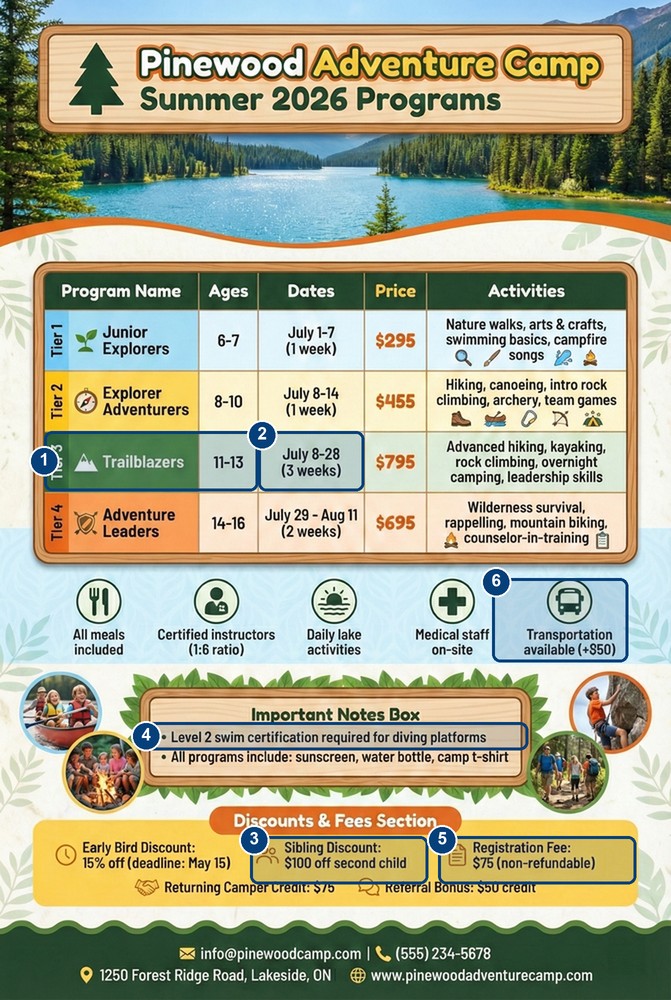
A CELPIP reading practice test with answers usually stops at the key. A key tells you which option was right, but not why a wrong one looked right to you, and that's what you need to know next time. So each answer below comes with its reasons. Open them one at a time.
Blank 1: answer and why
Answer: Trailblazers. The email says Liora is 13 and wants advanced outdoor activities. The Trailblazers row covers ages 11 to 13 and lists advanced hiking, rock climbing, overnight camping and leadership skills.
Adventure Leaders is the program the parent asked for, but it starts at 14, and the email says Liora has to wait until next summer.
Explorer Adventurers is for ages 8 to 10. It's Bram's program, not Liora's.
Junior Explorers is for ages 6 and 7, with basic activities.
Blank 2: answer and why
Answer: July 8-28. Two clues in the email point here: the program starts after the family's trip in the first week of July, and it's the camp's longest session. The diagram shows Trailblazers running July 8-28, three weeks, longer than any other program.
July 8-14 has the right start date, but those are the dates for Explorer Adventurers, Bram's one-week program.
July 1-7 belongs to Junior Explorers, and the family is away that week.
July 29-August 11 is Adventure Leaders, the program Liora can't join yet.
Blank 3: answer and why
Answer: $100 sibling discount. The email says registering two siblings qualifies the family, "applied to the second child". The Discounts and Fees section lists a sibling discount of $100 off the second child.
15% early-bird discount had a May 15 deadline. The email is dated May 22 and says the discount has expired.
$75 returning-camper credit doesn't apply because both children are first-time campers.
$50 referral bonus is on the diagram, but nobody mentions a referral.
Blank 4: answer and why
Answer: Level 2 swim certification. The Important Notes box says Level 2 swim certification is required for the diving platforms, and Liora wants to use them.
Bronze Cross certification is in the email, which makes it tempting. But the email mentions it to say it's only enough for general swimming.
Proof of returning-camper status relates to a $75 credit, not to swimming.
A receipt for the transportation fee has nothing to do with the platforms.
Blank 5: answer and why
Answer: non-refundable. The Discounts and Fees section reads "Registration Fee: $75 (non-refundable)".
Included in each program price is wrong because the fee is listed separately from all four prices.
A first-time-family surcharge doesn't appear anywhere on the diagram.
The same as the transportation charge can't be right: $75 against $50.
Question 6: answer and why
Answer: A, the $50 transportation charge. The diagram shows transportation as an optional extra at $50, and the email says the parent can drive the children instead. That's a specific-information question: one fact, found in one place.
B, the $75 registration fee, has to be paid either way. It's not a travel service.
C and D are the two program prices, which are due however the children get to camp.
Question 7: answer and why
Answer: B, welcoming while consistently applying the camp's limits. This one asks about the writer's attitude, so it's an inference question. The warm opening, the careful placements and the "Warmly" sign-off are welcoming, yet every rule stays in place: the age limit, the early-bird deadline, the returning-camper credit, the swim requirement and the fee.
A, apologetic about rules she is willing to ignore, doesn't fit: she doesn't bend a single rule.
C, promotional, is wrong because she offers transportation as a choice and doesn't push it.
D, uncertain, can't be right when every detail she gives matches the diagram.
Question 8: answer and why
Answer: B, choose whether to add transportation and send Liora's swim document. The last line of the email names these as the two things Sumiya still needs before she can complete both files. "Most likely" tells you it's an inference question.
A asks for a discount the email already says has expired, and the sibling discount is already applied.
C goes against the email, which explains why the programs are age-based.
D is ruled out because the children are first-time campers.
What This CELPIP Reading Sample Teaches About Part 2
Five patterns from this set to watch for in your next one.
The wrong options are real details
We wrote this set for Test 1, and in blanks 1 to 3 every wrong option is printed somewhere on the diagram. That's deliberate. An option that isn't on the page is easy to rule out, so the traps here are true facts attached to the wrong child, the wrong week or the wrong condition. July 8-14 really is a camp session. It's just Bram's.
What the parent asked for isn't the answer
The parent asked for Adventure Leaders. Blank 1 wants the program Liora can actually join. In this email the director turns down one request and redirects another, so read for what she decides, not for what was asked.
The email's date settles one blank
The early-bird discount is right there on the diagram, and it's a real 15% saving. What rules it out is the email's own date line: May 22, a week after the May 15 deadline. If a blank involves a deadline, check when the email was sent.
A word from the email can be bait
Bronze Cross is in the email, so it feels safe. The email only mentions it to say it isn't enough for the platforms. The official study pack warns that answer choices often paraphrase the text. This blank shows the other side of that: the option that copies the email's wording is the wrong one, and the right one comes from the Important Notes box.
Questions 7 and 8 need the whole email
Question 7 asks about Sumiya's approach, and question 8 says "most likely". Both are inference questions, and the diagram won't help with either. The official timing gives the second set about two and a half minutes. Use all of it, because you can't answer these two by scanning.
How did you do?
Eight out of eight inside nine minutes means Part 2 probably isn't where your Reading score is leaking. Six or seven? Look at which trap caught you. Once you can name it, it's much easier to spot in the next set. Your Reading level comes from all 38 questions, and the CELPIP Reading score chart shows what a total like 34 out of 38 works out to.
You can also do this exact set with a real countdown and working drop-down menus on the free Test 1 Reading Part 2 practice page. For more CELPIP reading Part 2 practice and an approach for each question type, see the Reading Part 2 diagram strategy guide. The CELPIP Reading tips cover Parts 1, 3 and 4, and the rest of Test 1 is in the free CELPIP practice test with answers, all four skills.
Want to practise listening the same way? The CELPIP listening sample test plays a full Part 1 with audio and explains every answer.
Sources & further reading
The official CELPIP sources behind the Part 2 format, timing and scoring facts on this page.
- CELPIP Reading Pro Study PackPart 2 format (8 questions, about 9 minutes), the suggested timing steps, question types and scoring rulesOfficial CELPIPcelpip.ca
- CELPIP Guidebook for Test Takers (July 2026)Current Reading time (43 to 56 minutes), questions per part, and unscored contentOfficial CELPIPcelpip.ca
- CELPIP Test FormatOfficial overview of the four Reading partsOfficial CELPIPcelpip.ca
- CELPIP Free Practice TestsOfficial free practice tests to try after this sampleOfficial CELPIPcelpip.ca