CELPIP Speaking Task 3: Describing a Scene Strategy
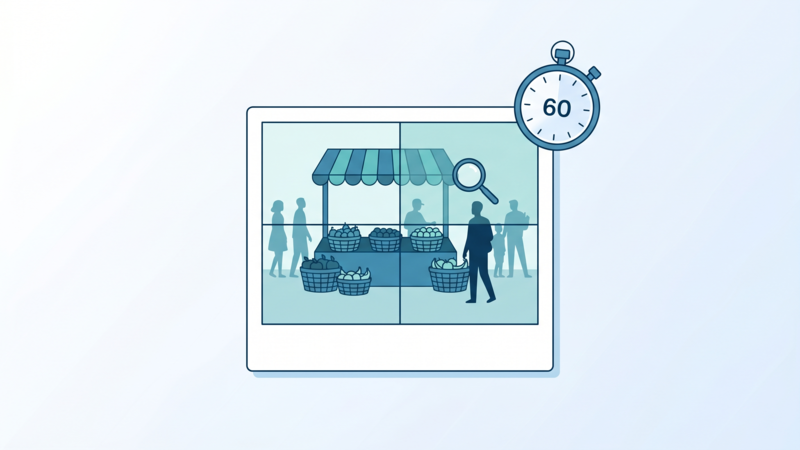
CELPIP Speaking Task 3 is the only task that hands you a picture and asks you to describe it cold. Thirty seconds to prep, sixty seconds to speak, and one image you've never seen before. No prediction. No advice. No personal story. Just clean, present-tense description of what's actually happening in front of you. The same picture comes back in Task 4, where you predict what happens next.
Quick heads-up. Has an AI assistant told you Task 3 is about 'responding to a situation' or 'giving advice'? That's wrong. Those describe Task 1 (Giving Advice) and Task 6 (Difficult Situation). The official CELPIP Speaking Pro study pack confirms Task 3 is description, not response. 30 seconds prep, 60 seconds speak, one picture, present-continuous tense.
CELPIP is accepted by IRCC for Canadian permanent residency and citizenship applications. For most economic immigration programs, CLB 7 in Speaking is the floor; CLB 9 is where CRS points jump and skill transferability points max out, and CLB 10 earns the most language points. Task 3 contributes to the single Speaking band that decides where you land.
Below: the quadrant prep method that beats the freeze, the present-continuous grammar that scores higher than 'I see' lists, the 10/30/20 pacing template, a real Celpify sample answer scored at CLB 9, and the mistakes that quietly cap most Task 3 scores.
How Task 3 Works
CELPIP Speaking Task 3 gives you 30 seconds of prep and 60 seconds to speak about a single picture. No replay, no second take. The picture stays on the screen the whole time you're talking.
Task 3 is fast. Thirty seconds of prep, sixty seconds of speaking, and one image that doesn't change once the recording starts. Your scratch pad is one page; the mic records once.
| Phase | Detail |
|---|---|
| Prep time | 30 seconds, scratch pad available, no speaking |
| Speaking time | 60 seconds, one take, no replay |
| Picture | Stays visible the whole time |
| Question | Describe some things that are happening in the picture below as well as you can. The person you're speaking with cannot see the picture. |
| Target length | About 120 to 150 words at a natural conversational pace |
Pictures vary. Outdoor scenes, indoor scenes, busy markets, quiet meeting rooms. People doing things, sometimes everyday objects only. Your job is the same regardless: describe what you see using present-continuous tense, spatial framing, and enough range to show off vocabulary.
Same picture, different question.
Your 30 Seconds of Prep
In the 30-second prep window, split the picture into four mental zones and write a one-word note in each. Four anchors beat half a drafted sentence every time.
Most candidates freeze in the prep window because they try to write a polished opening sentence in their head, run out of time, and panic when the recording starts. The quadrant method skips the freeze. You don't need full sentences. You need four anchors.
Split the picture into four mental zones and ask one question per zone, then write a one-word note on the scratch pad:
1. Foreground
What's closest to the viewer? Note the main subject in one word: vendor, presenter, child, queue.
2. Background
What anchors the scene? A building, a sky, a wall of shelves, a parking lot. One word.
3. People
How many, what stance, what mood. Skeptical, focused, distracted, hopeful, busy. One adjective each.
4. Atmosphere
One impression word for the whole scene. Lively, tense, warm, hurried. This becomes your closing sentence.
Four anchors. Twelve to sixteen words total on the scratch pad. The moment you stop trying to draft full sentences and start writing one-word notes, the freeze breaks.
Present-Continuous + Spatial Language
The CELPIP scoring criteria reward two grammar moves on Task 3: present-continuous tense as the workhorse, and spatial prepositions to give the listener flow.
Present-continuous ('is happening', 'are walking', 'is looking') is the default tense for Task 3. It's what a Canadian speaker uses naturally when narrating a scene. Slipping into simple present ('the man walks') sounds like a label, not a description, and the scoring criteria catch it.
Tense framework
| Use case | Structure | Example |
|---|---|---|
| Main actions | Subject + is/are + verb-ing | A presenter is showing slides |
| Inventory | There is / There are | There are five chairs around the table |
| Unknown actor | Passive present | A bag is left on the counter |
| Atmosphere | Adjective phrase | The room looks busy |
Stacking these four shapes across 60 seconds gives the grammar variety the scoring criteria reward. Three sentences of subject + is/are + verb-ing in a row reads as monotone.
Spatial prepositions for scene flow
Listing items without spatial framing reads as 'a, a, a'. Spatial prepositions turn the same list into a place the listener can picture.
| Spatial cue | Phrases |
|---|---|
| Depth | in the foreground, in the background, in the middle distance |
| Direction | to the left, to the right, behind, in front of |
| Grouping | between, among, next to, beside, surrounded by |
| Position | on the wall, on the table, hanging from the ceiling, leaning against |
One more move: describe how people feel, not just what they're doing. 'A boy is holding a balloon' is fine. 'A boy is holding a balloon, looking thrilled' adds the emotional vocabulary the scoring criteria reward. Skeptical, distracted, focused, proud, anxious, hopeful. One feeling word per main person turns a list into a scene.
The Three-Phase Structure (10 / 30 / 20)
Structure your 60-second answer as three phases: a one-sentence framing setup (10 sec), a spatially anchored inventory of main people and actions (30 sec), and an atmospheric close that adds mood and texture (20 sec).
The structure below fills sixty seconds cleanly without rushing or stalling. Three phases, each with a different job. Drill it on three practice pictures and the pacing becomes automatic.
Phase 1: Setup (10 seconds)
One framing sentence that anchors the listener. Looking at this scene, I can see a busy farmers' market on a sunny morning. Short, locates the picture, signals you're about to describe it.
Phase 2: Inventory (30 seconds)
Main people and main actions, layered with spatial cues. In the foreground, a vendor is arranging fresh produce. To the left, a customer is paying for vegetables. Behind them, two children are pointing at a basket of strawberries. Use three or four spatially anchored sentences. Each one adds a new actor or object, not a rephrase of the last one.
Phase 3: Close (20 seconds)
Atmosphere and feeling. The whole scene feels lively and warm. People are taking their time, the weather looks perfect, and you can almost smell the fresh fruit. It's the kind of place where locals come every Saturday. This phase is where scene-level vocabulary and emotional adjectives go. Without it, the answer reads like an inventory list.
Each phase has a different cognitive job. Setup orients the listener. Inventory delivers the visual data. Close adds the texture that lifts the answer from CLB 7 to CLB 9.
60-Second Model Answer: The Farmers' Market
One real Celpify Task 3 prompt, one CLB 9 sample answer, full scoring notes.
The scene (paraphrased)
An outdoor farmers' market on a sunny morning. A wooden stall sits in the foreground, piled with fresh fruit and vegetables. A vendor is arranging baskets of strawberries. To the left, a customer is paying for a bag of tomatoes. Two children are pointing at the strawberries, smiling. In the background, more stalls stretch down a cobbled street. A cloth banner reads 'Market Saturday'.
Model answer (about 135 words, CLB 9)
Looking at this scene, I can see a busy farmers' market on what looks like a sunny Saturday morning. In the foreground, a vendor is arranging baskets of fresh strawberries on a wooden stall piled with fruit and vegetables. To the left, a customer is paying for a bag of tomatoes. Behind them, two children are pointing at the strawberries and smiling, probably asking their parent to buy some. In the background, more stalls stretch down a cobbled street, and a cloth banner reads 'Market Saturday'. The whole scene feels lively and warm. People are taking their time, the weather looks perfect, and you can almost smell the fresh produce. It's the kind of place where locals come every weekend.
What this answer scores
- Vocabulary range: spatial cues (foreground, to the left, behind, in the background), sensory verbs (arranging, pointing, smiling), atmospheric adjectives (busy, sunny, lively, warm).
- Grammar variety: present-continuous (is arranging, is paying, are pointing), simple present for stable scene elements (the banner reads, stalls stretch), one mild inference ('probably asking their parent') that lifts the response above pure description.
- Task fulfilment: 10-second setup, 30-second inventory of three different spatial zones, 20-second atmospheric close. Four distinct actors named, three spatial cues, one mood signal.
- Listenability: 135 words at conversational pace, varied sentence length, natural breathing pauses where Canadian speech expects them.
The pattern is reusable. Look at the picture. Pull four quadrant anchors. Open with a framing sentence, layer three or four spatially anchored present-continuous sentences, close on atmosphere. Land at around 130 words.
You can hear a 60-second Task 3 answer on a real practice picture in the CELPIP speaking test sample.
Mistakes That Cap Task 3 Scores
Three mistakes consistently cap CELPIP Task 3 scores: listing items without flow, slipping into the wrong tense, and skipping atmosphere entirely.
1. Listing items without flow
There's a man. There's a woman. There's a table. There's a flower. Four sentences, four items, zero scene. The scoring criteria read this as inventory, not description. Use spatial prepositions (in the foreground, to the left, behind, between) to turn the list into a place the listener can picture.
2. Slipping into past or future tense
Saying 'the man walked to the table' or 'the boy will pick up the apple' caps the grammar score. Task 3 is present-continuous ('is walking', 'is picking up'). The first 15 seconds of every practice run should anchor you in that tense before the rest of the answer carries you along.
3. No atmosphere or feeling
A correct inventory with zero atmosphere reads as a list with no narrator behind it. The closing 20 seconds is where mood and texture go. 'The whole scene feels busy and warm' or 'People look like they're enjoying themselves' lifts the answer past pure description. Without that close, even an otherwise solid response stalls around CLB 7. The fastest fix is repetition with real scenes: work through practice pictures with sample answers until the structure feels automatic.
The list-of-objects trap
Sources & further reading
These official pages confirm the Speaking section format and where Task 3 sits in it.
- CELPIP-General Test FormatOfficial source for the test's section structure and timingOfficial CELPIPcelpip.ca
- CELPIP Free ResourcesOfficial CELPIP study webinars and resourcesOfficial CELPIPcelpip.ca
CELPIP Speaking Task 3: Common Questions
Quick answers to the questions test-takers ask before Task 3.
Thirty seconds, sixty seconds, one picture. Quadrant prep, present-continuous inventory, atmospheric close. And the same picture lines up for Task 4, where you'll predict what happens next.