CELPIP Speaking Templates: 8 Answer Plans, Not Scripts
Search for a CELPIP speaking template and you'll find page after page of fill-in-the-blank sentences, built to be memorised and repeated on test day. CELPIP itself sees it differently. In a post about sample responses, it says that "memorizing, copying, and templating are the opposite of what is required of CELPIP test takers", and that people who include memorised or copied content in their tests "are subject to invalidation of their test results."
So what's safe to bring into the room? A plan: the job each part of your answer has to do, and roughly how many seconds it gets. CELPIP's own Speaking Pro study packs teach that kind of structure for every task, and using a structure isn't copying anyone's words.
Below are answer plans for all eight tasks, gathered on one printable sheet, plus a recording of the Task 3 plan used on a picture from Celpify's free Test 1.
CELPIP Speaking Template or Answer Plan: What Raters Hear
A script picks your words before you've seen the prompt. A plan picks what each stretch of your answer has to do.
Trained people rate your speaking answers. CELPIP describes the process as "two or three extensively trained, highly fluent English users" assessing several dimensions of each response. The Speaking Pro packs name those dimensions: content and coherence, vocabulary, listenability, and task fulfillment. Task fulfillment covers relevance, completeness, tone and length.
Now picture a memorised opener. It sounds polished on the one prompt it was written for. On every other prompt, those first ten seconds say nothing about the person you're supposed to be helping, and relevance is part of what's being rated. Every test taker also agrees to give spontaneous, original responses, so copied wording can cost you far more than a point.
A plan works the other way round. "First suggestion, with a reason, about 20 seconds" tells you what to do and leaves the words to you. In other words, it's a CELPIP speaking structure with a clock attached, and it's how the official packs teach each task: speak directly to the person in Task 1, open and close the phone call in Task 8. The plans on this page follow those strategies and add a time budget to each move.
Why does the time budget matter so much? Because the test won't wait. When your prep time runs out, the screen moves on, you hear "Start speaking now", and recording starts on its own. A plan you know well is quick to call up in 30 seconds. A script you have to bend to fit the prompt isn't.
All 8 CELPIP Speaking Templates on One Page
Every task's timing and the moves that fill it, on one sheet you can print.
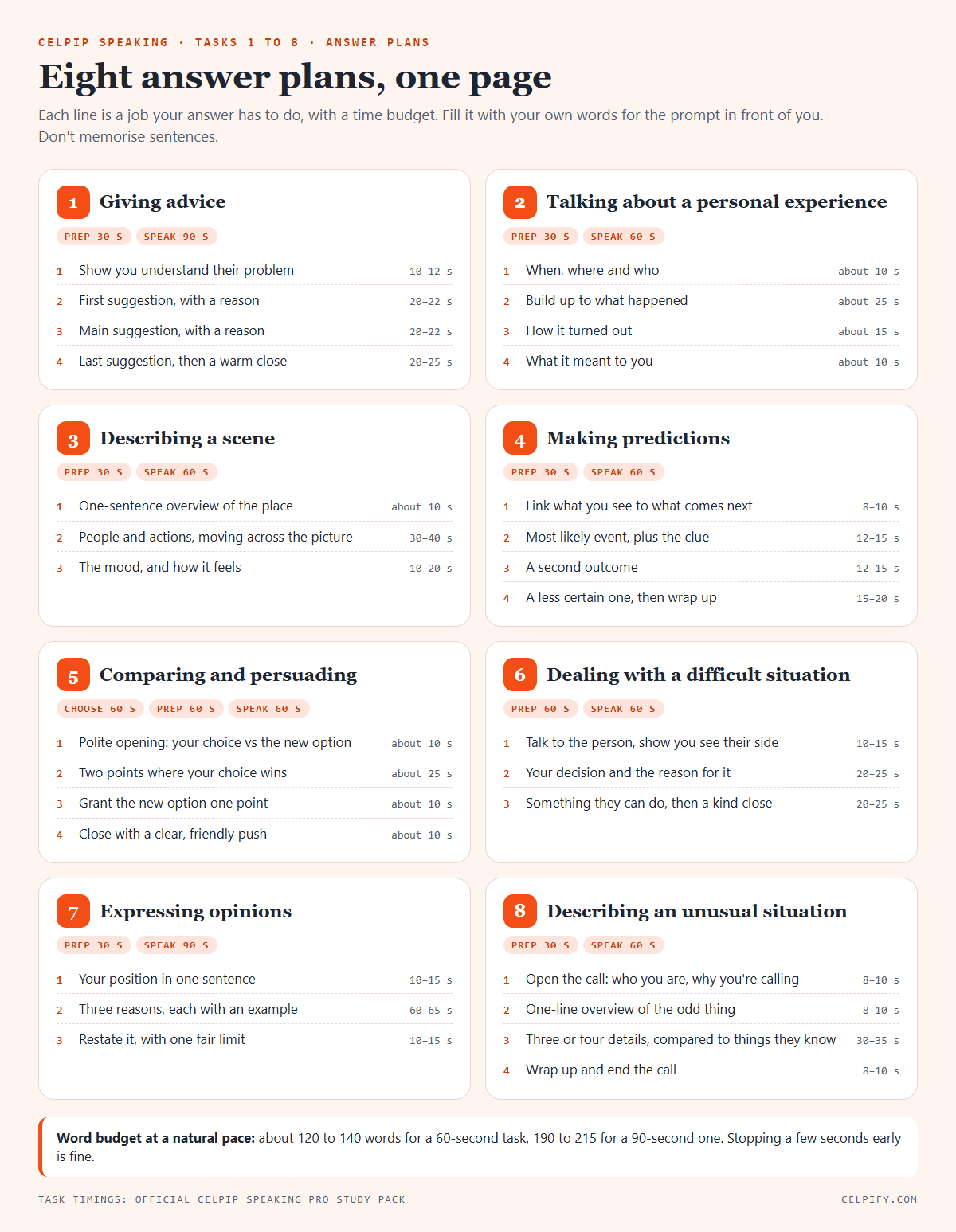
Looking for a CELPIP speaking templates PDF? Save this image or print it. There's no sign-up or email form. Most CELPIP templates online are full sentences; this sheet has none, only jobs and seconds. Keep it on your desk while you practise until the moves come without looking.
The word budget at the bottom of the sheet comes from our own recording. We timed the Task 3 model answer you'll hear further down: 134 words took 53.7 seconds at a relaxed, natural pace, about 150 words a minute. Most people slow down a little under pressure, so aim for roughly 120 to 140 words on a 60-second task and 190 to 215 on a 90-second one. Finishing a few seconds early is fine. Running out of time halfway through your last point is the bigger risk.
To drill with it, pick any prompt, give yourself the real prep time, and record your answer. Then check it against the card. Did every move happen? Did one move steal time from the next?
Answer Plans for Tasks 1, 2, 6 and 7 (No Picture)
These four tasks give you a situation on screen and nothing else, so the plan has to come from the prompt itself.
CELPIP Speaking Task 1 template: giving advice (30 seconds to prepare, 90 to speak)
Speak to the person directly, as if they're across the table. Spend 10 to 12 seconds showing you understand the problem, then give three suggestions of about 20 seconds each, with a reason attached to every one. The official pack asks for at least three suggestions and a clear signal before each new one. Put the suggestion you care about most last, then close warmly. The move-by-move version, with a 90-second sample answer, is in the Task 1 giving advice guide.
Where it goes wrong: three suggestions with no reasons, which sounds more like a list than advice.
Task 2: talking about a personal experience (30 seconds, 60 seconds)
Choose your story in the first few seconds of prep. If nothing real comes to mind, the official pack's advice is surprisingly direct: borrow one. Then tell it in order: when, where and who (about 10 seconds), the build-up (about 25), how it turned out (about 15), and what it meant to you (about 10). Keep to past tenses, and add a detail or two so the listener feels what you felt. The Task 2 personal experience guide shows how time markers hold the story together.
Task 6: dealing with a difficult situation (60 seconds, 60 seconds)
You pick one of two ways to handle an awkward situation, then speak to the person involved. Talk to them directly and show you see their side (10 to 15 seconds). State your decision and the reason in the same breath (20 to 25). Finish with something they can actually do, and close kindly (20 to 25). The official advice is to be considerate but firm, so don't soften your decision until it disappears. The Task 6 difficult situation guide works through a full example.
Task 7: expressing opinions (30 seconds, 90 seconds)
Pick a side before prep ends and say it in one sentence (10 to 15 seconds). Spend the middle minute on three reasons, each with an example or a real detail (60 to 65 seconds), and move between them with clear transitions. Close by restating your view with one fair limit, such as who it wouldn't apply to (10 to 15). The reasons have to be genuinely different. Saying one reason three ways is the first pitfall in the Task 7 opinions guide.
Answer Plans for Tasks 3, 4, 5 and 8 (Picture Tasks)
These four put an image on screen. The plan tells you where to look and in what order.
Task 3: describing a scene (30 seconds, 60 seconds)
Your listener can't see the picture. Open with one sentence about the whole place (about 10 seconds). Then move through the people and what they're doing, in one steady direction, like front to back or left to right (30 to 40 seconds). Finish with the mood and how the scene feels (10 to 20 seconds). The official pack also suggests including a feeling, yours or the people's. You'll hear this plan in the next section, and the Task 3 describing a scene guide covers the present continuous and spatial words.
Task 4: making predictions (30 seconds, 60 seconds)
Same picture, new job: say what happens next. Link what you see to the future in one line (8 to 10 seconds). Then give three predictions, from most to least certain, each tied to a clue in the picture (12 to 15, 12 to 15, then 15 to 20 with a short wrap-up). Don't describe the scene again, because your listener already heard it in Task 3. The Task 4 predictions guide has the language for strong and weak certainty.
Task 5: comparing and persuading (60 seconds to choose, 60 to prepare, 60 to speak)
Task 5 comes in two parts, and plenty of online templates forget the second one. In part one, you compare two options and pick one. You don't speak yet. In part two, a new option appears, suggested by someone else, and you have to persuade them your choice is better than that new option. The plan for part two: a polite opening that names your choice and the new option (about 10 seconds), two points where your choice wins (about 25), one point you'll grant the new option (about 10), and a friendly close that asks them to agree (about 10). The Task 5 comparing and persuading guide flags the grammar slips that show up in comparisons.
Task 8: describing an unusual situation (30 seconds, 60 seconds)
It's a phone call, so open it like one: who you are and why you're calling (8 to 10 seconds). Give a one-line overview of the odd object or scene (8 to 10), then three or four details, compared with things your listener already knows (30 to 35). End the call properly (8 to 10). The official pack lists both steps, setting up the call and finishing it, and both are easy to drop when the clock is running. More in the Task 8 unusual situation guide.
Hear the Task 3 Plan on a Practice Test Picture
This is the Task 3 scene from Celpify's free Test 1, with a model answer built on the plan above.

Task 3 model answer: the busy office
A model answer written by Celpify's editorial team and read by an AI voice at a natural pace. 134 words, 54 seconds.
Show transcript
Here's where each move lands in the recording:
| Time | Move | What the answer does |
|---|---|---|
| 0 to 9 s | Overview | Two short sentences: what the place is, then where the windows are, so the listener has a left and a right. |
| 10 to 48 s | People and actions | Five people in five places (in the front, behind her, in the middle, on the right, at the back), each with an action in the present continuous. The woman in the headset gets a feeling too. |
| 49 to 54 s | Mood | One line: "Overall, it feels like a friendly, hard-working team." |
The opening sentence is about this office in particular. The place words (in the front, behind her, on the right) do the organising, so there's no need to repeat "I can see" before every detail. The answer also finishes with about six seconds to spare. On a calmer picture with a clear mood, you'd spend longer on that last move, which is why the plan allows up to 20 seconds for it. This crowded office earns more time for people.
Want to try it yourself first? Record your own answer on the free Test 1 busy office task before you play the recording.
All eight Test 1 tasks are answered with a plan like this, and voiced, in our CELPIP speaking test sample.
One Plan, Three Different Answers
The same Task 1 plan, used on three different prompts. The jobs stay the same. The words don't.
Below are the first two moves of the Task 1 plan (show you understand, then a first suggestion with a reason) on three prompts that have nothing in common.
Prompt 1
Your neighbour's son wants to spend his summer savings on a used car. Give him advice.
"Jordan, I get it. You worked all summer, and a car means no more waiting for rides. Before you pay for anything, though, ask a mechanic to look at it. Twenty minutes with someone who knows engines can stop you buying a car that only looks good."
Prompt 2
A friend who moved to Canada in the fall is finding it hard to meet people now that winter has started.
"I know how you feel, Priya. When it's dark by five, staying home is the easy choice. My first suggestion is to join something that meets every week, like a skating class or a volunteer shift. When you see the same faces every Tuesday, conversations start on their own."
Prompt 3
A coworker keeps missing the early bus and arriving late for his shift.
"Sam, mornings have been rough for you lately, and that bus schedule doesn't help. Something that worked for me was packing everything the night before, even lunch. It sounds small, but it gave me ten extra minutes, and that's the difference between catching the bus and watching it leave."
Same two jobs, three times over: show you understand, then give a suggestion with its reason. Now glue one memorised opener onto all three. It might fit one of them. On the other two, it spends your opening seconds saying nothing about Jordan's car, Priya's winter or Sam's bus, and those are the details a rater is listening for.
Sources & further reading
The official CELPIP pages behind the timings, strategies and integrity rules on this page.
- Using CELPIP Sample Responses in the ClassroomCELPIP on memorising, copying and templating, invalidation of results, and rating by two or three trained ratersOfficial CELPIPcelpip.ca
- CELPIP video on memorised and copied contentThe official video CELPIP links from that post to explain invalidationOfficial CELPIP · YouTubeyoutube.com
- CELPIP Speaking Pro: Target 9+ Study PackPreparation and speaking times for all eight tasks, the four rating dimensions, and how recording startsOfficial CELPIPcelpip.ca
- CELPIP Speaking Pro Study Pack: Tasks 1 to 4Official key strategies for Tasks 1 to 4Official CELPIPcelpip.ca
- CELPIP Speaking Pro Study Pack: Tasks 5 to 8Official key strategies for Tasks 5 to 8, including the new option in Task 5, part twoOfficial CELPIPcelpip.ca
- CELPIP Score Comparison ChartReal test-taker Speaking responses with audio and transcripts at each levelOfficial CELPIPcelpip.ca
- CELPIP Test FormatThe eight Speaking tasks and the 15-minute Speaking testOfficial CELPIPcelpip.ca