CELPIP Writing Templates: Answer Plans for Task 1 and 2
Search for CELPIP writing templates and most of what you'll find is a script: an opening line to memorise, a closing line to memorise, and blanks for everything in between. The official CELPIP Writing Pro: Target 9+ study pack never gives you a sentence like that. It gives you jobs: state your purpose, cover the tasks in the order they're given, give each main idea its own paragraph with a real detail behind it, and end with a concluding statement.
That's the kind of CELPIP writing template worth learning: a plan for what each paragraph has to do, filled with new sentences every time. There's one plan for the Task 1 email and one for the Task 2 survey response, each drawn as a one-page sheet and then tried on a real prompt from Celpify's free Test 1.
What the Official Writing Pro Pack Asks For
The plans below are built on the official study pack for the Writing test and the current CELPIP guidebook for test takers.
These are the numbers every plan has to fit:
| Task 1: Writing an email | Task 2: Responding to a survey | |
|---|---|---|
| Time | 27 minutes | 26 minutes |
| Length | 150 to 200 words | 150 to 200 words |
| Planning, before you type | 4 to 5 minutes | 4 to 5 minutes |
| Checking, at the end | about 3 minutes | about 3 minutes |
The pack even spells out the planning steps: brainstorm in point form for two or three minutes, choose your main ideas, put them in order, think of supporting details, then write a clear purpose statement. On test day the screen shows a timer and a word counter, and spell-check is built in, so you won't be counting words by hand.
What raters score
Each response is judged on four dimensions: Content/Coherence (the number and quality of your ideas, how they're organised, how well they're supported), Vocabulary (word choice, range and precision), Readability (format and paragraphing, transitions, grammar, spelling and punctuation) and Task Fulfillment (relevance, completeness, tone and word count).
Notice how much of that list a plan settles before you write a single sentence: organisation, paragraphing, relevance, completeness. Our CELPIP writing tips show what each dimension looks like at CLB 7 and at CLB 9, and the CELPIP writing score chart shows how your level converts to CLB.
What the official samples show
The pack includes rated responses from real test takers, and they make the case for planning better than any tip could. Its Level 7 email doesn't state its purpose until the second paragraph. Its Level 12 email earns praise for specific, realistic details, such as the school's "bright pink mural". And among the weaknesses the pack notes in a Level 8 survey response are no clear purpose statement, no concluding statement, no paragraphing, and no clear choice between the two options.
None of those are vocabulary problems. Planning problems, every one.
CELPIP Writing Task 1 Template: The Email Plan
The Task 1 plan has five parts, and the middle of the email is built from the bullet points in the prompt.
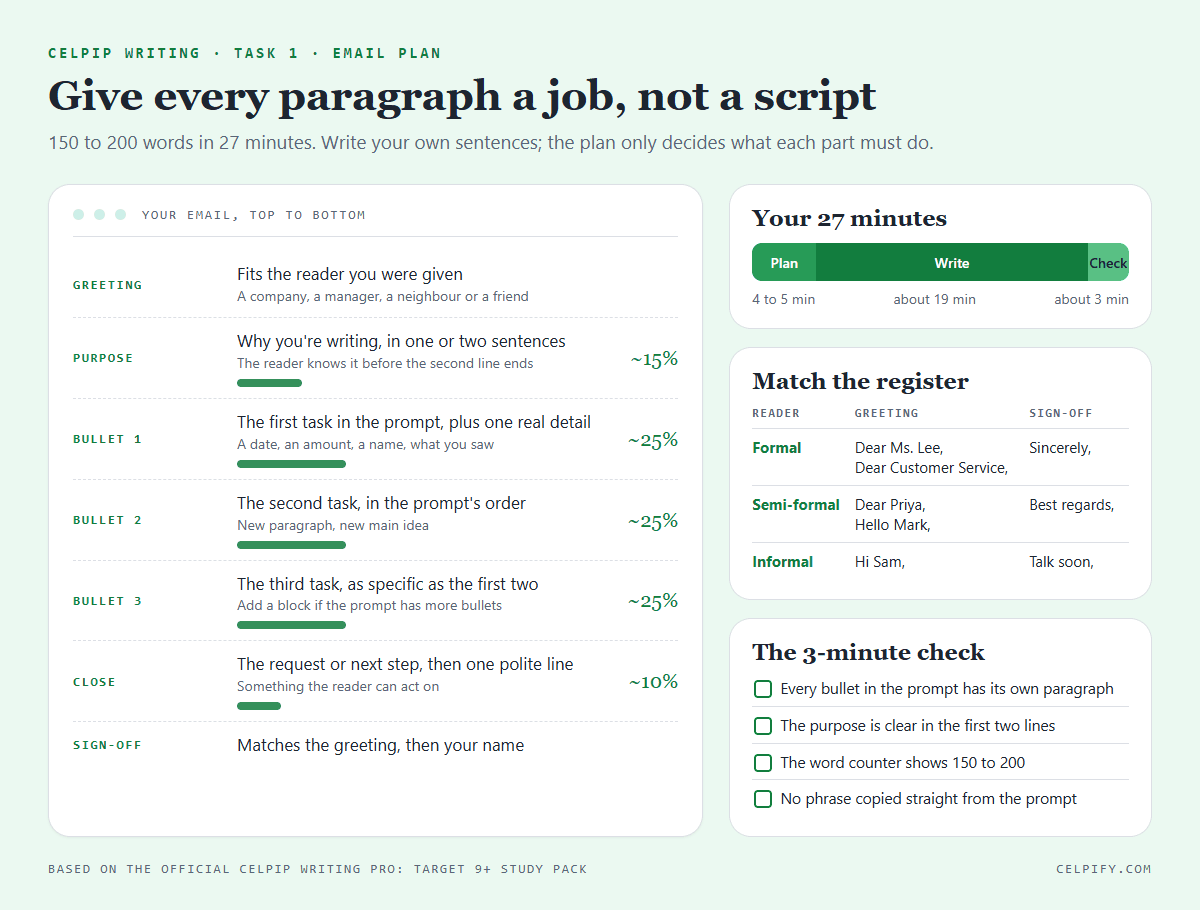
Here's the job of each part. The word shares on the sheet are rough guides for an email of about 180 words, not quotas.
Greeting. Choose it from the reader the prompt gives you, not from habit.
Purpose, in one or two sentences. Say why you're writing so clearly that the reader knows it before the second line ends. For a complaint, that's what went wrong. For a request, it's what you need.
One paragraph per bullet, in the prompt's order. Each bullet gets its own paragraph and at least one concrete detail: a date, an amount, a name, something you saw. The pack's advice is to mention real places, people and situations.
A close the reader can act on. A request, a deadline or a next step. This is your concluding statement.
Sign-off. It has to match the greeting, then your name.
The whole Task 1 plan fits in those five lines. It works for complaints, requests, invitations and apologies because it never tells you what to say, only what each part is for. Hunting for a CELPIP writing templates PDF? Save the two plan images on this page instead. Each one prints on a single sheet.
Match the register to the reader
| Who you're writing to | Greeting | Sign-off | Tone |
|---|---|---|---|
| A company, a landlord or an office you don't know (formal) | Dear Ms. Lee, Dear Customer Service, | Sincerely, Regards, | Polite and direct. Firm if you're complaining, never rude. |
| A colleague, your manager or a neighbour (semi-formal) | Dear Priya, Hello Mark, | Best regards, Kind regards, | Friendly but careful. |
| A friend or a family member (informal) | Hi Sam, | Talk soon, Take care, | Warm and personal. Contractions and small news are fine. |
The pack's tone advice is short: think about the purpose and the audience, use a greeting and sign-off that fit the situation, and avoid rudeness, sarcasm and casual slang. Even an angry complaint to a company stays polite. For useful words by email type, see our Task 1 vocabulary guide, and for more rated emails on other topics, the CELPIP Writing Task 1 samples with answers.
The Email Plan on a Real Prompt: The Maple Tech Laptop
This is the Task 1 prompt from Celpify's free Test 1, planned and written with the steps above.
The prompt
Three weeks ago, you ordered a new laptop from Maple Tech, an online electronics store, for $1,200. When the package arrived, the screen was cracked and three keys were missing from the keyboard. You have called customer service twice and sent two follow-up emails, but no one has offered a replacement or a refund, and the laptop is still unusable.
Write an email to Maple Tech's customer service department. In your email:
Describe the problems with the laptop when it arrived
Explain what you have already done to try to resolve the issue
State exactly what you would like the company to do now
Want to try it cold first? The same prompt is on the free Test 1 email practice page. Write your own version there, then come back and compare.
The five-minute plan
Point-form notes, no full sentences
Reader: a company I don't know. Formal. Dear Customer Service / Sincerely
Purpose: order number, arrived damaged, four tries, nothing fixed
Bullet 1, problems: crack across top corner; M, K, space bar gone; photos; kept the box
Bullet 2, what I did: 2 calls, 2 emails with photos; told 2 days; nothing; using a friend's computer
Bullet 3, what I want: new laptop in 5 business days + prepaid return label, or full $1,200 refund
Close: reply by Friday
The notes already cover every bullet, in the prompt's order, before the email has a single full sentence. Those first five minutes are there for exactly this.
The email (173 words)
Model email, formal complaint173 words
Dear Maple Tech Customer Service,
Purpose
My order 48213, a $1,200 laptop I bought from your website three weeks ago, arrived damaged. After four attempts to reach you, it still hasn't been replaced and I haven't received my money back.
Bullet 1: the problems
When I opened the box, a long crack ran across the top corner of the screen, and the M, K and space bar keys had fallen off. I photographed everything that evening and kept the original packaging, so the damage is easy to confirm.
Bullet 2: what I've tried
Since then, I've phoned your support line twice and written to you twice with the photos attached. Each time, I was promised an answer within two days, but no one has followed up. Meanwhile, I'm borrowing a friend's computer to finish my college assignments.
Bullet 3: what I want now
Please ship a new laptop within five business days, along with a prepaid label so I can return the damaged one. If that isn't possible, I'd like the full $1,200 refunded to my credit card.
Close
I look forward to your reply by Friday.
Sincerely,
Daniel Okafor
Look at the second paragraph. The prompt says the screen "was cracked" and three keys "were missing". The email describes the same damage in its own words, a crack across the corner and keys that had fallen off, and then adds what only the writer could know: which keys, and the photos. The pack's advice to avoid overusing words and phrases from the question looks like this in practice.
CELPIP Writing Task 2 Template: The Survey Response Plan
Task 2 gives you a survey question with two options. The plan has four parts, and the first one isn't optional.
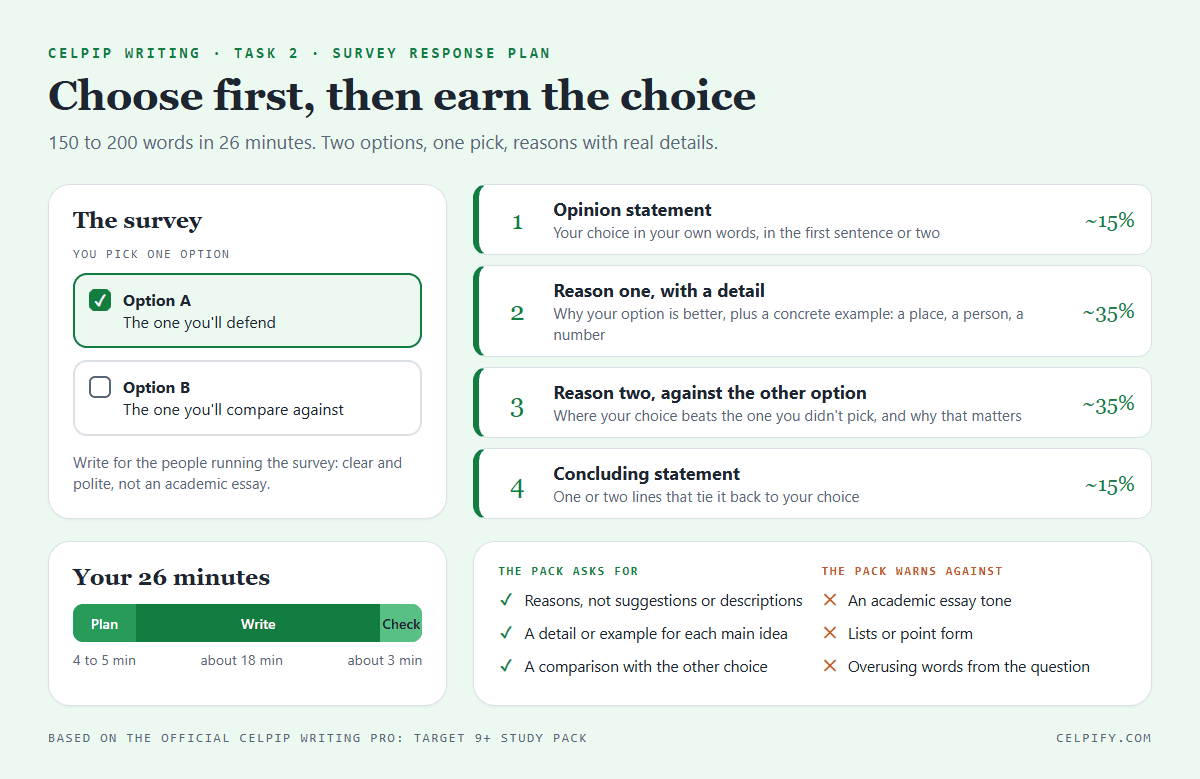
Open with your choice, in the first sentence or two and in your own words. The pack's fix for that Level 8 response was exactly this: state a clear choice at the beginning.
Give your first reason and back it with something concrete. A reason explains why your option is better; a suggestion (add benches to the park) or a description of the option doesn't do that job.
Make your second reason a comparison. The pack tells you to compare your choice with the other one, so show where your pick wins and why that matters to the people running the survey.
Close with a line or two that brings the reader back to your choice. That's your concluding statement.
In 150 to 200 words, two reasons with real support usually beat three thin ones. Tone matters here too. You're writing to whoever runs the survey, so be clear and polite, and follow two more warnings from the pack: don't write an academic essay, and don't use lists or point form in the response itself. For rated responses on other survey topics, see our CELPIP Writing Task 2 samples with answers.
The Survey Plan on a Real Prompt: Library or Park?
The Task 2 prompt from Test 1 asks residents how the city should use a grant for an empty downtown lot.
The prompt
Downtown Development Survey. Your city has received a $2 million provincial grant to develop an unused lot in the downtown core. The city council has narrowed the choice to two proposals and is asking residents to share their preference through an online survey.
Option A: Build a modern public library branch with a community meeting hall and study spaces
Option B: Create a large central park with gardens, walking paths, and a children's play area
Choose the option that you prefer. Why do you prefer your choice? Explain the reasons for your choice. Write about 150-200 words.
You can answer it yourself on the free Test 1 survey practice page before reading on.
The five-minute plan
Point-form notes
Pick: A, the library. Reader: city council. Polite, not an essay
Reason 1, all year: snow from Nov to Mar; students in small apartments; nearest branch is 2 bus rides
Reason 2, vs the park: a hall for groups (tenants' association in a coffee shop), newcomer classes, seniors; Riverside Park 10 min away
Close: a building for every season
The response (170 words)
Model survey response170 words
Opinion statement
I'd put the grant into Option A. A library branch with a meeting hall and study rooms would serve downtown better than a park.
Reason 1 + detail
First, people could use it all year. From November to March, gardens and a play area would sit under snow, while a library stays warm and busy every day. Many students rent small apartments near the core, and the closest branch is two bus rides away, so a quiet place to study within walking distance would make a real difference.
Reason 2 vs the park
Second, the hall meets a need that a park can't. My tenants' association meets at the back of a coffee shop because renting a room costs too much. A free space downtown could host newcomer classes, seniors' clubs and neighbourhood meetings. A park is pleasant on a sunny afternoon, but it can't give these groups a roof, and Riverside Park is already a ten-minute walk from the lot.
Concluding statement
For these reasons, I hope council spends the money on a building people can enjoy in every season.
A park answer can score just as well. The marks come from the order and the support: the choice comes first, each reason includes something only a resident would know, and the second reason measures the library against the park instead of ignoring it.
Why a Memorised CELPIP Email Template Scores Lower
Put a memorised opening next to a planned one on the same prompt, and the difference is easy to see.
Memorised opening, 35 words
I hope this email finds you in the best of health. I am writing this email to bring an important matter to your kind attention, and I kindly request you to take the necessary action.
Planned opening, 34 words
My order 48213, a $1,200 laptop I bought from your website three weeks ago, arrived damaged. After four attempts to reach you, it still hasn't been replaced and I haven't received my money back.
Plenty of CELPIP templates online open with a line much like the first one. After it, a rater still doesn't know what the email is about. Nothing in it belongs to this prompt; it could sit on top of any email ever written. That hurts relevance, which falls under Task Fulfillment, and it spends about a sixth of your 200 words before the first bullet. It's also the Level 7 weakness from the official pack: a purpose that arrives late.
The planned version spends roughly the same number of words naming the problem, giving the order details and showing why the email exists. Memorised lines have a second cost, too. They're written for no reader in particular, so the register often doesn't fit, and phrases like "your kind attention" can read as borrowed rather than natural, which works against you under Vocabulary.
CELPIP's own rule on templates
There's also a line you shouldn't cross. In an official post about using sample responses, CELPIP says that "memorizing, copying, and templating are the opposite of what is required of CELPIP test takers." Every test taker signs a contract to produce spontaneous and original responses, and people who include memorised or copied content "are subject to invalidation of their test results." CELPIP explains the rule in a short official video, linked in the sources below.
A plan doesn't cross that line, because a plan isn't text. It tells you that paragraph three covers the second bullet and needs a real detail. Your sentences have to be new every time. The plan is the part you get to bring with you.
The same plan-not-script idea carries over to the spoken half of the test: our CELPIP speaking templates give one plan per speaking task.
Sources & further reading
The official CELPIP sources behind the timings, strategies and rules on this page.
- CELPIP Writing Pro: Target 9+ Study PackTask timing, the planning and checking minutes, the key strategies for both tasks, and the rated Level 7 to 12 samples discussed aboveOfficial CELPIPcelpip.ca
- CELPIP Guidebook for Test Takers (July 2026)Writing component length and the on-screen timer, word counter and spell-checkOfficial CELPIPcelpip.ca
- Using CELPIP Sample Responses in the ClassroomCELPIP's statement that memorised, copied or templated content can lead to invalidated resultsOfficial CELPIPcelpip.ca
- Official CELPIP video on memorised and copied responsesThe short video CELPIP links from that post to explain the ruleOfficial CELPIP · YouTubeyoutube.com
- CELPIP Score Comparison ChartReal rated Writing responses at each CELPIP levelOfficial CELPIPcelpip.ca
- CELPIP Test FormatOfficial overview of the Writing tasksOfficial CELPIPcelpip.ca