CELPIP vs PTE for Australian Immigration: Side-by-Side
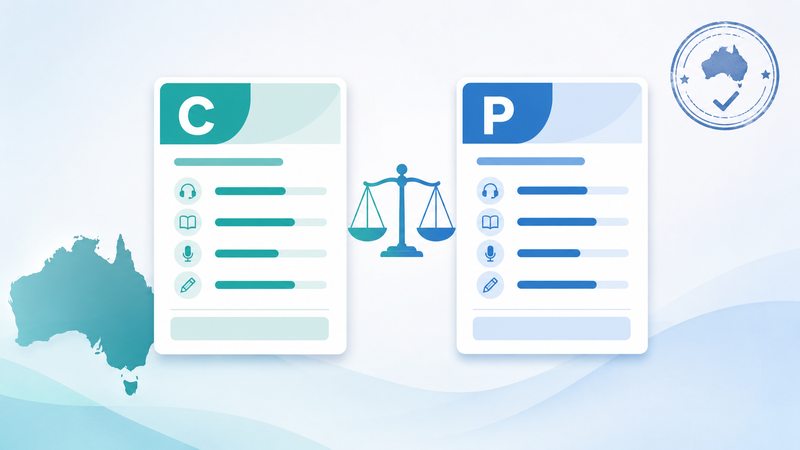
You're booking an English test for an Australian visa, and it's down to CELPIP-General or PTE Academic. Both are approved by the Department of Home Affairs. Both work for skilled migration, employer sponsorship, the 482, the 485, and student visas. Both cap at the same +20 points ceiling for Superior English. So the real question isn't which one is approved. It's which one is right for you.
Here's the cleanest way to think about it.
If you might also apply to Canada, the choice is made. CELPIP-General is the only test designated by both IRCC for Canadian PR and DHA for Australian visas. One sitting, two files. PTE can't do that, because PTE Academic is the Australian variant and PTE Core is the Canadian one, and they don't share an acceptance letter.
If Australia is your only destination, it comes down to format fit. From the writing and speaking submissions we've graded on Celpify, the biggest gap between CELPIP and PTE shows up on Speaking. CELPIP rewards a natural, well-organised response that a trained rater can hear is structured. PTE Academic rewards crisp, on-time delivery inside a tight word window that an algorithm grades. Same skill, different incentives.
Below: the full side-by-side. Score thresholds, PR points, AUD cost, format, and who tends to do better on each.
The Scoring, Side by Side
Both tests use per-skill scoring. DHA sets the thresholds. Here's how each test's bands translate to the Competent, Proficient, and Superior English tiers.
| DHA English tier | CELPIP-General (per skill) | PTE Academic (per skill) |
|---|---|---|
| Competent | 7 | 50 |
| Proficient | 9 | 65 |
| Superior | 10 or higher | 79 or higher |
It's per skill, not an average
The tier you claim is set by your lowest of the four skills. A CELPIP score of 10 / 10 / 10 / 7 reads as Competent, not Superior. So does a PTE Academic of 85 / 85 / 85 / 50. The points slot you fall into is determined by your weakest section, not your strongest. For points-tested visas where Proficient or Superior English adds meaningful extra points, the practical task is to drag every skill above the next threshold, not to push your best section higher.
DHA publishes the official thresholds at immi.homeaffairs.gov.au. The Australia-facing CELPIP landing page mirrors them at celpip.ca/au.
How Each Test Maps to Australian PR Points
For points-tested visas like the 189 and 491, English isn't only an eligibility check. It also adds points to your ranking. Both tests sit on the same DHA points ladder.
| DHA English tier | CELPIP per skill | PTE Academic per skill | Skilled migration points |
|---|---|---|---|
| Competent | 7 | 50 | 0 (eligibility met) |
| Proficient | 9 | 65 | +10 |
| Superior | 10 or higher | 79 or higher | +20 |
The two tests cap out at the same points ceiling. Hitting Superior on CELPIP and hitting Superior on PTE Academic both earn the same +20 in your skilled-migration tally. The choice of test doesn't change your points ceiling. It changes your route to that ceiling.
Whichever test format makes Proficient or Superior the realistic outcome for you, given your speaking style, your typing speed, and how you handle a 2-3 hour timed environment, is the test that wins.
Test Format Head-to-Head
Same purpose, very different sittings. Duration, delivery, scoring approach, and turnaround all differ.
| CELPIP-General | PTE Academic | |
|---|---|---|
| Duration | Under 3 hours, single sitting | About 2 hours, single sitting |
| Delivery | In-centre, computer-based | In-centre or PTE Academic Online (proctored remote) |
| Scoring approach | Reading and Listening auto-marked. Writing and Speaking reviewed by trained raters with AI assist. | Fully algorithmic across all four skills, including Writing and Speaking. |
| Score scale | 1-12 per skill (CLB-mapped) | 10-90 per skill |
| Result turnaround | 2-4 business days | Typically within 48 hours |
| Retake gap | One sitting per 5 calendar days | About 5 days minimum |
| Cost in AUD | Around $355 | Around $410 |
| Validity | 2 years from test date | 2 years from test date |
Two things stand out.
First, the scoring approach matters more than most candidates realise. PTE's full algorithm doesn't reward what a human ear would call natural conversational ability. It rewards exact word counts, clear consonants, and steady pacing inside narrow timing windows. Strong speakers with regional accents or hesitant delivery can score lower than weaker speakers who fit the algorithm's expected pattern. CELPIP's mixed AI-plus-rater model on Speaking and Writing tends to forgive a stumble if the overall response is well-constructed.
Second, the in-person requirement is the biggest logistical difference. CELPIP-General is in-centre only. PTE Academic Online lets you sit from your own room, anywhere in Australia, with a remote proctor watching. For a regional applicant in WA or Tasmania who'd otherwise drive five hours to a capital-city centre, that's a real factor.
From the writing and speaking attempts on Celpify, the candidates who outperform their predicted band are usually the ones with the natural-conversation profile, the same profile that the CELPIP scoring criteria explicitly reward. The candidates who underperform are typically the ones whose timing and pronunciation patterns drift from the algorithm-friendly profile that PTE expects. Both signals matter when you're picking which test to book.
Who Picks Which
The decision usually comes down to format fit, speed of result, and whether you're cross-applying to Canada.
Pick CELPIP if you're applying to both Canada and Australia. The same sitting counts toward your Express Entry CRS score and your Australian skilled-migration English requirement. There's no other test on the market that does both because IRCC doesn't recognise PTE Academic and DHA doesn't recognise PTE Core. The dual-applicant edge gets its own section below.
Pick CELPIP also if your speaking style is more conversational than transactional. The scoring criteria reward organised, in-context speech a trained rater can hear. Candidates who freeze when an algorithm expects a 35-word response in 35 seconds often do better on CELPIP's freer speaking format.
Pick PTE Academic if speed matters and the algorithm tends to like you. Result turnaround of around 48 hours is genuinely useful when a state nomination round closes in a fortnight. The fully online option also matters if you're regional or remote. If you've got a clear neutral accent, type quickly without hunting for keys, and can stay on-pacing under a tight timer, you'll typically score well on PTE.
Pick PTE Academic too if you've already taken it once. Familiar test format beats unfamiliar test format almost every time, even if the unfamiliar one nominally suits your speaking style better.
The Dual-Applicant Angle (CELPIP's Single Strongest Edge)
If you're considering both Canada and Australia, the test choice isn't actually 50/50. One option doubles up. The other requires two separate sittings.
CELPIP-General is the only test designated by both IRCC for Canadian permanent residence and DHA for Australian visas, so the same result feeds both government files. Your CLB band feeds the Canadian CRS calculator and your DHA tier feeds the Australian points calculator from the exact same per-skill scores.
PTE doesn't work this way. PTE Academic is the variant DHA accepts for Australian visas; PTE Core is the variant IRCC accepts for Canadian PR. They aren't interchangeable. A PTE candidate applying to both countries prepares for two different test versions and pays both fees.
From what we've seen on Celpify, dual-country applicants who pick CELPIP early in their planning skip a second test-prep cycle entirely. Whether that matters depends on your timeline. If you're decided on Canada first and Australia is only a possibility for later, the dual-applicant edge matters less. If both files are live at once, it's hard to argue against the single-test path.
CELPIP vs PTE for Australia: Common Questions
Direct answers to the questions Australian visa applicants ask most about CELPIP-General and PTE Academic.
Sources & further reading
Official CELPIP pages used to confirm the test format, scoring, and the Australian acceptance status referenced above.
- CELPIP for Australia (official)Australia-facing landing page with DHA acceptance status, test centres, and current pricingOfficial CELPIPcelpip.ca
- CELPIP-General overviewOfficial overview of the CELPIP-General test formatOfficial CELPIPcelpip.ca
- CELPIP Test ResultsHow CELPIP scores are reported and what each band representsOfficial CELPIPcelpip.ca